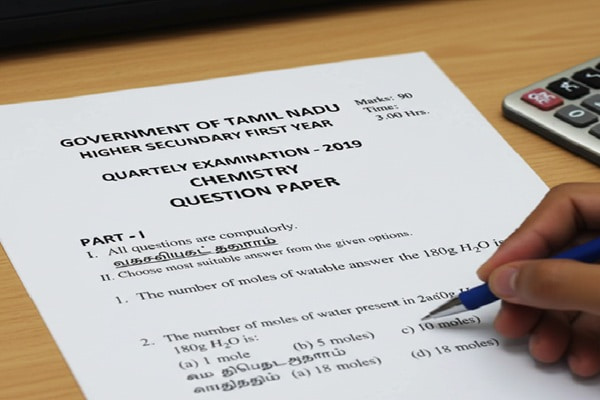
The quarterly examination is the first real test of the Plus One Chemistry syllabus. For most Class 11 students in Tamil Nadu, it is also the first encounter with the Samacheer Kalvi Chemistry textbook format under exam conditions.
The 2019 quarterly exam Chemistry paper was conducted in September 2019 as part of the common quarterly examinations held across all Tamil Nadu state board schools. The paper followed the standard four-part format introduced with the new Samacheer Kalvi syllabus and covered the first three units of the Plus One Chemistry textbook.
This guide covers everything about that paper: what was tested, how marks were distributed across parts, which question types appeared, where to download the original paper with answer keys, and how to use it for focused preparation. If you are preparing for the quarterly exam or using it as a reference for half-yearly and public exam preparation, this is the complete resource.
11th Chemistry Quarterly Exam 2019: At a Glance
| Detail | Information |
| Exam Name | 11th Standard Quarterly Examination 2019-20 |
| Board | Tamil Nadu State Board (Samacheer Kalvi) |
| Subject | Chemistry (Plus One) |
| Conducted In | September 2019 |
| Total Marks | 85 marks (Theory) |
| Exam Duration | 3 hours |
| Medium Available | English Medium and Tamil Medium |
| Syllabus Covered | Units 1 to 3 of Plus One Chemistry textbook |
| Paper Type | Common examination for all Tamil Nadu state board schools |
| Minimum Pass Mark | 35 marks |
Paper Pattern: Part-Wise Marks Breakdown
The 11th quarterly Chemistry paper follows the standard Tamil Nadu board four-part format. Understanding this structure before solving the paper is essential because each part requires a different approach and a different level of answer detail.
| Part | Question Type | Number of Questions | Marks Each | Total Marks | Choice |
| Part I | Multiple Choice Questions (MCQ) | 15 questions | 1 mark | 15 marks | No choice, all compulsory |
| Part II | Short Answer (2-mark questions) | 9 questions answered from 12 | 2 marks | 18 marks | Answer any 9 of 12 |
| Part III | Short Answer (3-mark questions) | 9 questions answered from 12 | 3 marks | 27 marks | Answer any 9 of 12 |
| Part IV | Long Answer (5-mark questions) | 5 questions answered from 7 | 5 marks | 25 marks | Answer any 5 of 7 |
| Total | 85 marks |
Chapters Covered in the 2019 Chemistry Quarterly Exam
The quarterly exam covers the Term 1 syllabus, which corresponds to the first three units of the Plus One Samacheer Kalvi Chemistry textbook. Here is a detailed breakdown of each unit and what it covers.
Unit 1: Basic Concepts of Chemistry and Chemical Calculations
This is the foundational unit of Plus One Chemistry and consistently produces the highest number of questions in the quarterly paper. Students who are weak in this unit cannot afford to skip it because it forms the basis for understanding all subsequent units.
| Topic | Common Question Types | Part Usually Tested In |
| Matter and its classification | MCQ, 2-mark definition | Part I, Part II |
| SI units and measurement | MCQ, 3-mark problems | Part I, Part III |
| Atomic mass, molecular mass and mole concept | 3-mark and 5-mark numerical | Part III, Part IV |
| Percentage composition and empirical formula | 5-mark numerical problems | Part IV |
| Stoichiometry and limiting reagents | 5-mark problems | Part IV |
| Significant figures and scientific notation | MCQ, 2-mark | Part I, Part II |
| Laws of chemical combination | 2-mark and 3-mark explanations | Part II, Part III |
Unit 2: Quantum Mechanical Model of Atom
This unit tests both conceptual understanding and numerical problem-solving ability. The 2019 quarterly paper had two 5-mark questions from this unit in Part IV, making it one of the highest-contributing units in the paper.
| Topic | Common Question Types | Part Usually Tested In |
| Thomson, Rutherford and Bohr models | MCQ, 3-mark explanation | Part I, Part III |
| Quantum numbers (n, l, m, s) | MCQ, 2-mark definitions | Part I, Part II |
| Electronic configuration and Aufbau principle | 2-mark and 5-mark | Part II, Part IV |
| Photoelectric effect and de Broglie relation | MCQ, 3-mark numerical | Part I, Part III |
| Heisenberg uncertainty principle | 2-mark explanation, MCQ | Part I, Part II |
| Shapes of orbitals (s, p, d) | 3-mark with diagram | Part III |
| Electromagnetic spectrum and wave properties | MCQ, 2-mark | Part I, Part II |
Unit 3: Periodic Classification of Elements
The Periodic Table unit is conceptually straightforward but requires precise factual recall. MCQ questions in Part I of the 2019 paper heavily drew from this unit because the definitions and trends are clear-cut and easy to test objectively.
| Topic | Common Question Types | Part Usually Tested In |
| History and development of periodic table | MCQ, 2-mark | Part I, Part II |
| Modern periodic law and IUPAC naming | MCQ, 2-mark | Part I, Part II |
| Periodic trends: atomic radius | MCQ, 3-mark explanation | Part I, Part III |
| Periodic trends: ionisation energy | MCQ, 3-mark comparison | Part I, Part III |
| Periodic trends: electron affinity | 2-mark, MCQ | Part I, Part II |
| Periodic trends: electronegativity | MCQ, 3-mark | Part I, Part III |
| s, p, d, f blocks and their properties | 3-mark and 5-mark | Part III, Part IV |
| Anomalous properties (Be, N, O) | 2-mark, 3-mark explanation | Part II, Part III |
What the 2019 Quarterly Paper Reveals About How Chemistry Is Tested
The 2019 quarterly paper followed a consistent internal pattern that helps students understand not just what to study but how to study it.
Part I MCQs test definition precision: All 15 MCQs in the 2019 paper were directly based on textbook definitions, numerical values and factual statements. There were no trick questions or application-based MCQs in the quarterly paper. Reading each unit’s definitions and remembering key numerical values (like atomic masses, standard units, and quantum number rules) is sufficient for full marks in Part I.
Part II rewards concise textbook language: The 2-mark questions in 2019 asked for definitions, state the law, give two differences, or list two examples. Answers that used precise textbook language scored full 2 marks. Paraphrased or vague answers scored 1. Practising 2-mark answers by writing them within 3 to 4 lines is the correct preparation approach.
Part III numericals come from Unit 1: In the 2019 paper, at least four of the nine answered Part III questions were numerical problems from Unit 1 (mole concept, empirical formula, stoichiometry). Students who avoided Unit 1 numericals lost 12 marks in Part III alone. Unit 1 numerical practice is not optional.
Part IV long answers reward structured writing: The 5-mark questions in 2019 required either a complete numerical solution with steps, or a structured explanation with subheadings. Answers that jumped directly to a formula without showing working, or explanations written as one paragraph without structure, lost 2 marks consistently on answer keys.
Diagram questions in Part III and IV carry dedicated marks: Questions asking for shapes of orbitals, electronic configuration notation, or periodic trends diagrams had 1 mark allocated specifically to the diagram. A correct written answer without the diagram scored 4 out of 5 in those questions.
Where to Download the 11th Chemistry Quarterly Paper 2019
The original question papers and multiple answer keys from the 2019 quarterly Chemistry exam are publicly available on the following trusted Tamil Nadu education platforms.
1. Padasalai.net
This is the primary platform used by Tamil Nadu state board teachers and students. The 2019-20 quarterly exam page on Padasalai has the original Chemistry question paper in Tamil Medium (uploaded by Mr. B. Balaji) and English Medium (uploaded by Mr. Subanesh). Multiple answer keys from different teachers are listed including Mr. S. Shanmugam (English Medium), Sami (English Medium), AR (Tamil Medium) and SVB School. The page is indexed under the 2019-2020 quarterly exam archive.
2. TRB TNPSC (trbtnpsc.com)
This platform published the same set of papers and answer keys simultaneously with Padasalai during the 2019 exam window. The Chemistry section of the 2019 quarterly exam page lists original papers and multiple answer keys. Both English Medium and Tamil Medium papers are available as direct download links.
3. Namma Kalvi (nammakalvi.com)
Namma Kalvi has the Plus One 11th Chemistry quarterly 2019 original question paper in its archive alongside other subject papers from the same exam session. The platform indexes papers by material number for direct access.
4. Education Observer (educationobserver.com)
The Education Observer forum thread for the 2019 March and quarterly exam papers has Chemistry question paper links and answer keys shared by teachers from multiple districts. The forum format allows comparison of answer keys from different schools.
5. Samacheer Kalvi Guru (samacheerkalvi.guru)
This platform has the Plus One Chemistry model and previous year question papers for 2019-20, including the March 2019 public exam paper. For quarterly exam papers, cross-reference with Padasalai for the original quarterly paper specifically.
Unit-Wise Preparation Strategy for 11th Chemistry Quarterly Exam
Unit 1: How to Master the Numericals
Unit 1 is the most mark-heavy unit in the quarterly paper. Students who lose marks here cannot recover easily from other units because numerical questions carry 3 and 5 marks each.
- Learn the mole concept formula triangle: moles = mass divided by molar mass. Practise deriving any one variable when the other two are given.
- For empirical and molecular formula questions, practise the four-step method: convert percentage to grams, divide by atomic mass, divide by smallest ratio, multiply to get whole numbers.
- Stoichiometry problems always follow a four-step format: write the balanced equation, identify the known and unknown, apply mole ratio, calculate. Practise this sequence until it becomes automatic.
- Significant figures questions in Part I are straightforward if you memorise the five rules. Write them out as a list and test yourself.
- Unit conversions between SI units appear in every quarterly paper. Know the conversion factors for kilo, milli, micro, nano and pico.
Unit 2: How to Handle the Conceptual and Numerical Mix
Unit 2 tests both concepts and calculations. The key is to not treat them as separate preparation areas.
- For Bohr model questions, always start your answer with the postulate being tested, then apply the formula. Do not jump to numbers without stating the concept.
- Quantum numbers have rigid rules. Write a table with all four quantum numbers, their allowed values and what they represent. This covers MCQs, 2-mark and 3-mark questions.
- Electronic configuration questions ask you to write configurations for specific elements or identify the element from a given configuration. Practise both directions.
- de Broglie wavelength numerical: the formula is wavelength = h divided by mv. Practise at least five numericals from this topic as it appears in Part III every year.
- Shape of orbital diagrams: practise drawing s, p and d orbitals with labels. The 3-mark question asking for shapes always awards 1 mark for each correctly drawn and labelled orbital.
Unit 3: How to Score Full Marks Efficiently
Unit 3 is the most revision-friendly unit in the quarterly syllabus. The content is factual and the trends are logical, which makes it one of the fastest units to prepare well.
- Write out the periodic trends (atomic radius, ionisation energy, electron affinity, electronegativity) as a two-column table: trend across a period and trend down a group. This covers most 3-mark questions.
- MCQs from Unit 3 test numerical values (like first ionisation energy comparisons) and exceptions (like why N has higher ionisation energy than O). Memorise the exceptions with reasons.
- IUPAC naming of elements with atomic number above 103 uses a systematic rule. Learn the three-digit naming convention as it produces at least one MCQ in every quarterly paper.
- Block classification questions ask you to identify which block an element belongs to based on its electronic configuration. Practise 10 examples of identifying s, p, d and f block elements.
How to Use the 2019 Quarterly Paper for Exam Preparation
Step 1: Download the Original Paper and the Answer Key Separately
Download the original question paper first. Do not download the answer key at the same time. Keep them in separate files or printouts so you are not tempted to look at the key while solving.
Step 2: Analyse the Paper Before Solving
Read through all four parts before writing a single answer. Identify which Part IV questions come from which unit. Circle the ones you feel most confident about. This is your question selection plan.
Step 3: Solve Part I (MCQs) First
MCQs in the Chemistry quarterly paper are direct knowledge questions. Attempt all 15. If you are unsure about an MCQ, mark it and come back after completing the other parts. Do not spend more than 15 minutes on Part I.
Step 4: Select Your Questions in Parts II, III and IV
In Part II, read all 12 questions and select your 9. Prioritise questions from topics you revised most recently. Same approach for Parts III and IV. Making your selection before writing saves time and prevents mid-answer topic switches.
Step 5: Show All Working in Numerical Answers
For every numerical in Parts III and IV, write the formula, substitute values with units, show intermediate steps and circle or underline the final answer. Answer keys for the 2019 paper award step marks. A wrong final answer with correct method still earns partial marks.
Step 6: Compare With the Answer Key Critically
After completing the full paper, compare with the answer key. For MCQs, note which concepts the wrong answers tested. For long answers, check whether your structure matched the expected format and whether you included units in numerical answers.
Step 7: Build a Corrections List
For every question you got wrong or incomplete, write the topic, the specific gap (wrong formula, missed exception, incorrect unit) and the correct answer. This corrections list becomes your focused revision guide before the actual exam.
Mistakes Plus One Chemistry Students Make With the Quarterly Paper
| Mistake 1 | Skipping Unit 1 numericals because they feel difficult. Unit 1 contributes the most to Parts III and IV. Avoiding it means losing 12 to 15 marks from the paper. No amount of preparation in Units 2 and 3 compensates for this. |
| Mistake 2 | Not showing units in numerical answers. Chemistry numericals carry partial marks for method. But answers without units in the final line lose at least half a mark per question even when the numerical value is correct. |
| Mistake 3 | Writing continuous paragraphs for 5-mark long answers. Part IV answers need clear subheadings or numbered points. A 5-mark answer written as one unbroken paragraph is hard for examiners to mark and typically scores 3 out of 5. |
| Mistake 4 | Practising only model papers and ignoring the original 2019 paper. Model papers are estimates. The original question paper shows exactly what questions were set under the actual exam format and difficulty. Both are needed but the original paper takes priority. |
| Mistake 5 | Not practising diagram questions separately. Orbital shape diagrams and electronic configuration notation diagrams appear in every quarterly Chemistry paper. Students who draw these for the first time in the exam consistently lose 1 to 2 marks per diagram question. |
Preparation Checklist for 11th Chemistry Quarterly Exam
- Download the 2019 original quarterly Chemistry paper and answer keys from padasalai.net or trbtnpsc.com.
- Read through the paper and map each question to its unit and topic.
- Revise Unit 1 mole concept numericals: practise at least 10 problems from molar mass, empirical formula and stoichiometry.
- Write out all four quantum numbers with their allowed values and the physical meaning of each.
- Practise electronic configuration for at least 15 elements from across all periods.
- Draw s, p and d orbital shapes from memory with labels three times.
- Write the periodic trend table from memory: atomic radius, IE, EA and electronegativity for across a period and down a group.
- Memorise the five exceptions in periodic trends with their reasons (N vs O ionisation energy, Be vs B, etc.).
- Solve the full 2019 paper under timed conditions: 3 hours, no textbook.
- Compare with the answer key and build a corrections list for every wrong or incomplete answer.
Frequently Asked Questions
Where can I download the 11th quarterly question paper 2019 Chemistry?
The original 11th quarterly exam 2019 Chemistry question paper is available on padasalai.net and trbtnpsc.com. The Tamil Medium paper was uploaded by Mr. B. Balaji and the English Medium paper by Mr. Subanesh. Multiple answer keys from Mr. S. Shanmugam, Sami, SVB School and other teachers are also available on the same pages at no cost.
Which units are covered in the 11th Chemistry quarterly exam 2019?
The 11th Chemistry quarterly exam 2019 covers the first three units of the Samacheer Kalvi Plus One Chemistry textbook. These are Unit 1 Basic Concepts of Chemistry and Chemical Calculations, Unit 2 Quantum Mechanical Model of Atom and Unit 3 Periodic Classification of Elements. These three units form the complete Term 1 portion of the syllabus.
What is the paper pattern for the 11th quarterly Chemistry exam?
The 11th Chemistry quarterly exam has four parts. Part I has 15 compulsory MCQs of 1 mark each, totalling 15 marks. Part II has 12 short answer questions of 2 marks each and students answer any 9, totalling 18 marks. Part III has 12 questions of 3 marks each and students answer any 9, totalling 27 marks. Part IV has 7 long answer questions of 5 marks each and students answer any 5, totalling 25 marks. The grand total is 85 marks.
How many marks does Unit 1 carry in the quarterly exam?
Unit 1 does not have a fixed marks allocation but based on the 2019 quarterly paper, it contributed approximately 30 to 35 marks across all four parts. It dominated Part III and Part IV because numerical problems from the mole concept, empirical formula and stoichiometry are naturally suited to 3-mark and 5-mark question formats. It also contributed 4 to 5 MCQs in Part I.
Is the quarterly exam paper the same for all Tamil Nadu state board schools?
Yes. The Tamil Nadu government conducts a common quarterly examination for 11th standard across all state board schools. All schools in the state receive the same question paper. This is confirmed by the Tamil Nadu Department of School Education and noted on both padasalai.net and trbtnpsc.com. The paper is common for government, government-aided and private state board schools.
Are the original question paper and the model paper different?
Yes. The original question paper is the actual paper set by the Tamil Nadu government and used in the 2019 quarterly exam across all schools. The model paper is a practice paper prepared by individual teachers or coaching institutes based on the syllabus. Both are available on padasalai.net but are listed separately. For exam preparation, use the original paper first and then supplement with model papers.
How much time should I spend on each part in the Chemistry quarterly exam?
A recommended time distribution for the 85-mark 3-hour Chemistry paper is: Part I MCQs 15 to 20 minutes, Part II 2-mark questions 25 to 30 minutes, Part III 3-mark questions 45 minutes, Part IV 5-mark long answers 55 to 60 minutes, and 5 to 10 minutes for review. Practise this timing using the 2019 paper before the actual exam.
Can I use the 2019 quarterly paper to prepare for the 2024 or 2025 quarterly exam?
Yes. The Samacheer Kalvi Plus One Chemistry syllabus for Units 1, 2 and 3 has remained consistent. The quarterly exam format with four parts also remains the same. The 2019 paper is a valid and directly useful preparation tool for current year students. The only exception is if your school or the department has announced a reduced or revised syllabus for a specific year, in which case confirm the current year syllabus portion with your subject teacher.
What type of numerical problems appeared in Part IV of the 2019 Chemistry quarterly paper?
Part IV of the 2019 Chemistry quarterly paper included five-mark numerical problems from Unit 1 on empirical formula determination, stoichiometry with limiting reagent calculations and mole concept problems involving percentage composition. Unit 2 contributed numerical problems on de Broglie wavelength, Bohr model energy calculation and uncertainty principle calculations. All Part IV numericals required a structured stepwise solution with units at each step.
What is the minimum pass mark for the 11th Chemistry quarterly exam?
The minimum pass mark for the 11th Chemistry quarterly examination in Tamil Nadu state board is 35 marks out of 85. This is the standard minimum pass threshold for theory papers in Tamil Nadu Higher Secondary examinations. The quarterly exam mark contributes to the school’s internal assessment records but the public exam mark in March is the officially reported mark.