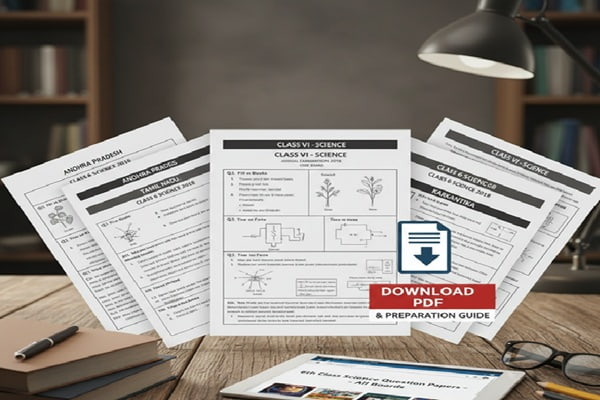
Class 6 Science is one of those subjects where the question paper you need depends completely on your board, and every board approaches it differently.
CBSE Class 6 uses the NCERT Science textbook and conducts school-level exams with no centralized paper. AP and Telangana have a combined subject called General Science tested through SA1 and SA2. Tamil Nadu uses the Samacheer Kalvi Science book with quarterly and annual exams. Kerala tests Basic Science through term-wise assessments. Karnataka uses SA1 and SA2 through its KSEEB framework.
The 2018 papers from all these boards exist, but they are on different websites, have different formats, cover different chapters, and carry different marks. This guide covers all of them, explains exactly what each 2018 paper tested, and shows you where to download each one without landing on broken links or wrong papers.
How Science Is Taught in 6th Class: Board-wise Subject Names
One of the first confusions students face is that Science in Class 6 goes by different names across boards. Knowing the subject name for your board helps you find the right paper.
| Board |
Subject Name in Class 6 |
Textbook Used |
How Assessed |
| CBSE |
Science (integrated) |
NCERT Science Class 6 |
School-level annual and mid-term exams |
| AP SCERT |
General Science (Prathyeka Samskruti Sasthram) |
AP SCERT General Science Class 6 textbook |
SA1 (Oct-Nov) and SA2 (Mar-Apr) in MCQ/OMR format |
| Telangana SCERT |
General Science |
TS SCERT General Science Class 6 textbook |
SA1 (Oct) and SA2 (Apr) in MCQ/OMR format |
| Tamil Nadu |
Science (Samacheer Kalvi) |
TN Samacheer Kalvi Science Class 6 |
Quarterly, Half Yearly, and Annual exams |
| Kerala SCERT |
Basic Science (Adisthana Saasthram) |
Kerala SCERT Basic Science Class 6 reader |
First Term (Onam), Second Term (Christmas), Annual |
| Karnataka KSEEB |
Science |
Karnataka SCERT Science Class 6 |
SA1 (Sep-Oct) and SA2 (Mar) or Annual exam |
| Maharashtra Board |
General Science and Technology |
Maharashtra State Board Science Class 6 |
School-level term exams and annual exam |
Important: For AP and Telangana, the 6th class science paper is called General Science and uses separate SCERT textbooks from each state. Downloading a Telangana General Science paper for an AP student (or vice versa) means studying content from a different textbook. Always verify your board before downloading.
6th Class Science Question Paper 2018: Board-wise Exam Overview
| Board |
Exam Name (2018) |
Marks |
Duration |
Medium |
| CBSE (school-level) |
Annual/Final Exam (school-conducted) |
60 to 80 marks (varies by school) |
2 to 3 hours |
English and Hindi Medium |
| AP SCERT |
SA1 (Nov-Dec 2017) and SA2 (Mar-Apr 2018) |
50 marks per exam |
2 hours |
Telugu Medium and English Medium |
| Telangana SCERT |
SA1 (Oct 2017) and SA2 (Apr 2018) |
50 marks per exam |
2 hours |
Telugu Medium and English Medium |
| Tamil Nadu |
Quarterly (Aug), Half Yearly (Dec 2017), Annual (Mar 2018) |
60 to 100 marks depending on exam type |
2 to 3 hours |
Tamil Medium and English Medium |
| Kerala SCERT |
T1 Onam (Sep 2017), T2 Christmas (Dec 2017), Annual (Mar 2018) |
60 marks per exam |
2 hours |
Malayalam Medium and English Medium |
| Karnataka KSEEB |
SA1 (Sep-Oct 2017) and SA2 (Mar 2018) |
80 marks |
2.5 to 3 hours |
Kannada Medium and English Medium |
CBSE Class 6 Science Question Paper 2018
CBSE does not conduct a centralized exam for Class 6. All exams are school-level, which means the question paper varies from school to school. However, CBSE provides a syllabus and most schools follow the NCERT textbook pattern closely. The 2018 school year papers from top CBSE schools and KV (Kendriya Vidyalaya) schools are the most widely circulated and serve as the reference model.
CBSE Class 6 Science 2018 Paper Pattern
| Section |
Question Type |
Number of Questions |
Marks |
| Section A |
Very Short Answer (1 mark each) – Define, name, state true/false |
8 questions |
8 marks |
| Section B |
Short Answer (2 marks each) – Explain briefly, give two examples |
10 questions |
20 marks |
| Section C |
Short Answer (3 marks each) – Describe, compare, explain with reasons |
9 questions |
27 marks |
| Section D |
Long Answer (5 marks each) – Detailed explanation, diagram labeling, experiment description |
3 questions |
15 marks |
| Total |
|
30 questions |
60 to 70 marks (varies by school) |
CBSE Class 6 Science Chapters Covered in the 2017-18 Annual Exam
| Chapter Number |
Chapter Name |
Topic Type |
| Chapter 1 |
Food: Where Does It Come From? |
Biology – sources of food, plant and animal products |
| Chapter 2 |
Components of Food |
Biology – nutrients, balanced diet, deficiency diseases |
| Chapter 3 |
Fibre to Fabric |
Chemistry/Technology – natural fibres, silk, cotton, wool |
| Chapter 4 |
Sorting Materials into Groups |
Chemistry – properties of materials, transparency |
| Chapter 5 |
Separation of Substances |
Chemistry – methods of separation, sieving, filtration |
| Chapter 6 |
Changes Around Us |
Chemistry – reversible and irreversible changes |
| Chapter 7 |
Getting to Know Plants |
Biology – types of plants, roots, stems, leaves, flowers |
| Chapter 8 |
Body Movements |
Biology – types of joints, movement in animals |
| Chapter 9 |
The Living Organisms and Their Surroundings |
Biology – habitat, adaptation, biotic/abiotic factors |
| Chapter 10 |
Motion and Measurement of Distances |
Physics – types of motion, standard units of measurement |
| Chapter 11 |
Light, Shadows and Reflections |
Physics – transparent materials, shadows, pinhole camera |
| Chapter 12 |
Electricity and Circuits |
Physics – electric circuit, conductors, insulators |
| Chapter 13 |
Fun with Magnets |
Physics – poles of a magnet, magnetic and non-magnetic materials |
| Chapter 14 |
Water |
Chemistry – sources, water cycle, conservation |
| Chapter 15 |
Air Around Us |
Chemistry – composition of air, oxygen, CO2, nitrogen |
| Chapter 16 |
Garbage In, Garbage Out |
Environmental – waste management, composting, 3Rs |
CBSE Class 6 Science 2018 papers are available on mycbseguide.com, studiestoday.com, and cbseboardonline.com. KV school papers specifically can be found on individual KV school websites and through schools.aglasem.com search.
AP and Telangana 6th Class General Science Question Paper 2018
For students in Andhra Pradesh and Telangana, the 6th class Science paper is called General Science. The subject uses a combined approach covering physical, biological, and environmental science concepts within a single textbook.
Both AP and Telangana conduct SA1 and SA2 assessments. The 2018 papers refer to SA1 (held November-December 2017 for the 2017-18 academic year) and SA2 (held March-April 2018). Both exams use the MCQ-based OMR answer sheet format introduced for middle school classes.
AP and Telangana SA2 2018 General Science Paper Pattern (50 Marks)
| Part |
Content |
Questions |
Marks |
| Part A |
Multiple Choice Questions on concepts, definitions, facts from the textbook |
20 MCQs – all compulsory |
20 marks |
| Part B |
Vocabulary, fill-in-the-blank style MCQs, match-the-following MCQs |
10 MCQs |
10 marks |
| Part C |
Diagram-based MCQs: identify parts, complete the diagram, label identification |
10 MCQs |
10 marks |
| Part D |
Application and reasoning MCQs: Why, How, Compare-type questions |
10 MCQs |
10 marks |
| Total |
50 objective MCQs on OMR sheet |
50 |
50 marks |
Key Chapters in AP and Telangana 6th Class General Science 2018
- Food and Nutrition: Sources of food, nutrients, balanced diet, deficiency diseases
- Materials in Daily Life: Properties of materials, solids, liquids, gases
- Natural Resources: Water cycle, air, soil, conservation of resources
- Our Environment: Ecosystems, food chains, habitat and adaptation
- Simple Machines: Lever, pulley, inclined plane, wheel and axle
- Light and Shadows: Transparent, opaque, translucent materials, shadow formation
- Motion and Measurement: Types of motion, standard units, measuring tools
- Electricity and Magnetism: Circuits, conductors, magnets, poles
- Plants and Animals: Photosynthesis, plant parts, animal adaptations
- Health and Hygiene: Communicable diseases, first aid, personal hygiene
AP vs Telangana 6th Class Science 2018 Papers: Key Differences
| Factor |
AP SCERT |
Telangana SCERT |
| Textbook |
AP SCERT General Science Class 6 (separate from TS after 2014 bifurcation) |
TS SCERT General Science Class 6 (separate from AP after 2014 bifurcation) |
| SA1 Exam Month |
November to December |
October to November |
| File Codes (telanganaboard.com) |
AP papers on tlm4all.com and apteacher.net |
TSBIE-CLASS-6-SA1-GENERAL-SCIENCE-R-38-OCT-2023 format (similar for 2018) |
| Medium |
Telugu Medium and English Medium |
Telugu Medium and English Medium |
| Download Source |
tlm4all.com, apteacher.net, schools360.in |
telanganaboard.com, educationobserver.com |
Tamil Nadu 6th Standard Science Question Paper 2018
Tamil Nadu Samacheer Kalvi Class 6 Science covers a wide range of topics including basic physics, chemistry, biology, and environmental science. The 2018 papers refer to three exam events: the Quarterly Exam (August 2017), the Half Yearly Exam (December 2017), and the Annual Exam (March 2018).
Tamil Nadu 6th Std Science 2018 Paper Pattern (Annual, 100 Marks)
| Section |
Type |
Questions |
Marks |
| Part I |
Multiple Choice Questions (1 mark each) |
15 MCQs |
15 marks |
| Part II |
Fill in the Blanks (1 mark each) |
10 questions |
10 marks |
| Part III |
Short Answer – 2 lines per answer (2 marks each) |
10 questions |
20 marks |
| Part IV |
Descriptive short answer (3 marks each) |
8 questions |
24 marks |
| Part V |
Long Answer with diagram or detailed explanation (5 marks each) |
5 out of 7 |
31 marks |
| Total |
|
|
100 marks |
Tamil Nadu 6th Science 2018 Chapter Coverage (Samacheer Kalvi)
- Term 1: Matter Around Us, Force and Motion, Living World of Plants
- Term 1: Living World of Animals, Health and Hygiene
- Term 2: Water, Magnetism, Natural Resources
- Term 2: Air, Weather and Climate, Universe
- Term 3: Electricity, Light, Sound
- Term 3: Computer and Information Technology, Career Awareness
- Annual exam (2018) covered all three terms combined
Tamil Nadu 6th standard Science papers for 2018 are available on tnkalvi.net, nammakalvi.com, and padasalai.net. The Quarterly and Half Yearly papers are listed separately from the Annual exam under the 2017 section on some sites, since T1 and T2 fell in the 2017 calendar year.
Kerala 6th Standard Basic Science Question Paper 2018
In Kerala, Class 6 Science is called Basic Science (Adisthana Saasthram). The Kerala SCERT approach to Basic Science integrates Environmental Science concepts with basic Physics, Chemistry, and Biology. The 2018 papers cover three assessments: the First Term (Onam) exam, the Christmas exam, and the Annual exam.
| Exam Type |
When Held |
Marks |
Download Source |
| First Term (Onam) Exam 2017 |
August to September 2017 |
60 marks |
keralaboard.com, educationobserver.com |
| Second Term (Christmas) Exam 2017 |
December 2017 |
60 marks |
keralaboard.com, educationobserver.com, examwinner.com |
| Annual Exam 2018 |
March to April 2018 |
60 marks |
keralaboard.com, educationobserver.com, examwinner.com |
Kerala Class 6 Basic Science papers from 2018 are available in both Malayalam Medium and English Medium. The educationobserver.com forum has a dedicated thread for Kerala Class 6 Science papers with answer keys. The file codes on keralaboard.com follow the pattern: KERALA-BOARD-CLASS-6-BASIC-SCIENCE-[EXAM TYPE]-2018.
Key Units in Kerala Class 6 Basic Science 2018
- Plants and their Characteristics: Classification, photosynthesis, seed dispersal
- Animals and their Adaptations: Habitat, food habits, movement
- Water in Our Life: Water cycle, conservation, water-borne diseases
- Our Environment: Ecosystem, food chains, human impact
- Light and its Properties: Reflection, shadows, sources of light
- Force and Motion: Types of force, effects of force on objects
- Electricity and Magnets: Simple circuits, magnetic materials
- Materials Around Us: Properties of substances, changes in materials
Karnataka 6th Standard Science Question Paper 2018
Karnataka follows the KSEEB (Karnataka Secondary Education Examination Board) syllabus for Class 6. Science is tested through two summative assessments: SA1 (conducted September to October) and SA2 (conducted March). Both the 2017-18 SA1 and SA2 papers are available on inyatrust.co.in with blueprints and answer keys.
Karnataka 6th Std SA2 2018 Science Paper Pattern
| Section |
Content |
Marks |
| Part A |
Multiple Choice Questions and Very Short Answer (1 mark each) |
10 marks |
| Part B |
Fill in the Blanks, True/False with reason |
10 marks |
| Part C |
Short Answer Questions (3 marks each) – explanation and examples |
18 marks |
| Part D |
Long Answer Questions (4 to 5 marks each) – diagrams and detailed explanation |
20 marks |
| Part E |
Essay or Experiment Description (5 marks) |
10 marks |
| Project/Activity (where applicable) |
Integrated activity or observation report |
12 marks |
| Total |
|
80 marks |
Karnataka SA2 2018 Class 6 Science papers are available on inyatrust.co.in in both Kannada Medium and English Medium. Blueprints showing chapter-wise marks distribution are provided alongside most papers. This makes Karnataka papers one of the most transparent and complete sets available for Class 6 Science.
Where to Download the 6th Class Science Question Paper 2018
| Board |
Website |
Search Term to Use |
| CBSE |
mycbseguide.com, studiestoday.com, cbseboardonline.com, schools.aglasem.com |
“Class 6 Science question paper 2017-18” or “CBSE 6th Science annual paper 2018” |
| AP SCERT |
tlm4all.com, apteacher.net, schools360.in |
“6th class SA2 General Science 2017-18 AP” or “AP Class 6 SA1 Science 2018” |
| Telangana SCERT |
telanganaboard.com, educationobserver.com |
“TS Class 6 SA1 General Science 2017” or go to telanganaboard.com > Class 6 > Science |
| Tamil Nadu |
tnkalvi.net, nammakalvi.com, padasalai.net |
“6th std Science annual question paper 2018 Tamil Nadu” or “6th Science half yearly 2017” |
| Kerala SCERT |
keralaboard.com, educationobserver.com, examwinner.com |
“Kerala class 6 Basic Science annual 2018” or KERALA-BOARD-CLASS-6-BASIC-SCIENCE file code |
| Karnataka KSEEB |
inyatrust.co.in, schoolkits.in |
“6th std SA2 Science 2017-18 Karnataka” then choose Kannada or English medium |
| Maharashtra |
mahahsscboard.in, aglasem.com (Maharashtra section) |
“Maharashtra class 6 Science paper 2017-18” or “Maha 6th General Science question paper 2018” |
Step-by-Step Download Guide
- Identify your board first. AP and Telangana students need the General Science paper. Kerala students need Basic Science. CBSE students need the NCERT-based Science paper.
- Choose the exam type: SA1, SA2, Annual, Quarterly, Half Yearly, or First/Second Term.
- Go to the board-specific website from the table above.
- Use the search bar with the exact search term listed in the table. Include the year (2018 or 2017-18) for more precise results.
- Look for PDF links. Most papers are hosted on Google Drive, Blogger, or direct server links.
- Click the download link. On mobile: long press the PDF and select Save. On desktop: right-click and choose Save As.
- For Telangana, if you cannot find the exact 2018 paper, look for the SA1 October papers as the 2017 SA1 and 2018 SA2 cover the 2017-18 academic year.
- For answer keys: look for a “Key Paper” or “Answer Key” link beside the question paper. Most AP and TS papers have answer keys on the same page.
Most Important Chapters in Class 6 Science for 2018 Exam Preparation
Across all boards, certain chapter types appear most frequently in the 2018 Science papers. The pattern is consistent: Biology chapters dominate the first half of the paper, Physics chapters appear in the middle, and Chemistry or Environmental Science chapters round off the paper.
| Topic Area |
Chapter Examples (NCERT / State Board) |
Typical Marks Weightage |
Question Types Most Used |
| Food and Nutrition |
Food: Where Does It Come From, Components of Food, Nutrition in Plants, Nutrition in Animals |
12 to 15% of paper |
Short answer (2-3 marks): Give examples of nutrients. Long answer: Explain deficiency diseases. |
| Materials and Properties |
Sorting Materials, Separation of Substances, Changes Around Us |
10 to 12% of paper |
MCQ and short answer: Identify reversible/irreversible changes. Name separation methods. |
| Plants and Animals |
Getting to Know Plants, Body Movements, Living Organisms and Surroundings |
15 to 18% of paper |
Diagram labeling: Label parts of a flower or leaf. Short answer: Compare different types of roots. |
| Physics: Motion, Light, Electricity |
Motion and Measurement, Light and Shadows, Electricity and Circuits, Magnets |
18 to 22% of paper |
MCQ: Identify transparent/opaque. Short answer: Draw a simple circuit. Long answer: Types of motion with examples. |
| Environment and Resources |
Water, Air, Natural Resources, Garbage Management |
12 to 15% of paper |
Short answer: Effects of deforestation. Long answer: Explain the water cycle with diagram. |
| Experiments and Activities |
Simple experiments from textbook activities |
8 to 10% of paper |
Describe experiment: Steps to test electrical conductors. Observation-type questions. |
How to Use the 2018 Science Paper for Exam Preparation
Downloading the paper is the first step. Using it correctly is what makes the difference in marks. Here is a practical method that applies whether you are preparing for a current exam or revisiting the 2018 paper for revision purposes.
Before You Solve: Analyse the Paper Pattern
- Go through the 2018 paper once without answering. Read every question.
- Write down which chapter each question comes from. Count the total marks per chapter.
- The chapters with the most marks get the most revision time.
- Note the question types: Are most marks in MCQ format (AP/TS) or in descriptive format (CBSE/Karnataka)?
- For diagram questions: identify which diagrams appeared and learn to draw and label them before the exam.
Solving Under Real Conditions
- Set a timer for the full exam duration (60 marks paper: 2 hours, 80 marks: 2.5 hours, 100 marks: 3 hours).
- Write answers as you would in the actual exam. For OMR-format papers (AP/TS), practice filling circles on paper.
- Do not check answers while solving. Complete the full paper first.
- After finishing, use the answer key to mark your responses.
After Solving: Targeted Revision
- List every question you got wrong by chapter. This is your personal weak area list.
- For Biology: re-read the chapter and make a simple diagram with labels. Biology errors usually come from memory gaps.
- For Physics: practice writing explanations for concepts like motion types, circuit diagrams, and light properties. Physics errors usually come from confusing similar definitions.
- For Chemistry/Environment: practice writing short answers for processes like separation methods, water cycle, and changes in materials. These are straightforward but require precise vocabulary.
- Repeat the process with one more year of previous papers. Use 2017 and 2019 papers alongside 2018.
Also Read : 8th Standard Malayalam Question Paper 2018 Kerala – Download PDF, Paper Pattern, Curriculum Types and Preparation Guide
Section-wise Scoring Tips for Class 6 Science
| Topic |
What the 2018 Paper Tested |
How to Score Full Marks |
| Food and Nutrition |
Sources of nutrients, naming deficiency diseases, examples of vitamins and minerals |
Make a two-column list: Nutrient + Deficiency Disease. This table form directly answers most short-answer questions. |
| Plant Science |
Parts of a flower, types of roots, photosynthesis, seed germination |
Draw and label the parts of a flower and a leaf. These diagrams earn 3 to 5 marks in CBSE and Karnataka papers. Learn at least 5 types of leaves and roots with examples. |
| Electricity and Circuits |
Conductors vs insulators, simple circuit diagram, open and closed circuits |
Draw a simple circuit from memory: cell, switch, bulb, wire. Practice this diagram 5 times. It appears in nearly every board paper. |
| Motion and Measurement |
Types of motion (linear, circular, periodic), units of measurement, measuring tools |
Create a table: 3 columns – Type of Motion, Definition, Real-life example. This structure earns full marks for any short answer on this topic. |
| Water and Environment |
Water cycle steps, water conservation methods, effects of pollution |
Learn the water cycle with a labelled diagram. The 5 steps (evaporation, condensation, precipitation, collection, transpiration) must be in order. |
| Separation of Substances |
Methods: sieving, filtration, evaporation, distillation |
For each method: write what it separates, how it works, one real example. This 3-point structure covers all question types for this chapter. |
Common Mistakes Students Make with the Class 6 Science Paper
| Mistake |
Why It Happens |
What to Do Instead |
| Downloading a CBSE paper when they need AP or Telangana SA paper |
Most Google results for “class 6 science paper 2018” return CBSE-focused pages |
Check your board first. AP and TS use General Science papers from SCERT, not NCERT. The chapters and question format are different. |
| Skipping diagram labeling practice |
Students focus on written answers and forget that diagrams carry 3 to 5 marks in Karnataka and CBSE papers |
Practice drawing and labeling at least 5 key diagrams: flower parts, leaf types, simple circuit, water cycle, food chain. |
| Only practicing MCQs for AP and TS students |
The MCQ format feels easier so students over-prepare for it and ignore conceptual understanding |
MCQs in AP and TS General Science are concept-based. Without understanding the chapter, the MCQ options confuse easily. Read the chapter first, then practice MCQs. |
| Studying all 16 chapters with equal time |
Students spread revision time evenly even though some chapters carry 2x more marks |
Use the chapter-wise marks distribution from the 2018 paper to allocate revision time proportionally. High-mark chapters get more time. |
| Not attempting the experiment-description questions |
These carry 3 to 5 marks and students skip them because they think they need lab access |
Experiment questions in Class 6 are based on simple observations and textbook activities. Read the “Activity” sections in each NCERT chapter and practice writing the steps. |
Year-wise Availability of 6th Class Science Question Papers
| Year |
CBSE |
AP SCERT |
Telangana |
Tamil Nadu |
Kerala |
Karnataka |
| 2015-16 |
KV papers available |
Available on tlm4all.com |
Available on telanganaboard.com |
Available on tnkalvi.net |
Available on keralaboard.com |
Available on inyatrust.co.in |
| 2016-17 |
Sample papers on mycbseguide.com |
Available on tlm4all.com |
Available on telanganaboard.com |
Available on tnkalvi.net |
Available on keralaboard.com |
Available on inyatrust.co.in |
| 2017-18 (2018 exam) |
School papers on studiestoday.com, mycbseguide.com |
SA1 (Nov 2017) and SA2 (Mar 2018) on tlm4all.com, schools360.in |
SA1 (Oct 2017) and SA2 (Apr 2018) on telanganaboard.com |
Quarterly, HY, Annual on tnkalvi.net, nammakalvi.com |
All three terms on keralaboard.com, educationobserver.com |
SA1 and SA2 on inyatrust.co.in with blueprints |
| 2018-19 |
studiestoday.com, cbseboardonline.com |
Full set on tlm4all.com |
Full set on telanganaboard.com |
Full set on tnkalvi.net |
Full set on keralaboard.com |
Full set on inyatrust.co.in |
| 2022-23 |
Comprehensive set on studiestoday.com |
Updated set on apteacher.net |
Full set on telanganaboard.com |
Full set on nammakalvi.com |
Full set on examwinner.com |
Full set on inyatrust.co.in |
Preparation Checklist for 6th Class Science Exam
- Confirm your board (CBSE, AP, Telangana, TN, Kerala, Karnataka) before downloading any paper
- Identify the exam type you need: SA1, SA2, Annual, Quarterly, Half Yearly, or term exam
- Download the 2018 paper from the correct board-specific source using the download guide above
- Read through the paper once to identify chapter-wise marks distribution
- List the 5 chapters with the highest marks and prioritize those in revision
- Practice drawing and labeling at least 5 key Science diagrams
- For AP and TS: practice filling OMR sheets with dark pen or HB pencil
- Solve the full 2018 paper under timed exam conditions
- Check answers using the available answer key and list all wrong answers by chapter
- Revise only the chapters where you lost marks, not the full syllabus
- Solve one more year of previous papers (2017 or 2019) to identify question patterns
Frequently Asked Questions
| Q: Where can I download the 6th class Science question paper 2018? |
| A: It depends on your board. CBSE students should check mycbseguide.com, studiestoday.com, or cbseboardonline.com. AP students should go to tlm4all.com or schools360.in and search for “Class 6 SA2 General Science 2017-18 AP”. Telangana students should check telanganaboard.com and navigate to Class 6. Tamil Nadu students should go to tnkalvi.net or nammakalvi.com. Kerala students should check keralaboard.com or educationobserver.com. Karnataka students should check inyatrust.co.in. |
| Q: Is the 6th class Science paper the same across all boards in India? |
| A: No. Each board has its own syllabus, textbook, and paper format for Class 6 Science. CBSE uses the NCERT Science textbook. AP and Telangana have separate SCERT General Science textbooks. Tamil Nadu uses Samacheer Kalvi Science. Kerala tests Basic Science using its own SCERT reader. Karnataka uses a state SCERT Science book. Downloading the wrong board paper means studying different chapter content entirely. |
| Q: How many marks is the 6th class Science exam? |
| A: It varies by board. CBSE school-level papers carry 60 to 80 marks. AP and Telangana SA papers carry 50 marks each for SA1 and SA2. Tamil Nadu annual exam carries 100 marks. Kerala term exams carry 60 marks. Karnataka SA2 carries 80 marks. The duration also varies: 2 hours for 50-mark papers, up to 3 hours for 100-mark papers. |
| Q: What chapters are most important for the Class 6 Science 2018 exam? |
| A: Across all boards, the highest-weightage topics are Food and Nutrition, Plants and Animals (Biology), Electricity and Circuits, Motion and Measurement, and Water or Environmental Science. These chapters consistently carry the highest marks in 2018 papers across CBSE, AP, Telangana, and Karnataka. Diagram-based chapters like Electricity and Plants account for 15 to 20 percent of the paper in CBSE and Karnataka formats. |
| Q: What is General Science in AP and Telangana Class 6? |
| A: General Science in AP and Telangana Class 6 is an integrated single subject that combines Physical Science, Biological Science, and Environmental Science topics in one textbook. At higher classes (8th and above in AP/TS), these separate into Physical Science and Biological Science as distinct subjects. In 6th and 7th class, it remains a single General Science paper. This is different from CBSE which teaches Science as one subject throughout middle school but uses the NCERT textbook. |
| Q: Are AP and Telangana 6th class Science papers in MCQ format? |
| A: Yes. AP and Telangana SA1 and SA2 exams for Class 6 use an MCQ-based OMR answer sheet format. All 50 questions are objective MCQs. Students fill in answer circles on the OMR sheet using a dark pen or HB pencil. This format requires the student to recognize the correct answer rather than write explanations. It is fundamentally different from the descriptive format used by CBSE, Karnataka, and Tamil Nadu where written answers are required. |
| Q: Is the 2018 Science paper still useful for preparing for current exams? |
| A: Yes. The core chapters of Class 6 Science have remained largely unchanged across all boards since 2018. Food and Nutrition, Plants, Electricity, Motion, Water Cycle, and Materials topics are present in every year. The 2018 paper is particularly useful for understanding question types, marks distribution, and difficulty levels. Use it alongside the current year model papers to account for any minor syllabus updates your board may have introduced. |
| Q: Are answer keys available for the 2018 6th class Science papers? |
| A: Yes for most boards. AP and Telangana papers on tlm4all.com and apteacher.net come with answer keys for both SA1 and SA2. Karnataka papers on inyatrust.co.in include teacher-prepared answer keys and blueprints. Kerala papers on educationobserver.com forum threads include answer keys in many years. For CBSE, studiestoday.com and mycbseguide.com provide solved papers with detailed answers. |