
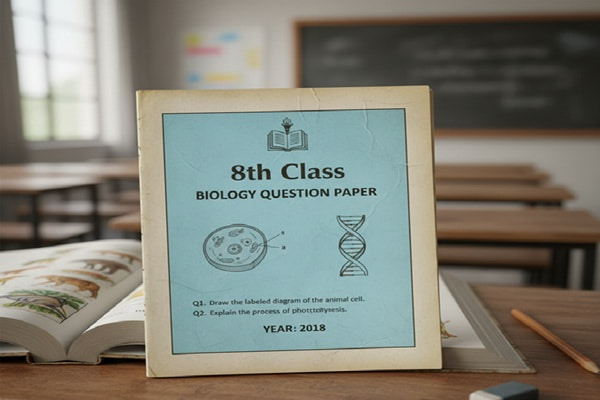
Most Class 8 students treat Biology as the easier half of Science. They memorize a few definitions, look at diagrams once, and assume they are prepared. Then the question paper arrives and they realize that three of the four long answer questions are from Biology chapters they only half-studied.
The 8th class Biology question papers from 2018 paint a very clear picture of how examiners weight this subject. In Telangana and AP, Biological Science is a completely separate paper from Physical Science. It has its own marks, its own paper structure, and its own set of chapters. This is different from CBSE and Karnataka where Biology is integrated into the broader Science paper.
This guide explains exactly what was in the 2018 Biology papers, which boards treated Biology separately and which integrated it, which chapters carried the most marks, and where to find the actual papers with answer keys.
Board-Wise Overview: 8th Class Biology Question Paper 2018
| Board | Biology Subject Name | Paper Format | Total Marks | 2018 Paper Available |
| Telangana (TSBIE) | Biological Science (BS) | BS Paper 1 (25 marks) + BS Paper 2 (25 marks) | 50 marks | SA1 (2018-19): TM and EM; SA2 (2017-18): TM and EM |
| Andhra Pradesh (BSEAP) | Biological Science (BS) | BS Paper 1 (25 marks) + BS Paper 2 (25 marks) | 50 marks | SA2 April 2018 key papers on amaravathiteacher.com; SA1 and SA2 on tlm4all.com |
| Karnataka (KSEEB) | Science (integrated) | Single Science paper covering Physics, Chemistry, Biology | 80 marks | SA1 Oct 2018 and SA2 Mar 2019 on inyatrust.co.in (EV and KV) |
| Kerala Board | Basic Science (BS) | Single Basic Science paper with Biology section | 80 marks | Annual exam papers on examwinner.com and educationobserver.com |
| CBSE | Science (integrated) | Single Science paper: Physics, Chemistry, Biology, Earth Science | 80 marks (school annual or half-yearly) | School-level papers from 2018-19 session on aglasem.com, cbseboardonline.com |
| Tamil Nadu | Science (integrated) | Single Science paper per term | 100 marks | Annual 2018 and term papers on padasalai.net |
Telangana 8th Class Biological Science (BS) Question Paper 2018
For Telangana Class 8 students, the 2018 Biology papers exist in two forms. The SA2 from the 2017-18 academic session was held in April 2018. The SA1 from the 2018-19 session was held in November 2018. Both fall within the calendar year 2018 and both are commonly referred to as the 2018 Biology paper.
Telangana Biological Science papers follow the SCERT Telangana syllabus. The official syllabus document from scert.telangana.gov.in outlines all chapters taught in Class 8 BS. The papers are available in both English medium (EM) and Telugu medium (TM) on telanganaboard.com and tlm4all.com.
Telangana 8th Class BS SA2 (April 2018): Chapter Coverage
The SA2 paper from April 2018 falls in the 2017-18 academic session. This paper covered the complete year syllabus for Biological Science. The chapters tested included:
| Paper | Chapters Covered in SA2 April 2018 | Key Topics Within the Chapter |
| BS Paper 1 | Cell Structure and Functions | Discovery of cells, cell theory, plant cell vs animal cell, cell organelles: nucleus, mitochondria, chloroplast, ribosomes, vacuole, cell wall, cell membrane |
| BS Paper 1 | Microorganisms: Friend and Foe | Types of microorganisms (bacteria, fungi, algae, protozoa, viruses), useful and harmful microorganisms, food preservation, nitrogen fixation |
| BS Paper 1 | Reproduction in Animals | Sexual and asexual reproduction, external and internal fertilization, development of zygote, metamorphosis (frog, butterfly), care of young ones |
| BS Paper 2 | Reaching the Age of Adolescence | Adolescence definition, physical changes during puberty, secondary sexual characteristics, reproductive health, role of hormones |
| BS Paper 2 | Some Natural Phenomena | Lightning, thunderstorms, earthquakes, seismic zones (this chapter overlaps with Physical Science in some boards but is in BS for Telangana Class 8) |
| BS Paper 2 | Conservation of Plants and Animals | Biodiversity, protected areas, wildlife sanctuaries, national parks, biosphere reserves, deforestation and its effects, endemic species, Red Data Book |
Telangana 8th Class BS SA1 (November 2018, Session 2018-19): Chapter Coverage
The SA1 from the 2018-19 session covers the first half of the Class 8 Biological Science syllabus. Based on the SCERT Telangana Class 8 BS syllabus and the available SA1 papers, the chapters covered are:
- What is Science: Nature of science, scientific method, observation, hypothesis, experimentation
- Cell: The Basic Unit of Life: Cell discovery, structure, plant vs animal cell differences, cell organelles in detail
- Microorganisms: Friend and Foe: Types, useful microorganisms (food fermentation, nitrogen fixation, antibiotics), harmful microorganisms (diseases caused), food preservation methods
- Crop Production and Management: Agricultural practices, soil preparation, sowing, irrigation, manures and fertilizers, crop protection, harvesting, storage
- Conservation of Plants and Animals: Deforestation, biodiversity loss, protected areas, flora and fauna
Telangana Class 8 BS Paper Structure 2018
| Section | Question Type | Questions | Marks Each | Total |
| Section I | Multiple Choice Questions (MCQ) | 5 | 1 mark | 5 marks |
| Section II | Fill in the Blanks | 5 | 1 mark | 5 marks |
| Section III | Short Answer Questions | 4 | 2 marks | 8 marks |
| Section IV | Long / Essay Answer (attempt 2 of 3 given) | 3 (attempt 2) | 4 marks | 8 marks (from 12 offered) |
| Total per BS paper | 17 | 25 marks |
Both BS Paper 1 and BS Paper 2 follow this same 25-mark structure. Together they give a combined Biological Science SA score of 50 marks. Section IV gives students a choice: attempt any 2 of the 3 long answer questions. Students should use this choice strategically by selecting the two questions from chapters they know most thoroughly.
Andhra Pradesh 8th Class Biological Science (BS) Question Paper 2018
Andhra Pradesh follows the same Biological Science structure as Telangana with Paper 1 and Paper 2, each carrying 25 marks. The AP SA2 Biological Science SA2 April 2018 key papers are specifically documented on amaravathiteacher.com under the title SUMMATIVE ASSESSMENT-2 ANNUAL EXAMS-APRIL-2018 BIOLOGICAL SCIENCE-B.S-8TH CLASS KEY PAPERS FOR AP TEACHERS.
This is one of the few direct references to an actual 2018 Biology exam on the first page of Google results, yet the page provides only the answer key without any chapter explanation or preparation guidance. The actual question papers for SA2 2017-18 in both English medium and Telugu medium are available on tlm4all.com.
AP Class 8 BS 2018: What Was Different From Telangana Papers
AP allows district-level variation in question wording and numerical values while the chapter syllabus remains the same as Telangana. The amaravathiteacher.com key paper confirms that the April 2018 AP BS SA2 exam tested exactly the same chapters as Telangana. The answer key breakdown from this source confirms the following question type distribution:
- 5 MCQs from different BS chapters each carrying 1 mark
- 5 fill-in-the-blank questions from chapter terminology and definitions
- 4 short answer questions requiring 3 to 4 sentence responses with specific biological terms
- 2 long answer questions from the options given, typically involving process descriptions, diagram-based explanation, or comparison between biological concepts
AP teachers and students can also access SA1 and SA2 BS papers organized by year on educationobserver.com under the Andhra State Syllabus SA1 Previous Year Question Papers for Class 8 section. The manabadi.co.in portal lists AP State Syllabus 8th Class Biology Previous Year Question Papers dating back several years.
CBSE 8th Class Science Question Paper 2018: Biology Chapters
CBSE does not have a separate Biology paper for Class 8. The Science paper covers Physics, Chemistry, Biology, and Earth Science as an integrated subject. The 2018-19 session papers (Half-Yearly and Annual) for CBSE Class 8 Science are available through KV school blogs and on aglasem.com.
Within the CBSE Class 8 Science syllabus, the Biology-related chapters carry approximately 25 to 30 marks in an 80-mark paper. These chapters were consistently tested in the 2018 school papers:
CBSE Class 8 Biology Chapters Tested in 2018 Papers
| Chapter | Chapter Name | Biology Topics | Marks Typically Tested |
| Chapter 1 | Crop Production and Management | Kharif and Rabi crops, soil preparation, fertilizers vs manures, irrigation, crop protection, storage | 5-7 marks |
| Chapter 2 | Microorganisms: Friend and Foe | Types of microorganisms, nitrogen fixation, food spoilage, antibiotics, diseases, vaccines, food preservation | 5-7 marks |
| Chapter 3 | Synthetic Fibres and Plastics | Overlaps with Chemistry. Biodegradable vs non-biodegradable materials | Part of Chemistry section |
| Chapter 7 | Conservation of Plants and Animals | Deforestation, biodiversity, wildlife sanctuaries, national parks, biosphere reserves, Red Data Book, migration | 5-7 marks |
| Chapter 8 | Cell Structure and Functions | Cell theory, plant vs animal cell, cell organelles, unicellular vs multicellular organisms | 6-8 marks |
| Chapter 9 | Reproduction in Animals | Types of reproduction, fertilization, viviparous and oviparous animals, metamorphosis, cloning | 5-7 marks |
| Chapter 10 | Reaching the Age of Adolescence | Puberty, secondary sexual characteristics, reproductive health, hormones, endocrine glands | 5-6 marks |
Together the Biology chapters in CBSE Class 8 Science typically account for 30 to 35 marks out of 80 in an annual paper. The remaining marks come from Physics (Motion, Force, Sound, Light, Chemical Effects of Current) and Chemistry (Materials, Combustion, Pollution, Coal and Petroleum).
Karnataka 8th Standard Science (Biology Sections) 2018
Karnataka KSEEB integrates Biology, Physics, and Chemistry into a single 80-mark Science paper for Class 8. The SA1 was held in October 2018 and the SA2 was held in March 2019. Both papers are available on inyatrust.co.in in English version and Kannada version.
In the Karnataka Class 8 Science SA papers from 2018, the Biology-related questions typically accounted for 25 to 30 marks. The chapters tested in the 2018 SA papers from the Karnataka state syllabus included:
Karnataka Class 8 Biology Topics in SA1 and SA2 Papers 2018
- Cell Structure and Functions: Cell theory, plant and animal cells, organelles, differences
- Microorganisms: Friend and Foe: Types, beneficial uses, harmful effects, preservation methods
- Crop Production and Management: Agricultural practices, irrigation methods, organic vs chemical farming
- Conservation of Plants and Animals: Protected areas, biodiversity, deforestation
- Reproduction in Animals: Sexual and asexual, viviparous, oviparous, metamorphosis
- Reaching the Age of Adolescence: Puberty, hormones, reproductive health
Kerala 8th Standard Basic Science: Biology Sections 2018
Kerala’s Class 8 Science is titled Basic Science (BS) and has a distinct character compared to other boards. The annual exam from 2018 covered integrated Science content including Biology topics. Kerala’s questions are open-ended and application-based rather than definition-heavy.
The 2018 Kerala Class 8 Basic Science annual exam paper is available on examwinner.com and educationobserver.com with detailed answer keys in both English medium and Malayalam medium. The Biology sections in the Kerala paper typically cover cellular biology, life processes, and environmental topics.
Chapter-Wise Marks Blueprint: 8th Class Biology 2018 Papers
Based on the actual 2018 SA1 and SA2 papers across all boards, here is how Biology chapters were weighted. This is the information that no other source on the SERP provides.
| Chapter | Telangana/AP BS (out of 50) | CBSE Science Biology portion (out of 80 total) | Karnataka Science Biology portion (out of 80 total) | Priority |
| Cell Structure and Functions | 10-12 marks | 6-8 marks | 8-10 marks | Very High |
| Microorganisms: Friend and Foe | 8-10 marks | 5-7 marks | 6-8 marks | Very High |
| Crop Production and Management | 6-8 marks | 5-7 marks | 5-7 marks | High |
| Conservation of Plants and Animals | 6-8 marks | 5-7 marks | 4-6 marks | High |
| Reproduction in Animals | 8-10 marks | 5-7 marks | 5-7 marks | High |
| Reaching the Age of Adolescence | 5-7 marks | 5-6 marks | 4-6 marks | Medium-High |
| What is Science (TS/AP only) | 3-5 marks | Not applicable | Not applicable | Medium (TS/AP) |
Where to Download 8th Class Biology Question Papers 2018
| Website | Board | What Is Available | Medium | Answer Key? |
| telanganaboard.com | Telangana TSBIE | SA1 (2018-19) and SA2 (2017-18) BS papers, official TSBIE codes, Paper 1 and Paper 2 for each SA exam | English / Telugu | Yes (A suffix files) |
| tlm4all.com | AP and Telangana | 8th Class SA2-BS Question Paper 2018-19 (TM), 8th Class SA2-BS Question Paper 2017-18 (TM and EM), SA1 model papers | English / Telugu | Yes for most |
| amaravathiteacher.com | AP (BSEAP) | SA2 April 2018 Biological Science BS 8th Class Key Papers specifically for AP teachers. Direct key download. | Telugu medium (key focus) | Yes (keys only) |
| apteachers.in | AP | SA1 and SA2 previous year papers and key sheets for Class 8 BS | English / Telugu | Yes (key sheets) |
| schools360.in | AP and Telangana | SA1 SA2 model and previous year papers with answer keys for Class 8 all subjects including BS | English / Telugu | Yes |
| educationobserver.com | AP | Andhra SA1 previous year question papers for Class 8 all subjects. Year-wise collection. | English / Telugu | Yes |
| manabadi.co.in | AP | AP State Syllabus 8th Class Biology Previous Year Question Papers organized by year | English / Telugu | No (papers only) |
| dcebjayashankar.blogspot.com | Telangana | 8th class all subjects SA1 (2018-19) and SA2 (2017-18) with Biology (BS) TM and EM download links | English / Telugu | No (papers only) |
| inyatrust.co.in | Karnataka KSEEB | SA1 and SA2 Science papers 2018-19 in English and Kannada versions with biology sections | English / Kannada | Yes (key answers) |
| examwinner.com | Kerala | Class 8 Basic Science annual exam 2018 with answer keys | English / Malayalam | Yes |
| aglasem.com | CBSE | Class 8 Science sample and previous year papers from 2018-19 session with Biology chapters | English / Hindi | Yes |
| cbseboardonline.com | CBSE | Class 8 Science half-yearly and annual papers 2018-19 session | English | No |
Chapter-Wise Preparation Guide for 8th Class Biology
The 2018 question papers reveal exactly how examiners test each Biology chapter. Here is what each chapter demands and how to prepare for it.
Cell Structure and Functions
This is the highest-marks chapter in 8th class Biology across all boards. In the 2018 SA papers for Telangana and AP, Cell Structure and Functions consistently appeared as both a short answer question and a long answer question. The long answer question typically asked students to draw a labeled diagram of a plant cell or an animal cell.
- The labeled diagram question for plant and animal cells is worth 4 marks in Telangana and AP BS papers. Practice drawing both cells with all organelles labeled using textbook terminology.
- Comparison questions: Differences between plant cell and animal cell carry 2 to 4 marks in all boards. Prepare a minimum 5-point comparison table that you can write from memory.
- Cell organelle functions: MCQs and fill-in-the-blank questions consistently test organelle functions. Know the function of each organelle: mitochondria (energy production/powerhouse), chloroplast (photosynthesis), nucleus (control center/heredity), ribosome (protein synthesis), vacuole (storage, large in plant cells), cell wall (structural support in plants).
- Cell theory: The 2018 SA papers in Karnataka and CBSE included a 2-mark question on the three points of cell theory. State all three points: all living organisms are made of cells, cell is the basic unit of life, all cells arise from pre-existing cells.
Microorganisms: Friend and Foe
This chapter is tested heavily in 2018 papers because it connects to real-life applications like food preservation, antibiotics, and disease prevention. The questions range from 1-mark MCQs to 4-mark essay questions.
- Types of microorganisms: Know all four types with one example each. Bacteria (Lactobacillus), Fungi (yeast, mushroom), Protozoa (Amoeba, Plasmodium), Virus (not a living organism but a microorganism for exam purposes), Algae (Spirogyra).
- Useful microorganisms: The 2018 papers across all boards tested nitrogen fixation (Rhizobium fixes atmospheric nitrogen in legume root nodules), fermentation (yeast in bread and alcohol production), and antibiotics (Penicillin discovered by Alexander Fleming from Penicillium fungus).
- Disease-causing microorganisms: Prepare a table of diseases caused by bacteria (tuberculosis, typhoid, cholera), viruses (common cold, chickenpox, polio, COVID precursor content was already in 2018 books as viral disease examples), fungi (ringworm, athlete’s foot), and protozoa (malaria from Plasmodium).
- Food preservation: Know all methods with scientific reasoning. Salting, pickling, pasteurization (Louis Pasteur), refrigeration, dehydration, use of preservatives. The 2018 SA papers asked which method is used for which type of food as a 2-mark question.
Crop Production and Management
This chapter has a predictable question pattern in Class 8 Biology papers. The 2018 exam questions focused on practical farming knowledge rather than definitions.
- Kharif and Rabi crops: Know five examples of each. Kharif (June to September): paddy, maize, soybean, groundnut, cotton. Rabi (November to April): wheat, gram, pea, mustard, linseed.
- Manure vs Fertilizer: 2-mark comparison question. Manure is natural, slow-acting, improves soil structure. Fertilizer is chemical, fast-acting, does not improve soil structure.
- Irrigation methods: Drip irrigation (water goes directly to roots, minimizes wastage) vs Sprinkler irrigation (for uneven ground, simulates rainfall). The 2018 SA papers asked which method is more suitable in water-scarce regions and why.
- Storage of grains: Silos and granaries, fumigation to prevent pests, moisture control. The long answer question sometimes asks to describe storage methods and their purposes as a 4-mark answer.
Conservation of Plants and Animals
This chapter carries consistent marks in all 2018 Biology papers. The questions test both factual knowledge (names of protected areas) and understanding (reasons for deforestation, effects on biodiversity).
- Types of protected areas: Wildlife sanctuary (animals protected but humans can enter for specific activities), National Park (strict protection, human activity not permitted), Biosphere Reserve (large area protecting ecosystem, core zone completely protected). The 2018 SA papers asked to distinguish between these three types as a 3 to 4 mark question.
- Red Data Book: An international list of endangered plants and animals maintained by IUCN. 1-mark MCQ in Telangana and AP SA papers.
- Endemic species: Species found only in a particular geographic area. Examples: Lion-tailed Macaque (Western Ghats), Nilgiri Langur. 1 to 2 mark question.
- Deforestation effects: The long answer question in 2018 SA papers asked to list and explain the effects of deforestation. Prepare 5 to 6 points: climate change, soil erosion, loss of biodiversity, reduced rainfall, desertification, disruption of water cycle.
Reproduction in Animals
This chapter is diagram-intensive and concept-intensive. The 2018 papers across Telangana, AP, and CBSE tested both the types of reproduction and the development process.
- Sexual vs Asexual reproduction comparison: 2-mark question. Sexual reproduction involves two parents and fusion of gametes. Asexual reproduction involves one parent and no fusion.
- Viviparous vs Oviparous: Viviparous animals give birth to young ones (humans, cows). Oviparous animals lay eggs (hen, frog). 1 to 2 mark question.
- Metamorphosis in frog and butterfly: The life cycle diagram is a 4-mark long answer in Telangana and AP BS papers. Draw the complete cycle with all stages labeled: egg, tadpole, young frog, adult frog (for frog) or egg, larva (caterpillar), pupa (chrysalis), adult butterfly.
- Cloning: Definition and one example (Dolly the sheep). 1 to 2 mark question tested in CBSE and Karnataka 2018 papers.
Reaching the Age of Adolescence
This chapter has a unique character: the questions are relatively straightforward but students often feel awkward studying it and under-prepare. The 2018 SA papers consistently included this chapter in the 2-mark section.
- Adolescence definition: Period between 11 and 19 years of age during which the body undergoes puberty changes. 1-mark definition question.
- Secondary sexual characteristics: Changes at puberty in males (voice change, facial hair, muscular body) and females (development of breasts, menstruation). Presented as a comparison question worth 2 to 4 marks.
- Role of hormones: Testosterone (male sex hormone from testes), Estrogen (female sex hormone from ovaries), Growth hormone (from pituitary gland). 2-mark question asking function of each hormone.
- Reproductive health: HIV/AIDS transmission and prevention, importance of balanced diet during adolescence. 2-mark question in Telangana and AP 2018 SA papers.
Diagram Questions in 8th Class Biology 2018 Papers
Diagrams carry significant marks in Class 8 Biology papers across all boards. The 2018 SA papers confirm that at least one 4-mark diagram question appears in every paper. Missing a diagram question is avoidable. Not preparing for it is a choice that directly reduces your final score.
Most Frequently Tested Diagrams in 8th Class Biology
- Plant Cell (labeled diagram): Must show cell wall, cell membrane, nucleus, chloroplast, vacuole, mitochondria, and endoplasmic reticulum with clear labels. 4 marks in Telangana and AP BS papers.
- Animal Cell (labeled diagram): Must show cell membrane, nucleus, mitochondria, ribosome, endoplasmic reticulum, centriole. Note absence of cell wall, chloroplast, and large vacuole compared to plant cell. 4 marks.
- Life cycle of a Frog: Four-stage diagram with arrows showing progression. Egg to tadpole to young frog to adult frog. All stages labeled. 4 marks.
- Life cycle of a Butterfly / Silkworm: Four-stage metamorphosis. Egg to larva (caterpillar or silkworm) to pupa (chrysalis or cocoon) to adult butterfly or silk moth. 4 marks.
- Nitrogen Cycle: Diagram showing atmospheric nitrogen, nitrogen fixation by Rhizobium, plant absorption, animal consumption, decomposition, denitrification, and return to atmosphere. 4 to 5 marks in CBSE and Karnataka 2018 papers.
How to Score Full Marks on Biology Diagrams
Diagrams in Class 8 Biology SA papers are marked on four criteria: accuracy of shape, clarity of drawing, correct labeling, and neatness. Students who fail to get full marks usually miss one or two labels rather than having the wrong diagram altogether.
- Draw diagrams in pencil first and trace over with pen only for final versions. Smudged or crossed-out labels reduce marks even when the diagram is correct.
- Use a ruler for label lines (the horizontal line connecting the label word to the diagram part). Freehand label lines look untidy and suggest carelessness.
- Labels must use exact textbook terms. Writing powerhouse instead of mitochondria, or gene center instead of nucleus, loses the label mark.
- Give the diagram a title. Write Plant Cell Diagram or Frog Life Cycle above the diagram. The title earns half a mark in most boards and takes two seconds to write.
Common Mistakes in 8th Class Biology Exams
- Confusing Biological Science (BS) with Physical Science (PS) in Telangana and AP. These are two different subjects with two different question papers. A student who prepares BS topics for a PS paper or vice versa will face questions they have not studied at all.
- Drawing animal cell with a cell wall. Plant cells have cell walls. Animal cells do not. This is the single most penalized diagram error in Class 8 Cell chapter questions across all boards.
- Listing only beneficial uses of microorganisms when asked for both. Questions asking about the role of microorganisms expect both useful (nitrogen fixation, antibiotics, fermentation) and harmful (disease-causing, food spoilage) aspects.
- Writing three-word answers for 2-mark short answer questions. A 2-mark question requires two or three complete sentences that demonstrate understanding, not just a key term.
- Skipping the metamorphosis diagram because it seems complicated. This is a 4-mark question that appears in almost every 8th class Biology SA exam across Telangana, AP, and CBSE. Skipping it is skipping guaranteed marks.
- Writing wildlife sanctuary and national park as the same thing. They have different levels of restriction. Students who do not know the specific difference lose marks on distinction-type questions.
- Not using Section IV choice wisely in Telangana and AP BS papers. The choice to attempt 2 of 3 long answer questions is a strategic advantage. Students who attempt the questions in order sometimes find the third question easier but have already committed time to the first two.
Exam Preparation Checklist: 8th Class Biology
- Confirm whether your board treats Biology as a separate subject (Telangana/AP) or as part of combined Science (CBSE, Karnataka, Tamil Nadu, Kerala)
- For Telangana and AP, download BS Paper 1 and BS Paper 2 separately for both SA1 and SA2
- Run a chapter audit on the 2018 paper and count how many marks come from each chapter
- Prioritize Cell Structure, Microorganisms, and Reproduction in Animals as the three highest-marks chapters
- Practice drawing and labeling plant cell and animal cell from memory, five times each
- Prepare a disease table: pathogen type, disease name, affected organ/system, prevention
- Prepare a protected area comparison: wildlife sanctuary vs national park vs biosphere reserve
- Attempt the full 2018 SA1 or SA2 BS paper under timed conditions (75 minutes for each 25-mark paper)
- Mark your paper against the official answer key and calculate your score
- Identify every question you got wrong and write the chapter name and error type
- Revise the chapters with the most errors specifically
- Reattempt your wrong questions two days after the first attempt
- Night before exam: write all organelle functions, disease table, and protected area differences from memory
Frequently Asked Questions
Is Biology a separate subject in Class 8 for Telangana and AP?
Yes. In Telangana (TSBIE) and Andhra Pradesh (BSEAP), Class 8 Science is divided into two separate subjects: Physical Science (PS) and Biological Science (BS). Each has its own question paper. A Class 8 student in Telangana or AP writes BS Paper 1 and BS Paper 2 as separate exam sittings, each carrying 25 marks for a combined BS total of 50 marks. This is different from CBSE, Karnataka, and Tamil Nadu where Biology is part of a combined Science paper.
Where can I download the 8th class Biology SA2 question paper from April 2018 for AP?
The AP SA2 Biological Science SA2 April 2018 key papers are available on amaravathiteacher.com under the page titled SUMMATIVE ASSESSMENT-2 ANNUAL EXAMS-APRIL-2018 BIOLOGICAL SCIENCE-B.S-8TH CLASS KEY PAPERS FOR AP TEACHERS. The actual question papers for this exam in both English medium and Telugu medium are available on tlm4all.com under the 8th Class BS SA2 2017-18 category.
What chapters are covered in the Telangana 8th class BS SA1 2018?
The Telangana 8th class Biological Science SA1 from the 2018-19 session (held November 2018) covers: What is Science, Cell: The Basic Unit of Life, Microorganisms: Friend and Foe, Crop Production and Management, and Conservation of Plants and Animals. These chapters are distributed across BS Paper 1 and BS Paper 2, each paper carrying 25 marks.
How many marks does Biology carry in the CBSE Class 8 Science paper?
CBSE does not have a separate Biology paper for Class 8. Biology topics are part of the integrated Science paper. In a typical 80-mark CBSE Class 8 Science annual or half-yearly paper, the Biology-related chapters (Cell Structure, Microorganisms, Crop Production, Conservation, Reproduction in Animals, Adolescence) together account for approximately 25 to 30 marks. The remaining marks come from Physics and Chemistry chapters.
What diagram questions appeared in the 8th class Biology 2018 papers?
Based on the 2018 SA papers across Telangana, AP, and CBSE, the most frequently tested diagram questions were: labeled plant cell diagram (4 marks), labeled animal cell diagram (4 marks), life cycle of a frog showing all four stages (4 marks), life cycle of a butterfly or silkworm (4 marks), and nitrogen cycle (4 to 5 marks in CBSE and Karnataka papers). At least one of these diagrams appeared in every 2018 Biology paper.
Are answer keys available for the 8th class Biology SA2 2018 papers?
Yes. AP answer keys for the SA2 April 2018 Biological Science paper are on amaravathiteacher.com. Telangana papers with answer keys are on telanganaboard.com labeled with the A suffix. AP papers on apteachers.in include downloadable key sheets. Kerala answer keys are on examwinner.com. CBSE Science papers with solutions are on aglasem.com.
What is the difference between the SA1 2018-19 and SA2 2017-18 Biology papers?
Both are referred to as 2018 Biology papers because they fall in the calendar year 2018. The SA2 2017-18 was held in April 2018 and covered the full year Class 8 Biology syllabus for that academic session. The SA1 2018-19 was held in November 2018 and covered only the first half of the Class 8 Biology syllabus for the new academic session. Students who want comprehensive chapter coverage should download both papers.
Conclusion
The 8th class Biology question paper from 2018 reveals a consistent pattern across all boards: Cell Structure and Functions, Microorganisms, and Reproduction in Animals together account for the majority of Biology marks. Diagram questions are the most reliable source of high marks for students who prepare them, and the most avoidable source of lost marks for students who do not.
The structural difference between Telangana and AP (separate BS subject with its own paper) versus CBSE and Karnataka (integrated Science) is something every student must confirm before downloading any paper. Using the wrong paper type wastes preparation time.
Download the 2018 paper that matches your board, attempt it under timed conditions, check your diagrams label by label against the answer key, and build your revision around the chapters where you lost the most marks. That specific, targeted approach is what the 2018 papers make possible.