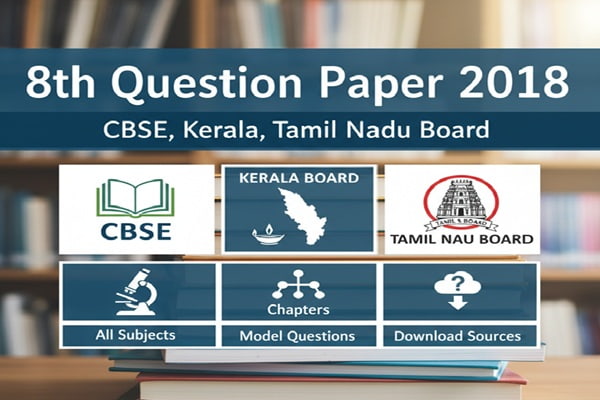
If you are searching for the 8th question paper from 2018, you already know the basic problem: you can find the link, but you cannot find the context. Download portals give you a PDF with no explanation of what board it belongs to, what exam type it was, which chapters it covers, or why a paper from 2018 is even worth practicing in 2025.
This guide fills every one of those gaps. The 8th question paper from 2018 is different things for different students. For a Kerala Board student, it is the Annual Examination 2017-18 conducted by the Department of General Education under SCERT guidelines. For a CBSE student, it is either the half-yearly or annual paper from the 2018-19 session. For a Tamil Nadu student, it is the First Term 2018 exam conducted under the Samacheer Kalvi system.
The 2018 papers are particularly significant because they are the last full-syllabus, unmodified Class 8 examination papers before the NCERT syllabus updates and COVID-19 disruptions changed the examination landscape. Practicing a 2018 paper gives you a clean benchmark for what a standard Class 8 exam looks like without any pandemic-era adjustments.
This guide covers CBSE, Kerala Board, Tamil Nadu, and KVS. For each board you will find which exam the 2018 paper represents, the complete subject list with chapters in scope, the paper format and marks distribution, model questions built on the 2018 pattern, and verified free sources to download every subject.
Why the 2018 Class 8 Question Paper Is Still the Right Paper to Practice
Students and parents often ask whether a paper from 2018 is too old to be useful for current preparation. The answer depends on how much the syllabus has changed since 2018. For most boards, the answer is: not much at the Class 8 level.
The NCERT Class 8 Science and Mathematics textbooks have not undergone fundamental chapter restructuring since 2018. The SCERT Kerala Class 8 textbooks had a significant revision starting from 2024-25 for some classes, but the 2018 paper still reflects the core concepts and question types that appear in current examinations. The Tamil Nadu Samacheer Kalvi term examination structure in use today is consistent with the 2018 pattern.
Most importantly, the 2018 papers are the last batch of full-syllabus, unmodified papers before pandemic-era disruptions changed how Class 8 examinations were conducted. Papers from 2020 to 2022 had reduced syllabi or modified formats. The 2018 paper gives you the complete, standard examination experience.
| Why 2018 Matters for Preparation Today | Details |
| Full-syllabus coverage | 2018 is the last year before COVID-19 caused widespread syllabus reductions. All chapters were tested with standard difficulty levels. |
| NCERT chapters unchanged | Class 8 NCERT Science and Maths chapters tested in 2018 are the same chapters in current CBSE papers. |
| Kerala SCERT chapters consistent | Core chapters in Physics, Chemistry, Biology, Maths, and Social Science from 2018 remain relevant to current Kerala Class 8 exams. |
| Tamil Nadu Samacheer pattern stable | The term examination format, section structure, and marks distribution in TN Class 8 have remained broadly consistent since 2018. |
| Well-documented answer keys | 2018 papers have official and teacher-prepared answer keys widely available, making evaluation straightforward. |
| Best available benchmark | Pre-pandemic, unmodified, full-syllabus paper with verified answer keys. No newer year offers all three simultaneously. |
Which Board Are You? Identifying Your 8th Question Paper 2018
Before downloading anything, confirm which board your school follows. A Kerala SCERT Class 8 Annual Exam paper from 2018 and a CBSE Class 8 Science paper from 2018-19 are completely different documents. Using the wrong paper misdirects your entire preparation.
| Board | Exam Type in 2018 | Subjects Covered | Marks |
| CBSE (school-level) | Half-yearly (Nov 2018) and Annual (Feb-Mar 2019) | All NCERT subjects: English, Hindi, Maths, Science, Social Science, Sanskrit/others | 60 to 80 marks per subject |
| KVS (Kendriya Vidyalaya) | Periodic Test 1, Periodic Test 2, Annual (2018-19) | Same NCERT subjects with KVS-specific format and three assessment tiers | PT: 40 marks, Annual: 80 marks |
| Kerala SCERT | Annual Exam 2017-18 (March-April 2018) | Malayalam/English, Maths, Basic Science, Social Science, Hindi, Arabic/Sanskrit | 60 written + 20 internal per subject |
| Tamil Nadu Samacheer Kalvi | First Term 2018 (Sept-Oct 2018) | Tamil, English, Maths, Science, Social Science | 55 to 100 marks depending on subject |
| AP State Board | SA1 (Oct 2018) and SA2 (Mar 2019) | Telugu/English, Hindi, Maths, Science, Social Studies | 80 written + 20 internal |
| Maharashtra Board | Half-yearly (Oct 2018) and Annual (Mar 2019) | All Balbharati subjects | 80 marks per subject |
This guide focuses on CBSE, KVS, Kerala, and Tamil Nadu in full depth as these are the most searched boards for 8th question paper 2018. AP students will find the CBSE section most applicable since both follow NCERT content.
Kerala Class 8 Annual Examination 2018: Complete Subject Guide
For Kerala Board students, the 2018 paper refers to the Annual Evaluation conducted in March-April 2018 for the 2017-18 academic year. This is a district-level common examination conducted by the Department of General Education under SCERT Kerala. The paper covers the full-year syllabus across all subjects.
The 2018 Kerala Class 8 Annual Exam papers are particularly well-documented. The Mathematics paper was prepared by Dr. V.S. RaveendraNath and includes 17 questions covering algebraic expressions, geometry, ratio and proportion, indices, and coordinate geometry. This paper and its answer key are available on Scribd. Additional subject papers are archived on Education Observer and Exam Winner.
Kerala Class 8 Annual Exam 2018: Subject Coverage and Format
| Subject | Chapters and Topics in Annual 2018 Paper |
| Mathematics (Annual 2018) | Algebraic expressions, Basic geometric shapes, Ratio and proportion, Profit and loss, Indices, Coordinate geometry. Paper prepared by Dr. V.S. RaveendraNath. 60 marks written. |
| Basic Science (Annual 2018) | Cell biology, Chemical reactions, Light and optics, Magnetic effects, Living world and classification, Human health and disease. 60 marks written. |
| Social Science (Annual 2018) | Physical features of India, Natural resources, The British period, Indian Constitution, Kerala geography and history. 60 marks written. |
| English (Annual 2018) | Reading comprehension, Writing skills (letter, report, paragraph), Grammar (tense, voice, transformation), Literature from SCERT textbook. 80 marks written. |
| Hindi (Annual 2018) | Reading passage, Grammar (vilom, paryayvachi, sandhi), Letter writing, Summary writing. 40 marks written. |
| Malayalam I / II (Annual 2018) | Prose comprehension, Grammar (sandhi, samasa), Essay/paragraph writing, Poetry appreciation. 80 marks (First Language) or 40 marks (Second Language). |
Kerala Class 8 2018 Paper Format
The Kerala Class 8 question paper follows an activity-based format that differs from the section-based format used by CBSE. In the 2018 Annual Exam, students were presented with activities numbered from 1 to 10 or 1 to 12, with instructions to attempt a specified number. This format rewards understanding over memorisation.
- Activity type 1: Short answer activities worth 1 to 2 marks. Tests definitions, identification, and basic recall.
- Activity type 2: Calculation or process activities worth 3 to 4 marks. Tests multi-step problem solving in Maths and Science.
- Activity type 3: Explanation or diagram activities worth 4 to 5 marks. Tests conceptual understanding and visual representation.
- Internal choice: Most activities in the 2018 Kerala paper offered choice between two questions of equal marks.
- Both English Medium and Malayalam Medium papers available: The 2018 Annual Exam papers are archived separately for each medium on Education Observer.
High-Marks Topics in Kerala Class 8 Annual 2018
- Mathematics: Algebraic operations (addition, subtraction, and multiplication of polynomials) consistently carry 6 to 8 marks in Kerala Class 8 Maths papers. Coordinate geometry (plotting points, finding midpoint, distance formula) appears in almost every annual paper with 4 to 5 marks.
- Basic Science: The Cell chapter and Chemical reactions chapter are the two highest-marks biology and chemistry topics. In 2018, the diagram of plant versus animal cell and balancing chemical equations each appeared as 4-mark activities.
- Social Science: Map-marking of India’s physical features and the Indian independence movement essay are consistent high-marks topics appearing in every Kerala Class 8 Social Science annual paper.
CBSE Class 8 Question Paper 2018-19: All Subjects
For CBSE students, the 2018 question paper typically refers to either the November-December 2018 half-yearly paper or the February-March 2019 annual paper from the 2018-19 academic session. These papers are school-set. There is no single national CBSE Class 8 paper. However, the chapter content, paper structure, and marks distribution are consistent across CBSE-affiliated schools.
CBSE Class 8 Subject-Wise Chapter Coverage in 2018-19
| Subject | Annual Exam Chapters (2018-19) | Key Questions |
| Mathematics | Rational numbers, Linear equations, Quadrilaterals, Squares and cubes, Algebraic expressions, Exponents, Mensuration, Data handling, Graphs | Algebraic expressions operations, Solving linear equations, Area and perimeter, Bar graph/pie chart drawing |
| Science | Crop production, Microorganisms, Coal and petroleum, Combustion, Conservation, Cell structure, Reproduction, Adolescence, Sound, Chemical effects, Natural phenomena | Cell diagram (plant vs animal), Metamorphosis stages, Balancing equations, Sound reflection |
| Social Science | Resources, Land, Soil, Water, Agriculture, Industries, Human resources, India after independence, Colonial period | Map of India (resources, industries), Colonial rule essay, Industries location questions |
| English | Literature from Honeydew and It So Happened readers, Writing section (letter, story, paragraph), Grammar (tenses, active/passive, reported speech) | Formal letter, Reading comprehension, Grammar transformation |
| Hindi | Vasant Bhag 3 and Durva Bhag 3 chapters, Vyakaran (grammar), Patra lekhan, Anuchchhed lekhan | Grammar fill-in, Muhavara usage, Letter writing |
CBSE Class 8 Annual Paper Structure (2018-19)
| Section | Format and Marks |
| Section A: 1-mark questions | Very short answer, MCQ, fill in blank, true or false. 6 to 10 questions. Tests recall and basic definitions. |
| Section B: 2-mark questions | Short answer requiring 2 to 3 sentences. 5 to 6 questions. Tests concept explanation. |
| Section C: 3-mark questions | Medium answer with explanation or diagram. 8 to 10 questions. Tests process understanding. |
| Section D: 4 to 5 mark questions | Long answer with multi-step solution or labelled diagram. 5 to 7 questions. Internal choice available. |
| Total | 60 to 80 marks depending on school and exam type. Duration 2.5 to 3 hours. |
High-Frequency Topics in CBSE Class 8 Papers from 2018-19
- Science: Cell structure diagram (plant and animal cell) appears in nearly every CBSE Class 8 Science annual paper. Microorganism uses, metamorphosis stages, and adolescence hormone questions are consistent across years.
- Mathematics: Linear equations in one variable (word problems and solution steps), algebraic expression operations (like terms, brackets), and mensuration (area, perimeter, volume) are the three most consistently tested topics.
- Social Science: Map-marking of India’s resources and industries is compulsory in most CBSE Class 8 Social Science papers. The British colonial impact and India’s resources are standard long-answer topics.
- English: Formal letter writing (to editor or principal) and reading comprehension passage questions appear in every CBSE Class 8 English paper with predictable formats.
KVS Class 8 Question Paper 2018: Periodic Tests and Annual Examination
Kendriya Vidyalaya schools use the same NCERT syllabus as CBSE but with a standardised KVS examination format. In the 2018-19 session, KVS conducted three assessments: Periodic Test 1 (July-August 2018), Periodic Test 2 (October-November 2018), and the Annual Examination (February-March 2019).
| KVS 2018-19 Assessment | Chapters Covered | Marks and Duration |
| Periodic Test 1 (August 2018) | First 3 to 4 chapters per subject. Science: Crop Production, Microorganisms, Coal and Petroleum. Maths: Rational Numbers, Linear Equations. | 40 marks, 1.5 hours per subject |
| Periodic Test 2 (November 2018) | Chapters 4 to 8 approximately. Science: Conservation, Cell Structure. Maths: Squares and Cubes, Algebraic Expressions, Visualising Solid Shapes. | 40 marks, 1.5 hours per subject |
| Annual Examination (February 2019) | Full year syllabus. All chapters from both Periodic Tests plus remaining chapters. | 80 marks, 3 hours per subject |
KVS released sample papers for each assessment type in 2018-19. The Periodic Test 2 sample papers (Sets 1, 2, and 3) for Class 8 are available from the KV DRDO Library resource portal, making them among the most useful KVS Class 8 papers from the 2018 period.
Tamil Nadu Class 8 Question Paper 2018: First Term Exam
For Tamil Nadu Samacheer Kalvi students, the 2018 question paper refers to the First Term Examination conducted in September-October 2018. This covers chapters from the first term portion of the Samacheer Kalvi textbooks. Padasalai.Net hosted Class 8 First Term 2018 answer keys with question papers for all subjects including the all-subjects Tamil medium compilation.
Tamil Nadu Class 8 First Term 2018 Paper Structure
| Section | Format in Tamil Nadu Class 8 First Term 2018 |
| Section I: Choose the Correct Answer | 5 MCQ of 1 mark each. Total: 5 marks. Tests basic concept identification. |
| Section II: Fill in the Blanks | 5 questions of 1 mark each. Total: 5 marks. Tests formula recall and definitions. |
| Section III: True or False | 5 questions of 1 mark each. Total: 5 marks. |
| Section IV: Match the Following | 5 pairs of 1 mark each. Total: 5 marks. |
| Section V: Short Answers (2 marks) | 8 questions, attempt 5. Total: 10 marks. |
| Section VI: Medium Answers (5 marks) | 8 questions, attempt 5. Total: 25 marks. |
| Section VII: Long Answers (8 marks) | 5 questions, attempt 2. Total: 16 marks. Internal choice in each question. |
| Grand Total | 71 marks. Duration: 3 hours. |
Tamil Nadu Class 8 First Term 2018 Chapter Coverage by Subject
| Subject | First Term 2018 Chapters |
| Science | Chapter 1: Measurement, Chapter 2: Force and Motion, Chapter 3: Matter around us, Chapter 4: Atomic Structure basics |
| Mathematics | Chapter 1: Rational Numbers, Chapter 2: Measurements, Chapter 3: Algebra, Chapter 4: Life Mathematics |
| Social Science | Chapter 1: Sources of History, Chapter 2: The Stone Age, Chapter 3: Ancient Civilisations, Chapter 4: India: Relief Features |
| Tamil | First term prose, grammar, poetry from Tamil textbook |
| English | Unit 1 and Unit 2 chapters from 8th Standard English reader, grammar section |
The Tamil Nadu Class 8 First Term 2018 paper is available in both English medium and Tamil medium. Padasalai.Net archives district-specific papers from Nagai, Tiruvannamalai, and other Tamil Nadu districts, each with answer keys prepared by local teachers.
Model Questions Based on the 8th Question Paper 2018 Pattern
The following questions are modelled on the actual question types, chapter content, and marks allocation observed across the 2018 Class 8 papers from Kerala and CBSE boards.
Mathematics: Model Questions (CBSE / Kerala 2018 Style)
| Q1. Simplify: (2x + 3)(3x – 5) – (x + 2)(2x – 1) (3 marks)
Step 1: Expand (2x + 3)(3x – 5) = 6x squared – 10x + 9x – 15 = 6x squared – x – 15 Step 2: Expand (x + 2)(2x – 1) = 2x squared – x + 4x – 2 = 2x squared + 3x – 2 Step 3: Subtract: (6x squared – x – 15) – (2x squared + 3x – 2) = 4x squared – 4x – 13
Q2. The length and breadth of a rectangular field are in the ratio 5:3. If the perimeter is 96 m, find the area. (4 marks) Let length = 5k and breadth = 3k Perimeter = 2(5k + 3k) = 16k = 96. So k = 6. Length = 30 m, Breadth = 18 m Area = 30 x 18 = 540 square metres
Q3. Evaluate: (125)^(2/3) + (64)^(1/2) (2 marks) (125)^(2/3) = (5 cubed)^(2/3) = 5 squared = 25 (64)^(1/2) = 8 Answer = 25 + 8 = 33 |
Science: Model Questions (CBSE 2018-19 Style)
| Q1. Name the cell organelle called the powerhouse of the cell. State its function. (2 marks)
Answer: Mitochondria is called the powerhouse of the cell. It produces energy in the form of ATP through the process of cellular respiration. This energy is used for all cellular activities.
Q2. State three differences between plant cells and animal cells. (3 marks) Plant Cell | Animal Cell Has a rigid cell wall made of cellulose | Does not have a cell wall Has chloroplasts for photosynthesis | Does not have chloroplasts Has a large central vacuole | Has small or no vacuoles
Q3. What is metamorphosis? Explain the life cycle of a butterfly with all four stages. (4 marks) Metamorphosis is the biological process of transformation from an immature form to an adult form in distinct stages. Stage 1 Egg: The adult butterfly lays eggs on leaves. Stage 2 Larva (Caterpillar): Egg hatches into a caterpillar which feeds on plant material. Stage 3 Pupa (Chrysalis): Caterpillar forms a protective case and undergoes internal body transformation. Stage 4 Adult Butterfly: Fully developed butterfly emerges from the pupal case.
Q4. Explain three methods of crop protection and pest control used by farmers. (3 marks) Method 1: Use of pesticides – Chemical sprays that kill insects and pests on crops. Method 2: Biological control – Using natural predators like ladybirds to control aphids. Method 3: Crop rotation – Growing different crops alternately in the same field to reduce pest build-up. |
Social Science: Model Questions (CBSE / Kerala 2018 Style)
| Q1. What is a biosphere reserve? Name any one biosphere reserve in India. (2 marks)
A biosphere reserve is a large protected area that conserves biodiversity as well as the traditional lifestyle of the local community within it. Example: Nilgiri Biosphere Reserve in South India.
Q2. Distinguish between natural resources and human-made resources with examples. (3 marks) Natural resources exist in nature without human intervention. Examples: Water, air, forests, minerals, sunlight. Human-made resources are created by humans using natural resources. Examples: Buildings, roads, machines, medicines. The key difference is that natural resources are gifts of nature while human-made resources are products of human knowledge and skill applied to natural materials.
Q3. Explain the causes and consequences of deforestation. (5 marks) Causes: Agricultural expansion, urbanisation, mining, industrial timber demand, firewood collection. Consequences: (1) Loss of biodiversity and extinction of species. (2) Soil erosion as tree roots no longer hold soil. (3) Disruption of the water cycle leading to reduced rainfall. (4) Increased carbon dioxide causing climate change. (5) Displacement of tribal communities dependent on forests. |
Subject-Wise Preparation Strategy Using the 2018 Class 8 Papers
Each subject in the Class 8 2018 question paper rewards a slightly different preparation approach. Here is what the papers show about how to prepare most efficiently for each subject.
Mathematics
The 2018 CBSE and Kerala Class 8 Maths papers both show a clear pattern: algebraic operations and mensuration carry the most Section C and D marks. Practice these two areas by solving from the question paper first, then checking your working step by step against the answer key. In both CBSE and Kerala boards, working steps carry marks. A correct final answer with no working shown earns partial marks at best.
Science
For CBSE Science, the Cell chapter and Microorganisms chapter together carry 10 to 12 marks in the annual paper. Both require memorised content (organelle names and functions, types of microorganisms) and the Cell chapter requires a labelled diagram. Practice drawing the cell diagram from memory until you can complete it with all labels in under three minutes. For Kerala Basic Science, the 2018 paper shows heavy emphasis on both Physics and Biology activities, so do not neglect the Physics portion.
Social Science
Map-marking is the most predictable scoring opportunity in Class 8 Social Science papers across all boards. The 2018 CBSE and Kerala papers both included map activities. Print a blank map of India and practice marking all the items that appeared in the 2018 paper and the two years following it. These include major rivers, mountain passes, industrial regions, and natural resource locations. Map marks are reliably available and reliably missed by students who have not practiced.
English
The 2018 CBSE Class 8 English annual paper shows that letter writing and reading comprehension together account for 25 to 30 marks. Letter writing topics in Class 8 revolve around a predictable set of themes: requesting leave, complaining about a problem, describing an experience. Practicing 8 to 10 letter-writing topics from previous year papers covers the full range of likely formats for the actual exam.
Common Mistakes Students Make When Using the 2018 Class 8 Papers
- Downloading the wrong board’s paper: A student from a CBSE school in Mumbai who downloads a Kerala Annual Exam 2018 paper is practicing for a completely different syllabus and format. Confirm board, year, and subject before downloading.
- Using 2018 papers from the wrong medium: Tamil Nadu and Kerala papers are available in both English and regional language mediums. The content is identical but the language of questions and expected answers is different. Answering a Tamil medium paper’s questions in English practice is misleading.
- Practicing without a timer: The 2018 papers were designed for a specific time limit. Reading through a paper over two hours is not the same as completing it in the allocated 2.5 or 3 hours. Time pressure is a separate skill that only timed practice builds.
- Treating model papers and previous year papers as identical: SCERT Kerala released model papers for 2018 before the actual exam. These are different from the actual 2017-18 Annual Exam paper. Both are useful but they are not the same document.
- Skipping diagram practice: The 2018 papers for Science required labelled diagrams worth 4 to 5 marks each. Students who study by reading textbook descriptions but never practice drawing and labelling from memory consistently lose these marks in exams.
- Not showing working steps in Mathematics: Both CBSE and Kerala Class 8 Maths 2018 papers award marks for each step of a multi-step solution, not just the final answer. A correct answer without working can earn as low as 1 out of 4 marks for a step-marked question.
Where to Download 8th Question Paper 2018 for Free: Verified Sources
All sources listed here provide free access. No subscription or payment is required for the papers described.
For Kerala Class 8 2018 Papers
- Scribd (scribd.com): The Kerala Class 8 Annual Exam 2018 Mathematics paper in English medium is directly available. Search ‘Kerala Class 8 Annual Exam Answer Key 2018 Maths EM’. Prepared by Dr. V.S. RaveendraNath. Contains 17 questions with step-by-step solutions.
- Education Observer (educationobserver.com): The most complete archive for Kerala Class 8 papers across all years. Forum threads for Class 8 Previous Year Question Papers contain papers from 2016 through 2024 including 2018 for all subjects in both English Medium and Malayalam Medium.
- Exam Winner (examwinner.com): Hosts Kerala Class 8 Previous Year Question Papers section with Annual Exam papers. Navigate to Class 8, then Previous Year Papers. Christmas Exam 2019 and earlier years are also archived.
- AglaSem Schools (schools.aglasem.com): Lists Kerala 8th Class Previous Year Question Papers including 2018 papers by year and subject with direct PDF download links.
- Spandanam News (spandanamnews.blogspot.com): A Kerala teacher-run blog with Class 8 question papers and model questions. Contains requests from teachers for model question papers and hosted several 2018 papers immediately after the exam.
For CBSE and KVS Class 8 2018-19 Papers
- StudiesToday (studiestoday.com): The largest CBSE Class 8 question paper archive. Papers are available by year, subject, and set. The 2018-19 session papers cover all main subjects. Answer keys included for most papers.
- LearnCBSE (learncbse.in): NCERT-based CBSE Class 8 papers with detailed solutions. Chapter-wise important questions derived from 2018 paper patterns are also available.
- KV DRDO Library (kvdrdolibrary.wordpress.com): Hosts KVS Periodic Test sample papers from 2018-19 for Class 8 including Sets 1, 2, and 3 for each subject. The most accurate source for KVS-format Class 8 papers from 2018.
- AECS Rawatbhata School (aecsrbt3.ac.in): An Atomic Energy Central School that publishes its Class 8 question papers from 2018-19 onward. These are KVS-pattern papers and among the most completely organised school-level Class 8 paper archives available online.
For Tamil Nadu Class 8 2018 Papers
- Net (padasalai.net): The 8th Standard Answer Key with Question Paper for First Term Exam 2018 is directly available. Navigate to 8th Standard, then First Term 2018. Both English medium and Tamil medium papers are hosted. District-specific papers from Nagai and Tiruvannamalai are listed.
- AglaSem Schools (schools.aglasem.com): Tamil Nadu 8th Class Question Papers section includes First Term 2018 and other term papers. Direct PDF download links available by year and subject.
- QB365 (qb365.in): Tamil Nadu Class 8 question bank with papers organised by term and year. Interactive practice format for 2018 content.
Frequently Asked Questions: 8th Question Paper 2018
Q1. Where can I download the 8th question paper 2018 for free?
For Kerala: Scribd (Class 8 Maths 2018 EM), Education Observer, Exam Winner, AglaSem Schools. For CBSE: StudiesToday, LearnCBSE, KV DRDO Library (KVS papers). For Tamil Nadu: Padasalai.Net (First Term 2018 with answer keys in both mediums). All sources are free. Always verify the board, year, and medium before downloading.
Q2. Is the 2018 Class 8 question paper still relevant for current exam preparation?
Yes. The NCERT Class 8 Science and Mathematics chapters have not fundamentally changed since 2018. The Kerala SCERT Class 8 core chapters and question format remain largely consistent. The 2018 paper is the last full-syllabus, unmodified Class 8 paper before pandemic disruptions, making it the most complete benchmark available. Answer keys are widely archived, which makes evaluation straightforward.
Q3. What is the difference between the Kerala Class 8 Annual 2018 paper and the CBSE Class 8 paper?
The Kerala Class 8 Annual 2018 paper is a district-level common exam set by SCERT Kerala, covering the full 2017-18 academic year syllabus from SCERT textbooks. The CBSE Class 8 paper is school-set, based on NCERT textbooks, and varies between schools. Kerala papers use an activity-based format. CBSE papers use a four-section format with fixed marks per section. Both are completely different documents with different chapters and question formats.
Q4. Which subjects are covered in the 8th question paper 2018?
For Kerala Annual 2018: Mathematics, Basic Science, Social Science, English, Malayalam (First or Second Language), Hindi, Arabic or Sanskrit. For CBSE 2018-19: Mathematics, Science, Social Science, English, Hindi, and additional language subjects. For Tamil Nadu First Term 2018: Mathematics, Science, Social Science, Tamil, and English. Papers for each subject are separate documents.
Q5. Are answer keys available for the 8th question paper 2018?
Yes. For Kerala: The Mathematics 2018 Annual paper answer key is available on Scribd. Education Observer has answer keys for other subjects. For CBSE: Answer keys accompany most school-level papers on StudiesToday and KV DRDO Library. For Tamil Nadu: Padasalai.Net provides teacher-prepared answer keys for First Term 2018 papers in both mediums. Answer keys are available for all three boards at no cost.
Q6. What chapters are covered in the Kerala Class 8 Annual Exam 2018 Mathematics paper?
The Kerala Class 8 Annual Exam 2018 Mathematics paper covers algebraic expressions and operations, properties of basic geometric shapes, ratio and proportion, profit and loss, indices and powers, and coordinate geometry. It contains 17 questions and was prepared by Dr. V.S. RaveendraNath. The paper is available on Scribd with a complete step-by-step answer key.
Q7. How is the Tamil Nadu Class 8 First Term 2018 paper structured?
The Tamil Nadu Class 8 First Term 2018 paper follows a seven-section format with 71 marks total. Section I through IV are objective questions (MCQ, fill in blank, true or false, matching) worth 1 mark each and carry 20 marks total. Sections V, VI, and VII are short, medium, and long answers with internal choice carrying 51 marks. Students attempt specified numbers from each section rather than all questions.
Q8. What is the difference between a model question paper and a previous year paper for Class 8?
A model question paper is released by the board before the exam to show the expected format and difficulty level. It is a benchmark for what the paper should look like. A previous year paper is the actual paper from a real examination. Both are useful but for different purposes. Model papers tell you the current format; previous year papers show you what actually appeared in real exams. The 2018 papers are previous year papers, not model papers.
Q9. How many marks does the Kerala Class 8 Annual Exam carry per subject?
For Kerala Class 8 Annual Exam, main subjects like Mathematics, Basic Science, Social Science, and languages carry 60 marks written plus 20 marks Continuous Evaluation (CE) for a total of 80 marks per subject. English as first language and Malayalam carry 80 marks written plus 20 marks CE for a total of 100 marks. The 2018 Annual Exam followed the same marks structure.
Q10. Should I practice the 2018 paper in my exam medium or in English?
Always practice in your exam medium. If you appear for the Malayalam medium paper, practice in Malayalam. If you appear for the Tamil medium paper, practice in Tamil. Practicing in a different language gives misleading feedback on your actual preparation. The Kerala and Tamil Nadu 2018 papers are available in both English and regional language mediums from Education Observer and Padasalai.Net respectively.
Conclusion: The Right Paper, Used the Right Way
The 8th question paper from 2018 is more than a PDF. It is a documented record of exactly what a standard Class 8 examination looked like at its most complete, before any pandemic adjustments, syllabus reductions, or format modifications.
Use it correctly: confirm your board, download the subject paper that matches your school’s syllabus, set a timer for the actual exam duration, attempt every question by hand, and evaluate your work section by section against the answer key.
That process, done honestly with two or three papers, tells you more about your actual exam readiness than weeks of passive revision. The paper reveals the gaps. What you do with that information determines your result.