
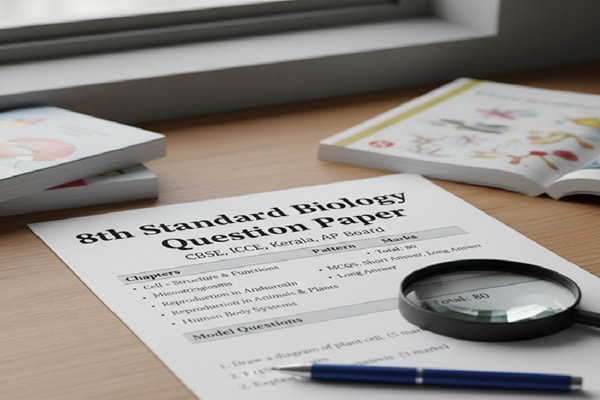
The first thing students searching for the 8th standard biology question paper need to understand is this: there is no single paper. The biology question paper for Class 8 looks completely different depending on whether you follow CBSE, ICSE, Kerala Board, AP State Board, or Telangana Board. Using the wrong paper wastes preparation time. Understanding which paper is yours before downloading is the most important step.
Every top-ranking website for this keyword either pushes you to log in and download without explaining anything, or gives you a Kerala Onam exam paper link when you might be from a CBSE school in Chennai. Neither serves you well.
This guide is different. It covers the 8th standard biology question paper for all four major boards in one place. For each board you will find the exact chapters tested, how many marks biology contributes, what the paper sections look like, the question types that appear most often, model questions with worked answers at every marks level, which diagrams are most frequently asked, common mistakes that cost students marks, and a full list of verified free download sources.
Step One Before Downloading Any Paper: Identify Your Board
This section alone makes this guide more useful than any other page on this topic. Every board gives students a completely different biology experience at Class 8, and the question paper reflects that. Here is a side-by-side comparison so you can immediately identify which paper applies to you.
| Board | Biology Format | Textbook | Total Marks |
| CBSE | Part of Science paper (biology = 25 to 30 of 80 marks) | NCERT Science Class 8 | 80 marks Science paper |
| ICSE | Standalone Biology subject | Ratna Sagar / Selina Concise Biology | 80 marks standalone paper |
| Kerala SCERT | Part of Basic Science (BS) paper | SCERT Kerala Class 8 Science | 60 marks written + 20 internal |
| AP State Board | Part of Science, tested in FA1, FA2, SA1, SA2 | AP SCERT Class 8 Science | FA: 20 marks, SA: 80 marks |
| TS State Board | Part of Science, tested in FA and SA exams | TS SCERT Class 8 Science | FA: 20 marks, SA: 80 marks |
| Maharashtra Board | Part of Science and Technology paper | Balbharati Class 8 Science | 80 marks combined |
The four sections below cover CBSE, ICSE, Kerala, and AP and TS in full detail since these account for the majority of students searching for this paper in India.
CBSE 8th Standard Biology Question Paper: Chapters and Paper Pattern
For CBSE students, Class 8 biology is not examined on its own. It sits inside the Science paper as a set of chapters. The annual Science exam carries 80 marks written plus 20 marks from practicals and internal assessment. Biology chapters typically account for 25 to 30 of those 80 marks, depending on how your school structures the paper.
Because CBSE does not issue a standardised Class 8 paper nationally, each affiliated school designs its own. However, the chapter content and paper structure are remarkably consistent across CBSE schools. Here is what those papers look like.
CBSE Class 8 Biology Chapters and Their Marks Contribution
| Chapter (NCERT Science Class 8) | Core Topics | Typical Marks |
| Ch 1: Crop Production and Management | Kharif and rabi crops, irrigation methods, fertilisers vs manure, weed control, pest control, food storage and animal husbandry | 3 to 4 marks |
| Ch 2: Microorganisms: Friend and Foe | Types of microorganisms, bacteria, fungi, viruses, protozoa, useful microbes in food and medicine, nitrogen fixation, diseases caused, food preservation, Pasteur and Fleming | 5 to 6 marks |
| Ch 5: Conservation of Plants and Animals | Deforestation causes and effects, biosphere reserve, national park, wildlife sanctuary, Red Data Book, endemic species, migration, reforestation | 4 to 5 marks |
| Ch 7: Cell: Structure and Functions | Cell theory, discovery of cell, plant cell vs animal cell, organelles and functions, unicellular and multicellular, prokaryotic and eukaryotic | 5 to 6 marks |
| Ch 9: Reproduction in Animals | Sexual and asexual reproduction, internal and external fertilisation, viviparous and oviparous, metamorphosis stages, budding in Hydra, binary fission in Amoeba | 4 to 5 marks |
| Ch 10: Reaching the Age of Adolescence | Puberty changes, secondary sexual characters, hormones, endocrine glands, testosterone, estrogen, pituitary, balanced diet for adolescents | 3 to 4 marks |
CBSE Class 8 Science Paper Section Structure
| Section | Biology Content in Each Section |
| Section A: 1-mark questions | Very short answer, MCQ, fill in blank, true or false. Biology typically contributes 3 to 4 questions. Tests definitions and recall. |
| Section B: 2-mark questions | Short answer requiring 2 to 3 sentences. Biology contributes 2 to 3 questions. Tests explanation of concepts. |
| Section C: 3-mark questions | Medium answer requiring explanation or a diagram. Biology contributes 3 to 4 questions. Tests process understanding. |
| Section D: 4 to 5 mark questions | Long answer with labelled diagram or multi-step explanation. Biology contributes 2 questions. Tests depth of knowledge. |
Which CBSE Biology Topics Appear Most Often
- Cell: Structure and Functions is the highest-scoring biology chapter. A draw-and-label question for either an animal cell or plant cell appears in nearly every CBSE Class 8 Science paper. The differences between plant and animal cells is a standard 3-mark question.
- Microorganisms covers the widest range of question types: 1-mark definitions (who discovered penicillin), 2-mark uses (two uses of bacteria in food), 3-mark disease tables (name disease, causative organism, preventive measure), and sometimes a short 4-mark explanation.
- Reproduction in Animals: Metamorphosis stages and the difference between viviparous and oviparous are consistent 2 to 3 mark questions across schools.
- Adolescence chapter: Gland-hormone-function questions appear as matching or short-answer in most CBSE papers. Often a passage-based or case-study format in more recent papers.
- Conservation: Definition questions for biosphere reserve, national park, and wildlife sanctuary appear as 1-mark questions. Consequences of deforestation is a reliable 3-mark question.
ICSE 8th Standard Biology Question Paper: Standalone Subject, Greater Depth
ICSE treats Biology as a completely separate subject at Class 8. This is the single biggest structural difference from CBSE. The ICSE Class 8 Biology paper is 80 marks, runs for 2 to 2.5 hours, and covers ten chapters drawn from the Ratna Sagar or Selina Concise Biology textbooks. This level of depth is closer to what CBSE covers in Class 10 Science.
ICSE Class 8 Biology: All Ten Chapters with Key Topics
| Chapter | Key Topics and Exam Focus |
| 1. Transport of Food and Minerals in Plants | Xylem transports water and minerals, phloem transports food. Transpiration definition, significance, and factors. Osmosis. Differences between xylem and phloem. |
| 2. Reproduction in Plants | Vegetative propagation: types and examples. Parts of a flower and their functions. Pollination types (self and cross). Fertilisation. Seed dispersal methods. |
| 3. Respiration in Plants | Aerobic and anaerobic respiration with equations. Gaseous exchange through stomata. Factors affecting respiration rate. |
| 4. The Nervous System | Neuron structure: cyton, dendrites, axon, myelin sheath. Types of neurons. Reflex arc. Functions of cerebrum, cerebellum, medulla. Five sense organs. |
| 5. The Endocrine System | Endocrine glands and their hormones. Pituitary (master gland), thyroid (thyroxine), adrenal (adrenaline), pancreas (insulin and glucagon), gonads. Feedback mechanism. Diabetes. |
| 6. The Excretory System | Organs of excretion. Kidney structure: cortex, medulla, pelvis. Nephron structure and urine formation in three steps. Dialysis. Role of skin and lungs in excretion. |
| 7. The Reproductive System | Male and female reproductive systems with diagrams. Fertilisation and implantation. Placenta functions. Embryo development. Menstrual cycle. |
| 8. Food and Nutrition | Macronutrients and micronutrients. Balanced diet. Deficiency diseases: kwashiorkor, marasmus, rickets, scurvy, night blindness. Food adulteration. |
| 9. Diseases and First Aid | Communicable and non-communicable diseases. Bacteria and virus-caused diseases. Prevention and treatment. Basic first aid for burns, fractures, bleeding. |
| 10. Health and Hygiene | Personal hygiene. Environmental health. Immunisation and common vaccines. Water purification methods. |
ICSE 8th Standard Biology Paper Pattern
| Section | Format and Marks |
| Section A: Objective Questions | 20 marks. MCQ (5 marks), True or False (5 marks), Fill in the Blank (5 marks), Match the Column (5 marks). No internal choice. Tests recall and identification. |
| Section B: Short Answer Questions | 30 marks. 2 to 3 marks per question. Requires 3 to 5 clear sentences or a labelled diagram. Tests concept explanation. |
| Section C: Long Answer Questions | 30 marks. 5 to 6 marks per question. Requires detailed explanation with labelled diagrams. Internal choice available in most questions. |
| Total Written Marks | 80 marks. Duration: 2 to 2.5 hours. |
ICSE Chapter-Wise Marks Weightage Analysis
| Chapter | Typical Marks in ICSE Class 8 Biology Paper |
| The Nervous System | 10 to 12 marks. Neuron diagram is almost always compulsory. Reflex arc and brain region functions are standard long-answer topics. |
| Reproduction (Plants and Animals) | 10 to 12 marks combined. Flower diagram with labels, fertilisation explanation, vegetative propagation table. |
| The Excretory System | 8 to 10 marks. Kidney cross-section with nephron labels. Urine formation three-step explanation. |
| The Endocrine System | 6 to 8 marks. Gland-hormone-function matching or table. Diabetes short answer. |
| Transport of Food and Minerals in Plants | 6 to 8 marks. Xylem vs phloem differences. Transpiration pull explanation. |
| Food and Nutrition | 4 to 5 marks. Deficiency disease table. Balanced diet description. |
| Diseases and First Aid | 4 to 5 marks. Communicable vs non-communicable. One disease explained in detail. |
| Health and Hygiene and Respiration | 4 to 6 marks combined. Aerobic vs anaerobic equation. Vaccine types. |
Kerala Board 8th Standard Biology Question Paper: Basic Science Format
For students in Kerala, biology does not appear as a separate subject at Class 8. It is part of the Basic Science paper which integrates Physics, Chemistry, and Biology. Two major terminal examinations are held each year: the Onam Exam in September (First Term) and the Christmas Exam in December (Second Term). The Annual Exam in March covers all three terms.
The Kerala SCERT Class 8 Basic Science paper follows an activity-based format that is structurally different from CBSE and ICSE. Students are given 8 to 10 activities and asked to attempt any 6 or 7. The biology portion of the paper covers approximately 20 to 25 marks of the 60-mark written total.
Kerala Class 8 Biology Chapters by Exam Term
| Exam Term | Biology Chapters Covered | Key Topics |
| First Term (Onam Exam) | Cell: The Basic Unit of Life, Microorganisms, Photosynthesis and Respiration | Cell theory, organelles, plant vs animal cell, bacteria types, useful and harmful microbes, photosynthesis equation, conditions |
| Second Term (Christmas Exam) | Heredity and Variation, Reproduction, Ecosystem | Mendel’s laws, dominant and recessive traits, asexual and sexual reproduction, vegetative propagation, food chains, ecological balance |
| Annual Exam | All chapters from all three terms | Full syllabus integration. Biology activities from all terms in scope. |
What Makes Kerala Class 8 Biology Papers Unique
- Activity-based question design: Instead of ‘list three differences between plant and animal cells’, the question might give a scenario or partially completed diagram and ask students to complete it, explain a process, or predict an outcome. This tests understanding rather than memorisation.
- Observation and inference style: A common activity type gives students a diagram of an experiment or process and asks them to state what they observe and what conclusion can be drawn.
- Internal choice: Students choose which activities to attempt. This means selecting activities in subjects you have prepared best for increases your score. Students who choose all ten activities and rush through them often score lower than students who carefully attempt only the required seven.
- Language options: The Basic Science paper is available in both English Medium and Malayalam Medium. The content and marks are identical but the language of questions and expected answers differs. Both versions are archived separately on Education Observer and Exam Winner.
- Answer keys available: Official answer keys or SCERT evaluation guidelines are published after each Onam and Christmas exam and are available on Education Observer and Exam Winner.
AP and Telangana 8th Standard Biology Question Paper: FA and SA Exams
Students in Andhra Pradesh and Telangana follow a formative and summative assessment model for Class 8. Biology is part of the combined Science paper and is tested four times per year: FA1, FA2, SA1, and SA2.
The FA (Formative Assessment) papers carry 20 marks each and cover a smaller portion of the syllabus. The SA (Summative Assessment) papers carry 80 marks and cover the full semester syllabus. For most students searching for the 8th standard biology question paper in AP or TS, the SA1 and SA2 papers are the most relevant.
| Exam Type | Biology Coverage | Source |
| FA1 (July-August) | Chapters 1 to 3: Microorganisms, Crop Production, Cell basics. 20 marks total. Biology contributes 5 to 8 marks. | Amaravathi Teacher, individual school websites |
| FA2 (October-November) | Chapters 4 to 6: Cell in detail, Conservation, Reproduction. 20 marks. Biology contributes 5 to 8 marks. | Amaravathi Teacher, school websites |
| SA1 (November-December) | Chapters 1 to 8 approximately. 80 marks. Biology contributes 25 to 30 marks. | Manabadi.co.in, BSE Andhra Pradesh |
| SA2 (March) | Full year syllabus. 80 marks. Biology contributes 25 to 30 marks. | Manabadi.co.in, BSE Andhra Pradesh |
The AP and TS Class 8 Biology chapters closely follow NCERT content with state-specific examples, particularly in chapters on conservation and local ecosystems. Telugu medium and English medium papers are both available from Manabadi and Amaravathi Teacher websites.
Model Questions from the 8th Standard Biology Question Paper
The questions below are built from the actual paper format, marks allocation, and expected answer depth observed across CBSE and ICSE Class 8 biology question papers. Practicing these builds real exam readiness.
1-Mark Questions
| Q1. Who discovered the cell?
Answer: Robert Hooke (1665)
Q2. Name the powerhouse of the cell. Answer: Mitochondria
Q3. Which gas is released during photosynthesis? Answer: Oxygen
Q4. Name the hormone secreted by the islets of Langerhans in the pancreas. Answer: Insulin (and glucagon)
Q5. Define metamorphosis. Answer: Metamorphosis is the transformation process by which a larva changes into an adult through distinct developmental stages.
Q6. Which book records information about endangered plants and animals? Answer: Red Data Book
Q7. Name the process by which Amoeba reproduces. Answer: Binary fission |
2-Mark Questions
| Q1. Differentiate between viviparous and oviparous animals. Give one example of each. (2 marks)
Answer: Viviparous animals give birth to live young ones after development inside the mother’s body. Example: Human beings, cows. Oviparous animals lay eggs from which the young ones hatch. Example: Hen, frog, butterfly.
Q2. What is a biosphere reserve? Name any one biosphere reserve in India. (2 marks) Answer: A biosphere reserve is a large protected area that conserves both biodiversity and the traditional lifestyle of local communities living within it. Example: Nilgiri Biosphere Reserve in South India.
Q3. State two differences between xylem and phloem. (2 marks) Answer: Xylem transports water and dissolved minerals from roots to all parts of the plant. Phloem transports food (prepared by photosynthesis) from leaves to all parts of the plant. Xylem consists mainly of dead cells while phloem consists of living cells. |
3-Mark Questions
| Q1. State three differences between plant cells and animal cells. (3 marks)
Plant Cell vs Animal Cell: 1. Has a cell wall made of cellulose | Does not have a cell wall 2. Has chloroplasts for photosynthesis | Does not have chloroplasts 3. Has a large central vacuole | Has small vacuoles or none
Q2. Explain the stages of metamorphosis in a butterfly with a diagram. (3 marks) Answer: Butterflies undergo complete metamorphosis with four distinct stages. Stage 1 Egg: Laid on leaves by adult butterfly. Stage 2 Larva (Caterpillar): Hatches from egg, feeds on plant material, grows rapidly. Stage 3 Pupa (Chrysalis): Larva forms a protective case around itself and undergoes internal transformation. Stage 4 Adult Butterfly: Fully formed butterfly emerges from the pupal case.
Q3. Name any three deficiency diseases, their causes, and the food sources that prevent them. (3 marks) Answer: (1) Night blindness: Caused by Vitamin A deficiency. Prevented by eating carrots, leafy vegetables, dairy. (2) Scurvy: Caused by Vitamin C deficiency. Prevented by citrus fruits, guava, amla. (3) Rickets: Caused by Vitamin D or calcium deficiency. Prevented by sunlight exposure, milk, fish liver oil. |
5-Mark Questions with Diagrams (ICSE Level)
| Q1. Draw a labelled diagram of a neuron. Explain how a reflex action takes place. (5 marks)
Diagram must include: Cell body (cyton), Dendrites, Axon, Myelin sheath, Schwann cells, Axon terminals, Node of Ranvier
Reflex arc explanation: Step 1: A stimulus (heat, sharp object) is detected by a receptor in the skin. Step 2: Sensory neuron carries the nerve impulse to the spinal cord. Step 3: A relay (interneuron) in the spinal cord connects the sensory to the motor neuron. Step 4: Motor neuron carries impulse to the effector (muscle). Step 5: The muscle responds (effector action, e.g., withdrawing hand from hot object). Note: The brain is informed only after the reflex has occurred. This makes reflex actions fast and involuntary.
Q2. With a labelled diagram, explain the structure of the kidney and describe the three steps of urine formation. (5 marks)
Diagram must include: Renal cortex, Renal medulla, Renal pelvis, Ureter, Renal artery, Renal vein, Nephron (labeled separately)
Urine formation (three steps): Step 1 Ultrafiltration: Blood enters glomerulus under high pressure. Small molecules (water, glucose, urea, salts, amino acids) filter into Bowman’s capsule forming glomerular filtrate. Step 2 Selective Reabsorption: As filtrate travels through tubules, useful substances (glucose, amino acids, water, salts) are reabsorbed back into surrounding blood capillaries. Step 3 Tubular Secretion: Remaining waste (urea, excess salts, uric acid) is concentrated and passed through collecting duct into renal pelvis as urine, then to ureter. |
Diagram Questions in the 8th Standard Biology Paper: What to Draw and How
Diagram questions are where prepared students earn guaranteed marks and underprepared students leave marks on the table. Based on analysis of CBSE and ICSE Class 8 biology question papers, these are the diagrams that appear most frequently and the marks they typically carry.
| Diagram | Board Where It Appears | Marks Allocated |
| Animal cell with all organelle labels | CBSE Section D, ICSE Section C | 4 to 5 marks |
| Plant cell with all organelle labels | CBSE Section D, ICSE Section C | 4 to 5 marks |
| Structure of a neuron (all labels) | ICSE Section C (mandatory) | 4 to 5 marks |
| Kidney cross-section with nephron | ICSE Section C | 4 to 5 marks |
| Male and female reproductive systems | ICSE Section C | 4 to 5 marks each |
| Life cycle of a butterfly or frog | CBSE Section C, ICSE Section B | 3 to 4 marks |
| Parts of a flower (stamen, pistil, etc.) | CBSE Section B, ICSE Section B | 2 to 3 marks |
| Binary fission in Amoeba | CBSE Section C | 2 to 3 marks |
Five Techniques for Scoring Full Marks on Diagram Questions
- Always draw in pencil before tracing. Biology diagrams drawn in pen with corrections look messy and lose presentation marks in evaluation.
- Label every part the question specifically asks for. A neuron diagram missing the myelin sheath label loses those marks even if everything else is perfect.
- Use a ruler for label lines pointing to parts. Freehand lines can point to the wrong part under exam pressure, which creates ambiguity.
- Maintain proportions. Drawing a nucleus the size of the entire cell signals to the examiner that you do not understand the structure. Proportions communicate biological understanding.
- Write the diagram title above it. Even when not explicitly asked, a titled and neatly drawn diagram earns full presentation marks and reflects exam discipline.
Common Mistakes Students Make in the 8th Standard Biology Exam
These mistakes appear repeatedly in Class 8 biology answer sheets and cost students marks they should have kept.
- Confusing xylem and phloem: Xylem transports water and minerals upward from roots. Phloem transports food from leaves downward. This confusion appears in at least one-third of ICSE Section B answers on this topic. Write this difference as a mnemonic: Xylem carries water eXternally from roots; Phloem carries food Products from leaves.
- Drawing a plant cell but labelling it as an animal cell (or vice versa): The three elements that distinguish the two are the cell wall, chloroplasts, and large central vacuole. If your diagram has all three, label it as a plant cell. If it has none, label it as an animal cell. Mislabelling a correctly drawn diagram loses the full diagram marks.
- Writing incomplete hormone answers: ‘Insulin controls blood sugar’ earns 1 mark. The complete answer is: ‘Insulin is produced by the islets of Langerhans in the pancreas and lowers blood glucose levels by stimulating body cells to absorb glucose from the blood.’ The second version earns 2 marks.
- Giving only three metamorphosis stages instead of four: Egg, larva, and adult is incorrect. The pupa (chrysalis or cocoon) is the stage most commonly missed. It always earns a separate mark in CBSE papers.
- Attempting all activities in Kerala papers instead of the specified number: Kerala SCERT papers specify how many activities to attempt. Attempting extras wastes time. The examiner evaluates only the required number.
- Writing single-sentence answers for 3-mark questions: Three marks means three distinct and separate points. One comprehensive sentence earns 1 mark at most, regardless of how accurate it is.
- Not verifying that diagram labels match the question: If the question asks you to label ‘any four organelles’, check before submission that you have labelled exactly four, with correct spellings. Missing labels and incorrect spellings both reduce marks.
Also Read : 9th Standard Question Paper 2018 – All Boards, All Subjects | PDF Download Guide
How to Use the 8th Standard Biology Question Paper for Exam Preparation
There is a difference between students who download a question paper and feel prepared, and students who use it to actually become prepared. The difference is in how they practice. Reading through a paper is not the same as writing answers under time pressure. Here is a preparation plan that works.
Four-Week Preparation Plan
- Week 1: Complete your textbook. For CBSE, read all six biology chapters in NCERT Science and complete the end-of-chapter exercises. For ICSE, read all ten chapters in your school textbook. Do not attempt any question paper yet. Papers reveal gaps in knowledge, they do not fill them.
- Week 2: Download one previous year or model paper for your board. Read through it carefully without attempting. Identify which chapters each question comes from. Note which sections carry the most biology marks. This builds your preparation map.
- Week 3: Sit down with a pen and paper and attempt the full paper under timed conditions. Set an alarm. Close your textbook. Write every answer as if it is the actual exam. For diagrams, draw in pencil. For 3-mark and 5-mark answers, write structured points.
- Week 4: Evaluate your paper against the answer key. Be strict. For each question you answered incorrectly or incompletely, write down exactly what information was missing. Identify your three weakest topics. Spend the last week revising only those three. Attempting one more model paper in the final days confirms your improvement.
Where to Download the 8th Standard Biology Question Paper for Free
Every source listed here is free. No payment or subscription is required for the papers described.
For CBSE Class 8 Biology Papers
- StudiesToday (studiestoday.com): The most comprehensive CBSE Class 8 Science paper archive. Papers are organised by year, set, and school. Includes both mid-term and annual papers. Answer keys are provided for most papers.
- LearnCBSE (learncbse.in): NCERT-aligned CBSE Class 8 Science question papers with detailed solutions. Particularly strong on chapter-wise important questions for each biology topic.
- CBSE Academic Portal (cbseacademic.nic.in): Official source for CBSE sample question papers released annually before the exam session. The official paper pattern and marking scheme are published here.
- Your school’s question paper archive: The most accurate source for CBSE students. Schools retain papers from previous sessions. The biology questions your school asked in previous years reflect how your school interprets the CBSE guidelines.
For ICSE Class 8 Biology Papers
- SelfStudys (selfstudys.com): Hosts ICSE Class 8 Biology sample papers with answers organised by chapter and year. Papers align with Selina and Ratna Sagar textbook content.
- Extramarks (extramarks.com): Provides ICSE Class 8 Biology question papers from multiple years with detailed solutions and chapter-wise question sets.
- KnowledgeBoat (knowledgeboat.com): ICSE Class 8 Biology test papers specifically aligned with the Ratna Sagar Living Science textbook used by most ICSE schools. This is the most textbook-accurate source for ICSE Class 8 Biology practice.
- Your school biology department: ICSE schools set their own papers. The past papers from your own school, available from your biology teacher, are the single most predictive resource for your upcoming exam.
For Kerala Board Class 8 Biology (Basic Science) Papers
- Education Observer (educationobserver.com): The most complete archive for Kerala SCERT Class 8 biology papers. The forum thread for ‘Kerala 8th std First Term Previous Year Question Papers with Answer Keys Biology’ contains Onam exam papers from 2016 through 2024. Christmas exam papers are archived in a separate thread. Both English Medium and Malayalam Medium versions are available.
- Exam Winner (examwinner.com): Hosts Class 8 Previous Year Question Papers including Onam and Christmas exam papers for Basic Science with answer keys. Navigate to Class 8, then PYQ section.
- AglaSem Schools (schools.aglasem.com): Lists Kerala Board Class 8 Biology Onam Exam Question Papers by year with direct PDF download links. Updated annually after each exam.
For AP and Telangana Board Class 8 Biology Papers
- Amaravathi Teacher (amaravathiteacher.com): Hosts AP Class 8 Biology FA1 and FA2 model question papers with solutions. Updated for each academic year. Covers both Telugu and English medium papers.
- Manabadi (manabadi.co.in): The most complete archive for AP State Syllabus Class 8 Biology papers including SA1 and SA2 previous year papers with answer keys.
- BSE Telangana (bse.telangana.gov.in): Official source for TS board model papers and previous year Science papers for Class 8.
Frequently Asked Questions: 8th Standard Biology Question Paper
Q1. Is biology a separate subject in 8th standard or part of Science?
It depends on your board. Under CBSE, biology chapters are part of the integrated Science paper and contribute 25 to 30 marks of an 80-mark paper. Under ICSE, Biology is a completely separate 80-mark subject with its own paper and ten full chapters. Under Kerala Board, biology is part of the Basic Science paper. Under AP and TS boards, biology is part of the combined Science paper tested through FA and SA examinations.
Q2. How many marks does biology carry in the CBSE Class 8 Science paper?
In the CBSE Class 8 Science annual exam (80 marks written), biology chapters typically account for 25 to 30 marks. This comes from six biology chapters in NCERT: Crop Production, Microorganisms, Conservation, Cell Structure, Reproduction in Animals, and Adolescence. The exact marks vary by school since each CBSE-affiliated school designs its own paper.
Q3. Which chapter carries the most marks in the 8th standard biology paper?
For CBSE students, Cell Structure and Functions consistently carries the highest biology marks (5 to 6 marks) because it includes a diagram question. For ICSE students, the Nervous System chapter carries 10 to 12 marks and is the single highest-weighted chapter, followed by the Reproduction chapters at 10 to 12 marks combined. For Kerala Board, the Cell chapter and Reproduction chapter carry the most marks.
Q4. What diagrams should I practice for the 8th standard biology paper?
For CBSE: Animal cell, plant cell, life cycle of a butterfly or frog, parts of a flower. For ICSE: Neuron structure, kidney cross-section with nephron, male reproductive system, female reproductive system, flower cross-section. For Kerala: Cell structure comparison diagram, photosynthesis process diagram, food chain diagram. Practice each from memory without referencing the textbook until you can complete and label each one correctly in under three minutes.
Q5. Where can I download the 8th standard biology question paper for free?
For CBSE: StudiesToday, LearnCBSE, CBSE Academic Portal. For ICSE: SelfStudys, Extramarks, KnowledgeBoat. For Kerala Board: Education Observer forum thread, Exam Winner, AglaSem Schools. For AP and TS boards: Amaravathi Teacher (FA papers), Manabadi (SA papers), BSE Telangana official website.
Q6. How is ICSE Class 8 Biology different from CBSE Class 8 Science biology?
ICSE Class 8 Biology is a standalone 80-mark subject covering ten chapters including the nervous system, endocrine system, excretory system, and reproductive system. These topics are covered in CBSE only at Class 10. CBSE covers six biology chapters within a combined Science paper worth 25 to 30 biology marks. ICSE requires longer written answers, more diagrams, and more precise scientific vocabulary. The difficulty level of ICSE Class 8 Biology is comparable to CBSE Class 10 Science biology content.
Q7. Are answer keys available for the 8th standard biology question paper?
Yes. For CBSE: Answer keys accompany most school-level papers on StudiesToday and Scribd. For ICSE: SelfStudys, Extramarks, and KnowledgeBoat provide solution guides. For Kerala Board: Education Observer and Exam Winner publish official answer keys for Onam and Christmas exam papers immediately after each exam. For AP and TS: Amaravathi Teacher provides FA answer keys, Manabadi provides SA answer keys.
Q8. What is the Kerala Board 8th standard Biology paper format?
The Kerala SCERT Class 8 Basic Science paper uses an activity-based format. Students are presented with 8 to 10 activities and required to attempt a specified number (usually 6 or 7). Each activity includes a mix of question types: short answers, observation-based questions, diagrams to label, and scenario-based reasoning questions. The paper is 60 marks written plus 20 marks internal assessment. Onam exam papers cover first-term biology chapters; Christmas exam papers cover second-term chapters.
Q9. What is the passing mark for 8th standard biology?
For CBSE, the passing requirement is 33 percent of total Science paper marks. For an 80-mark paper, this means 27 marks from the written exam. For ICSE, passing Biology requires 33 percent of 80 marks, which is approximately 27 marks. For Kerala Board, 33 percent of written marks per subject is required. For AP and TS, passing requires 35 percent of total marks. Since Class 8 is not a public board examination, individual schools may apply additional internal passing criteria.
Q10. How should I prepare diagrams for the ICSE 8th standard biology exam?
Start by listing all required diagrams from your ICSE textbook chapters. Practice each diagram from memory three times in the week before the exam. Do not copy while practicing. Draw from memory and then check your labels against the textbook. For the neuron and kidney diagrams specifically, the label names must be exact. Common errors include writing ‘nerve cell’ instead of ‘cyton’, ‘myelin’ instead of ‘myelin sheath’, and ‘urinary tube’ instead of ‘ureter’. These specific label names are what examiners mark against.