Every year around exam season, thousands of 9th class students across Andhra Pradesh, Telangana, Karnataka and CBSE schools search for one thing: the actual SA1 Maths question paper from 2018-19.
Some want it to understand the old pattern. Some want to compare it with their current syllabus. And many students simply want to practice real questions that were set by actual examiners, not just model papers created by coaching centers.
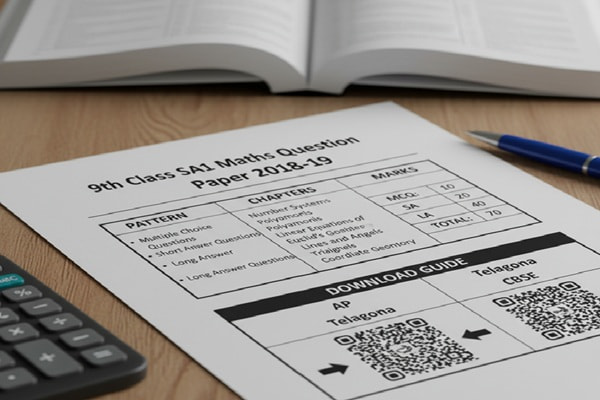
This guide collects everything about the 9th class SA1 Maths question paper 2018-19. You will find the paper pattern for each board, the exact chapters that were covered, the marks distribution, how AP and Telangana used OMR sheets that year, and a step-by-step plan to use these papers effectively right now.
What Is SA1 and Why the 2018-19 Paper Still Matters
SA1 stands for Summative Assessment 1. It is the first major exam in the academic year, held roughly halfway through the year, usually in October or November for state boards and September or October for CBSE.
The 2018-19 session was particularly important because AP and Telangana had shifted to an OMR-based objective format for SA1 exams. This was a significant change from the traditional descriptive format, and many students and teachers were caught off guard.
Even today, practicing the 2018-19 papers gives you a clear picture of which chapters were prioritized by examiners, which question formats were used, and how the marks were distributed. That pattern has not changed drastically across years.
Board-Wise Overview: 9th Class SA1 Maths 2018-19
| Board | Exam Month | Total Marks | Duration | Format | Papers |
| AP SCERT | December 2018 | 50 (each paper) | 2.5 hours | OMR Objective | Paper 1 and Paper 2 |
| TS SCERT | October 2018 | 50 (each paper) | 2.5 hours | OMR Objective | Paper 1 and Paper 2 |
| CBSE (CCE) | September 2018 | 80 marks | 3 hours | 4 Sections A to D | Single paper |
| Karnataka KSEEB | October 2018 | 80 marks | 3 hours | Descriptive | Single paper |
Note: AP and Telangana 9th class SA1 2018-19 Maths was divided into two separate papers. Paper 1 covered algebra and number system chapters. Paper 2 covered geometry and statistics chapters. Both were conducted on OMR sheets with objective-type questions only.
Chapters Covered in 9th Class SA1 Maths 2018-19
The SA1 exam covers roughly the first half of the academic year syllabus. For the 2018-19 session, here are the chapters that appeared across boards.
AP and Telangana SCERT: Chapter Coverage
| Paper | Chapters Included | Topics |
| Paper 1 | Real Numbers | Rational and irrational numbers, decimal expansions, number line representation |
| Paper 1 | Polynomials and Factorization | Types of polynomials, zeros, factor theorem, remainder theorem |
| Paper 1 | Elements of Geometry | Basic geometry terms, axioms, postulates |
| Paper 1 | Lines and Angles | Types of angles, transversal, parallel lines properties |
| Paper 2 | Triangles | Congruence rules, angle sum property, exterior angle theorem |
| Paper 2 | Quadrilaterals | Properties of quadrilaterals, parallelograms, mid-point theorem |
| Paper 2 | Statistics | Frequency tables, mean, median, mode, bar graphs |
| Paper 2 | Coordinate Geometry (intro) | Plotting points, Cartesian plane, quadrants |
CBSE CCE Class 9 SA1 Maths 2018-19: Chapter Coverage
| Section | Chapters | Marks |
| Number Systems | Real Numbers, Irrational Numbers, Laws of Exponents | 10 |
| Algebra | Polynomials: Remainder Theorem, Factor Theorem, Factorisation | 20 |
| Coordinate Geometry | Cartesian Plane, Plotting Points | 6 |
| Geometry | Lines and Angles, Triangles | 20 |
| Statistics | Bar Graphs, Frequency Polygons, Mean, Median, Mode | 12 |
| Mensuration | Area of Triangle using Heron’s Formula | 12 |
| TOTAL | 80 |
AP and Telangana SA1 2018-19: The OMR Format Explained
The 2018-19 session was one of the first years AP and Telangana conducted SA1 entirely on OMR sheets. This confused many students because they were used to writing long answers. Understanding that format is useful even now because some schools still use objective-type internal tests.
| How the OMR Format Worked in 2018-19
Each question had four answer options labeled A, B, C, D. Students had to fill the correct bubble using a blue or black ball-point pen. No marks were deducted for wrong answers in most schools. Paper 1 and Paper 2 were held on different days. Each paper had 50 marks with 50 questions of 1 mark each in most districts. Some districts had a mix of 1-mark and 2-mark questions totaling 50 marks. |
The OMR format tested speed and accuracy. A student who knew the concept but wrote slowly in descriptive exams could actually score better in this format. This is why many students who struggled earlier performed surprisingly well in 2018-19 SA1.
Marks Distribution Pattern: What Carried the Most Weight
In both AP SCERT and TS SCERT papers from 2018-19, certain chapters consistently carried more questions. Here is what the data shows.
| Chapter | Approx Questions in 2018-19 SA1 | Why It Was High Weightage |
| Real Numbers | 8 to 10 questions | Foundation chapter, many concept-type MCQs possible |
| Polynomials | 10 to 12 questions | Wide variety: types, zeros, operations, theorem applications |
| Lines and Angles | 8 to 10 questions | Diagram-based reasoning converted to MCQ well |
| Triangles | 8 to 10 questions | Congruence cases and properties lend to objective questions |
| Statistics | 6 to 8 questions | Calculation-based questions with clear correct answers |
| Quadrilaterals | 5 to 7 questions | Properties of parallelograms tested frequently |
| Coordinate Geometry | 3 to 5 questions | Introductory, fewer but easy marks |
Polynomials was clearly the highest-weightage chapter in the 2018-19 SA1 across AP and Telangana. Students who mastered factor theorem, remainder theorem, and types of polynomials had a clear scoring advantage.
CBSE Class 9 SA1 Maths 2018-19: Section-by-Section Breakdown
CBSE followed its CCE (Continuous and Comprehensive Evaluation) format for 2018-19. The paper had four sections with different question types.
| Section | Questions | Marks Each | Total | Question Type |
| Section A | 6 | 1 | 6 | Very short answer, MCQ style |
| Section B | 6 | 2 | 12 | Short answer |
| Section C | 10 | 3 | 30 | Short to medium answer with steps |
| Section D | 8 | 4 | 32 | Long answer with full working |
| TOTAL | 30 | 80 |
Note: CBSE abolished the SA1 and SA2 system after 2017-18 and replaced it with a single annual board exam for Class 10. For Class 9, which is an internal school exam, individual schools continued to hold SA1-style half-yearly tests. So 2018-19 CBSE SA1 papers for Class 9 were school-conducted using the old CCE pattern or a school-specific format.
Most Repeated Question Types in 9th SA1 Maths 2018-19 Papers
After analyzing multiple district-level papers from AP and Telangana from this session, these question types appeared most frequently.
From Real Numbers
- Identify whether a given number is rational or irrational
- Express 0.3333… or similar recurring decimals as fractions
- Simplify expressions with surds like root 3 plus root 5
- Find two irrational numbers between given rational numbers
From Polynomials
- Find the zero of a linear polynomial
- Check if a given value is a zero of a polynomial
- Use remainder theorem to find remainder when p(x) is divided by (x-a)
- Use factor theorem to check if (x-2) is a factor of a given polynomial
- Factorize using a squared minus b squared or sum/difference of cubes
From Lines and Angles
- Find angles using vertically opposite angle properties
- Use co-interior and alternate angles with parallel lines
- Problems involving linear pairs and supplementary angles
From Triangles
- State which congruence rule (SAS, ASA, SSS, RHS) applies
- Prove that angles opposite to equal sides are equal
- Find missing angles using angle sum property
From Statistics
- Calculate mean from a frequency table
- Find median from an odd or even set of values
- Identify mode from a data set
- Interpret a bar graph and answer questions
How to Use the 2018-19 Paper for Preparation Right Now
Many students think old papers from 2018-19 are not relevant anymore. That thinking costs marks. The chapter names may have shifted slightly, but the question format, the type of logic tested, and the marks distribution remain very similar.
Here is a practical step-by-step method.
- Download the actual 2018-19 papers. Get Paper 1 and Paper 2 for AP or Telangana from tlm4all.com or schools360.in. For CBSE, use jsuniltutorial.weebly.com which hosted the 2018-19 SA1 sample papers officially.
- Solve Paper 1 first without any help. Set a 2.5 hour timer. Attempt every question. Do not skip.
- Check your answers using the answer key. Most sites that host the paper also host the key. Note every question you got wrong.
- Identify which chapter each wrong answer belongs to. This tells you exactly which chapter needs more revision.
- Go back to that chapter in your NCERT or SCERT textbook. Re-read the relevant section and solve the textbook examples.
- Now solve Paper 2. Repeat the same process.
- In the final week before your SA1, revisit all the questions you got wrong earlier and re-attempt them from scratch.
| Important Tip for 2024-25 Students
The AP SCERT moved away from purely objective OMR-based SA1 from 2019-20 onwards. Current SA1 papers include both objective and subjective questions. So use the 2018-19 paper to practice the multiple-choice portion only. Supplement with recent 2022-23 and 2023-24 papers for descriptive question practice. |
Where to Download the 9th Class SA1 Maths Question Paper 2018-19
Here are the most reliable sources. All of these were verified during research and host actual papers from the 2018-19 session.
For AP and Telangana Students
- com: Hosts Paper 1 and Paper 2 for 9th class SA1 Maths 2018-19 in both Telugu Medium and English Medium. Direct PDF downloads available.
- in: Provides AP SA1 model papers and previous year papers for 9th class Maths including 2017-18 and 2018-19 sessions.
- in: AP teacher resource site with subject-wise SA1 papers for multiple years.
- com: Lists AP SA1 previous year question papers with download links organized by year.
- com: Hosts Telangana Board 9th class SA1 papers in English version including Mathematics October 2019 (M-76 and M-77 sets).
For CBSE Students
- weebly.com: One of the oldest CBSE resource sites, hosts the Class 9 Mathematics SA1 sample papers for session 2018-19.
- com: Lists CBSE Class 9 SA1 Mathematics papers organized by year.
For Karnataka Students
- co.in: Hosts Karnataka 9th standard SA1 Maths question papers in both Kannada and English medium for 2018-19 including papers from multiple districts.
Old Paper Pattern vs Current Pattern: What Changed
| Feature | 2018-19 SA1 (AP/TS) | Current SA1 (2024-25) |
| Format | 100% OMR objective | Mix of objective and descriptive |
| Papers | Paper 1 and Paper 2 separate | Combined or separate depending on district |
| Question Types | MCQ only | MCQ plus short answer plus essay |
| Marks | 50 per paper | Varies by board and class |
| Negative Marking | None | None |
| Chapters Covered | Half yearly syllabus | Half yearly syllabus (same logic) |
| Medium | Telugu and English | Telugu and English |
The core chapters tested have not changed significantly. Real Numbers, Polynomials, Triangles, and Lines and Angles remain the backbone of 9th class SA1 Maths across all years.
Also Read : Physics Model Question Paper 2023: Chapter Weightage, Paper Pattern and Complete Preparation Strategy
Common Mistakes Students Make When Practicing Old SA1 Papers
- Treating the paper as a formality. Solving old papers without checking answers defeats the entire purpose.
- Ignoring the medium difference. Telugu Medium and English Medium papers sometimes have different question sets. Make sure you download the correct medium.
- Skipping Paper 2. Many students only practice Paper 1 because it has algebra which feels more familiar. Paper 2 covers geometry and statistics, which are equally important.
- Not timing themselves. Answering 50 MCQs in 2.5 hours sounds easy until you try it. Practice with a timer every time.
- Searching for hard copies only. Most 2018-19 papers are available as PDF downloads for free. There is no need to spend money on printed booklets.
- Using answer keys from unreliable sources. Always cross-check answers using your SCERT textbook or NCERT textbook, not just whatever answer key comes with the downloaded paper.
Chapter-Wise Quick Preparation Guide for SA1 Maths
Whether you are using the 2018-19 paper or preparing for the current exam, these strategies work for each chapter.
| Chapter | Most Tested Concept | Fastest Way to Prepare |
| Real Numbers | Irrational numbers, decimal form | Memorize which operations keep numbers rational or irrational |
| Polynomials | Zeros, factor theorem, factorization | Practice 10 factorization problems daily for one week |
| Lines and Angles | Parallel lines, angle pairs | Draw and label diagrams for every property |
| Triangles | Congruence rules, angle sum | Write all 5 congruence rules from memory, then apply in 5 problems |
| Quadrilaterals | Parallelogram properties | Make a one-page property summary for all quadrilateral types |
| Statistics | Mean, median, mode, bar graph | Practice calculation problems using actual data tables |
| Coordinate Geometry | Plotting, quadrant identification | Practice plotting 20 different points on graph paper |
What Experienced Teachers Say About SA1 Maths Preparation
Based on how SA1 papers from 2017-18 to 2023-24 have been set, experienced Maths teachers at government high schools across AP have noted a few consistent patterns.
| Pattern 1
Polynomials chapter questions always include at least one application of the factor theorem or remainder theorem. This is a guaranteed topic year after year. |
| Pattern 2
In the Lines and Angles chapter, the most common question type asks students to find missing angles in a diagram involving parallel lines and a transversal. If you can solve five different variations of this problem, you will answer this correctly every time. |
| Pattern 3
Statistics calculations, especially finding the mean from a frequency table, appear in almost every SA1 paper regardless of whether it is objective or descriptive format. A student who can do this quickly and accurately never loses marks here. |
| Pattern 4
The congruence of triangles section tests SAS, ASA, SSS, and RHS. One of these four is always tested either directly or as the basis for a proof. Knowing which rule applies to which figure is the key skill. |
Frequently Asked Questions
Q1. Where can I get the original 9th class SA1 Maths question paper from 2018-19 in Telugu Medium?
The best source is tlm4all.com, which hosts the 2018-19 SA1 Maths Paper 1 and Paper 2 in Telugu Medium as PDF downloads. Schools360.in and apteachers.in also have Telugu Medium versions of these papers.
Q2. Was the 2018-19 SA1 Maths paper OMR-based for all schools in AP?
Yes. Andhra Pradesh shifted the 9th class SA1 to an OMR-based objective format for the 2018-19 session. This was a state-wide directive from AP SCERT. However, implementation varied slightly between districts, with some using 50 one-mark questions and others using a mix of 1 and 2-mark questions.
Q3. Is the 2018-19 SA1 paper still relevant for students preparing in 2025?
Yes, for chapter-based preparation it is very relevant. The chapters, concepts tested, and the logic behind questions remain largely the same. The format has shifted to include descriptive questions, but the objective portion of current SA1 papers covers the same chapter content as the 2018-19 paper.
Q4. How was the CBSE Class 9 SA1 Maths paper in 2018-19 different from state board papers?
CBSE used a descriptive 4-section format with 80 marks and 3-hour duration. State boards like AP and Telangana used a 2-paper OMR objective format. CBSE covered more chapters including Heron’s Formula for Mensuration, which state boards placed in SA2. The difficulty level and question depth was also higher in CBSE SA1.
Q5. Did Karnataka also have SA1 for 9th class in 2018-19?
Yes. Karnataka KSEEB conducted a First Summative Assessment for 9th standard in the 2018-19 session. Inyatrust.co.in hosts the Karnataka 9th standard SA1 Maths question papers in both Kannada and English medium from this session, contributed by teachers from various districts.
Q6. How many questions were there in AP 9th SA1 Maths 2018-19?
The AP SA1 Maths 2018-19 had two separate papers. Each paper typically had 50 questions of 1 mark each, for a total of 50 marks per paper. Both papers combined covered the full SA1 syllabus. The exact number varied slightly by district set.
Q7. What is the difference between Paper 1 and Paper 2 in AP SA1 Maths 2018-19?
Paper 1 focused on Number System (Real Numbers), Polynomials and Factorization, and Lines and Angles. Paper 2 focused on Triangles, Quadrilaterals, Coordinate Geometry basics, and Statistics. Together they covered the full first-half syllabus of 9th class Maths under AP SCERT.
Q8. Can I use the 2018-19 paper to prepare for Telangana SA1 also?
Yes. AP and Telangana followed very similar syllabi and paper patterns in 2018-19 because both states were using SCERT materials derived from the common NCF framework. The chapter coverage, marks distribution, and OMR format were nearly identical. Telangana paper sets from October 2019 (M-76 and M-77) are also available on telanganaboard.com.