
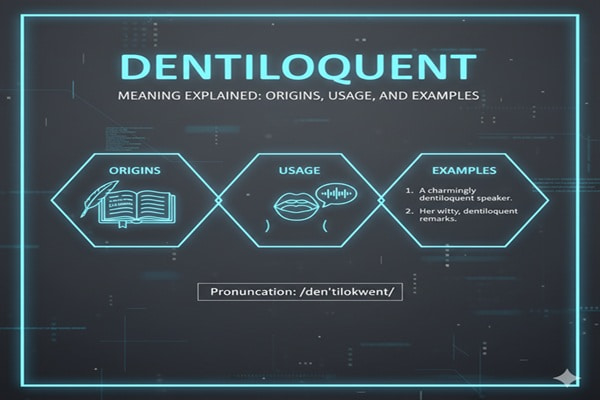
Let me guess. You saw the word dentiloquent, paused for a second, and thought, “Is this even a real word?” You’re not alone. I had the same reaction the first time I stumbled across it. But here’s the fun part: dentiloquent is real, fascinating, and way more relatable than it sounds.
If you’ve ever noticed how some people speak with a sharp, teeth-forward clarity or maybe you’ve caught yourself doing it this one’s for you. Let’s unpack dentiloquent together, casually, clearly, and without turning this into a linguistics lecture that puts us both to sleep.
What Does Dentiloquent Actually Mean?
At its simplest, dentiloquent describes speech that actively involves the teeth. The word comes from Latin roots: dens (tooth) and loqui (to speak). Put them together, and you get “speaking with the teeth.”
Sounds fancy, right? But the idea stays surprisingly grounded.
When someone speaks in a dentiloquent way, they use their teeth prominently to shape sounds. Think crisp consonants, precise articulation, and a noticeable interaction between the tongue and teeth.
Ever wondered why certain voices sound extra sharp or precise? Dentiloquent speech often plays a role.
Why Dentiloquent Isn’t About Personality
Let’s clear something up before things get weird.
Dentiloquent does not describe attitude, mood, or emotion. It doesn’t mean aggressive. It doesn’t mean sarcastic. It doesn’t even mean confident. It strictly focuses on how speech forms physically.
People sometimes confuse it with terms like “eloquent” or “loquacious.” Those talk about what or how much someone says. Dentiloquent only cares about how the mouth does the work.
That distinction matters more than you’d expect.
How Dentiloquent Speech Sounds in Real Life
You don’t need audio equipment to recognize dentiloquent speech. Once you know what to listen for, you hear it everywhere.
Common Traits of Dentiloquent Speech
You’ll often notice:
-
Strong “s,” “z,” and “th” sounds
-
Clear, sharp articulation
-
Visible tongue-to-teeth interaction
-
A slightly forward mouth posture
I once caught myself paying attention during a podcast and realized the host spoke in a distinctly dentiloquent way. I couldn’t unhear it after that. Kind of a blessing and a curse, honestly.
Dentiloquent vs Other Speech Styles
Let’s do a quick comparison, because context helps everything make sense.
Dentiloquent vs Eloquent
-
Eloquent means expressive and persuasive
-
Dentiloquent means teeth-focused articulation
Someone can be dentiloquent and awkward. Someone can be eloquent and mumble. They don’t depend on each other.
Dentiloquent vs Lisps
This one trips people up.
A lisp affects how sounds come out due to tongue placement. Dentiloquent speech intentionally or naturally uses the teeth, but it doesn’t distort sounds. Dentiloquent articulation usually increases clarity rather than reducing it.
So no, dentiloquent does not equal speech impediment.
Why Linguists Care About Dentiloquent Speech
Okay, tiny nerd moment. Stick with me.
Linguists and speech specialists love terms like dentiloquent because they describe precise articulation mechanics. Language isn’t just vocabulary. It’s physical movement.
Dentiloquent helps experts:
-
Classify speech patterns
-
Study phonetics
-
Understand articulation differences
Ever wondered how accents form? Mouth mechanics play a huge role, and dentiloquent articulation often appears in those discussions.
Dentiloquent in Speech Therapy and Training
This is where things get practical.
Speech therapists sometimes analyze dentiloquent articulation to:
-
Improve clarity
-
Adjust pronunciation
-
Refine professional speaking voices
Actors and voice professionals also pay attention here. Dentiloquent articulation can sharpen dialogue delivery, especially on stage or on mic.
IMO, that explains why some voices sound “cleaner” without sounding stiff.
Is Dentiloquent Speech Good or Bad?
Short answer: neither.
Dentiloquent speech stays neutral. It doesn’t signal intelligence, rudeness, or superiority. It simply describes how speech forms.
That said, context matters.
When Dentiloquent Speech Helps
-
Public speaking
-
Teaching
-
Acting
-
Broadcasting
When It Can Feel Distracting
-
Extremely exaggerated articulation
-
Overly sharp consonants
-
Certain microphone settings
But again, that’s not a flaw. That’s just mismatch.
Dentiloquent Speech in Everyday Conversations
You don’t need to label people in real life (please don’t). But once you understand dentiloquent speech, you start noticing patterns.
Friends, teachers, podcasters, presenters you’ll hear it.
Ever had someone tell you, “You pronounce everything so clearly”? Dentiloquent articulation might explain that compliment.
The Role of Teeth in Speech (Yes, They Matter)
People forget this, but teeth do a lot of work when we talk.
They:
-
Shape airflow
-
Guide tongue placement
-
Control consonant sharpness
Dentiloquent speech highlights that role instead of hiding it. Teeth don’t just sit there looking pretty.
Dentiloquent Across Languages
Here’s where things get interesting.
Some languages naturally encourage dentiloquent articulation because of their sound structures. Others rely more on the lips or throat.
Languages with frequent dental consonants often:
-
Encourage tongue-to-teeth placement
-
Produce crisper consonants
-
Sound more precise to non-native ears
Ever wondered why some accents sound “cleaner” than others? Mouth mechanics, including dentiloquent patterns, play a big role.
Dentiloquent vs Dental Consonants
These sound similar, but they aren’t identical.
-
Dental consonants describe sound categories
-
Dentiloquent describes the speaker’s articulation style
You can use dental consonants without speaking dentiloquently, and vice versa.
Subtle difference. Big implications.
My Personal Take on Dentiloquent Speech
Let me be honest for a second.
I love clarity. I love hearing words land cleanly. Dentiloquent speech often delivers that. But I also think moderation matters.
When articulation turns exaggerated, it can feel theatrical. That’s great on stage. Less great in casual chats.
Balance wins here, like most things in language 🙂
Why Dentiloquent Is Showing Up Online More Often
Search trends don’t lie.
People look up dentiloquent meaning, dentiloquent definition, and dentiloquent speech because:
-
Rare words spark curiosity
-
Linguistic terms trend on social platforms
-
People love unusual vocabulary
And honestly? It’s refreshing to see language curiosity trending instead of nonsense.
Dentiloquent in Writing and Descriptions
Writers sometimes use dentiloquent to add texture to character descriptions. Instead of saying “he spoke sharply,” dentiloquent paints a clearer physical picture.
It works best when used sparingly. Overuse turns it into a gimmick.
FYI, subtle vocabulary always hits harder.
Also Read : Žižole Explained: Benefits, Uses, Taste & Cultural Value
Common Misunderstandings About Dentiloquent
Let’s bust a few myths.
-
It’s not an insult
-
It’s not a diagnosis
-
It’s not rare or abnormal
Dentiloquent simply labels a natural articulation style.
Language loves labels. Humans love overthinking them.
Should You Care If You’re Dentiloquent?
Only if you want to.
If your speech feels clear and comfortable, you’re doing great. Dentiloquent awareness only matters when you:
-
Train your voice
-
Study linguistics
-
Work in performance or speech
Otherwise, it’s just a cool word you now understand.
Dentiloquent vs Modern Communication
Texting, voice notes, podcasts speech still matters. Dentiloquent articulation often shines in audio-heavy platforms where clarity beats speed.
Ever notice how some voices sound better through earbuds? Dentiloquent speech often plays nicely with microphones.
Not magic. Just mechanics.
Final Thoughts on Dentiloquent
Dentiloquent sounds intimidating, but it really isn’t. It simply describes speaking with noticeable involvement of the teeth, nothing more, nothing less.
Once you know what it means, you start hearing it everywhere. And honestly? That awareness makes listening more fun.
So next time you hear crisp consonants or feel your tongue brush your teeth mid-sentence, smile. Language just did its thing. And hey, now you’ve got a fancy word for it.