Before you download a single paper, there is something important to understand about the Class 9 English SA1 2018 paper that no other guide will tell you.
CBSE formally discontinued the Summative Assessment 1 and Summative Assessment 2 (SA1/SA2) examination system after the 2017-18 academic year. From 2018-19 onwards, CBSE moved to a different assessment structure. This means that if your school follows CBSE, the last official CBSE SA1 English paper for Class 9 was conducted in September-October 2017. When students search for ‘Class 9 English SA1 2018’, they are typically looking for one of three things: the CBSE SA1 paper from 2017-18 (the final CBSE SA1), the 2018-19 school-level first-term paper used after CBSE changed its format, or the Karnataka or AP board SA1 paper from the 2018-19 session, which still uses the SA1 terminology.
This matters because the top-ranking page for this exact keyword confuses 2018 and 2019 in its first sentence, confirming it was written without any understanding of what the paper actually is. This guide is different. It covers all three interpretations with the correct context, and then gives you what you actually came for: the section-wise breakdown, the Beehive and Moments chapters covered, the grammar topics tested, the writing tasks, model questions built on the actual paper pattern, and verified sources to download every version.
Understanding SA1 in 2018: CBSE, Karnataka and AP Board Differences
This section is critical. Most pages on this topic never explain the SA1 system at all. Understanding it prevents you from practicing the wrong paper.
| Board | SA1 Status in 2018-19 | What the 2018 Paper Represents | Where to Find It |
| CBSE (Central Board) | SA1/SA2 system formally discontinued after 2017-18 | The last official CBSE SA1 paper is from 2017-18 (Sept-Oct 2017). 2018-19 school papers use different names (Half-yearly, PT, Term 1). | cbsenoteshindi.com, studiestoday.com, jsuniltutorial.weebly.com |
| KVS (Kendriya Vidyalaya) | Moved to Periodic Test (PT1, PT2) format by 2018-19 | The 2018-19 papers are called PT1 and PT2, not SA1. However, the English paper format remains very similar. | kvdrdolibrary.wordpress.com, individual KV school websites |
| Karnataka State Board | SA1 (First Summative Assessment) still officially used | Karnataka 9th std SA1 English 2018-19 papers are available from multiple districts with blue prints and answer keys. | inyatrust.co.in (most comprehensive source) |
| AP State Board (APSCERT) | SA1 still officially used | AP Class 9 SA1 English 2018-19 papers in both Telugu and English medium with answer keys. | educationobserver.com, Manabadi |
Bottom line: If you are a CBSE student, the most relevant 2018 paper is either the final 2017-18 CBSE SA1 English paper or your school’s 2018-19 half-yearly paper. If you are a Karnataka or AP board student, the 2018-19 SA1 papers are directly available and specifically labelled SA1.
CBSE Class 9 English SA1 Paper: Section-Wise Breakdown
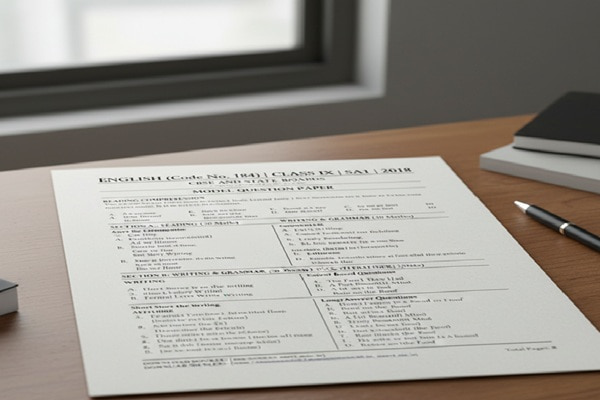
Regardless of whether the paper is from 2017-18 or 2018-19, the CBSE Class 9 English paper structure was consistent during this period. The paper followed a four-section format totalling 80 marks and running for 3 hours. Here is the complete section-wise breakdown.
| Section | Content and Marks Allocation |
| Section A: Reading Skills (20 marks) | Two unseen passages. Passage 1 is a discursive or literary passage of 400 to 500 words (10 marks). Passage 2 is a factual passage of 200 to 250 words (10 marks). Questions test comprehension, vocabulary, inference, and interpretation. |
| Section B: Writing Skills and Grammar (30 marks) | Writing tasks: letter writing or article or report (8 marks), story writing or descriptive paragraph based on visual or hints (10 marks). Grammar: editing, gap filling, sentence reordering, error correction (12 marks total across sub-questions). |
| Section C: Literature (30 marks) | Extract-based questions from Beehive prose (5 marks). Extract from poetry Beehive (5 marks). Short answer questions from Beehive chapters (10 marks). Long answer question from Beehive or Moments (10 marks). |
| Total | 80 marks written. Duration: 3 hours. |
Beehive and Moments Chapters Covered in Class 9 English SA1
This is the most practically useful information for preparation and the one thing completely absent from every competing page. The SA1 exam covers approximately the first half of the Beehive and Moments syllabus. Based on CBSE teaching schedules and school examination patterns from 2017-18 and 2018-19, here are the chapters typically within SA1 scope.
Beehive (NCERT Prose) Chapters in SA1 Scope
| Chapter | Author / Text | Key Exam Topics |
| Chapter 1: The Fun They Had | Isaac Asimov | Futuristic school vs real school contrast. Character of Margie and Tommy. Significance of the old book. Short answer and extract questions. |
| Chapter 2: The Sound of Music (Parts 1 and 2) | Deborah Cowens / Evelyn Glennie | Evelyn Glennie’s hearing loss and determination. Bismillah Khan’s devotion to music. Character-based short answer questions. The theme of music transcending disability. |
| Chapter 3: The Little Girl | Katherine Mansfield | Kezia’s relationship with her father. Change in perspective at the end. Theme of parental love. Extract and short answer questions. |
| Chapter 4: A Truly Beautiful Mind | Based on Einstein’s life | Einstein’s childhood, pacifism, nuclear weapons stance. Theory of relativity introduction. Long answer question material. |
| Chapter 5: The Snake and the Mirror | Vaikom Muhammad Basheer | Humour and irony. The doctor’s vanity. The snake’s behaviour. Extract and short answer questions. |
| Chapter 6: My Childhood | A.P.J. Abdul Kalam | Values of communal harmony, friendship, and ambition. Abdul Kalam’s early influences. Long answer question favourite topic. |
Beehive (NCERT Poetry) Chapters in SA1 Scop
| Poem | Poet | Key Exam Topics |
| Poem 1: The Road Not Taken | Robert Frost | Central theme of choices and individuality. Symbolic meaning of the two roads. Extract questions on specific stanzas. |
| Poem 2: Wind | Subramania Bharati | Personification of wind. Message of inner strength. Contrast between weak and strong. |
| Poem 3: Rain on the Roof | Coates Kinney | Nostalgia and memories. The sound of rain as a comfort. Poetic devices: alliteration, personification. |
| Poem 4: The Lake Isle of Innisfree | W.B. Yeats | Longing for peace and nature. Contrasting city life and natural life. Imagery questions. |
Moments (Supplementary Reader) Chapters in SA1 Scope
| Chapter | Author | Key Exam Topics |
| Chapter 1: The Lost Child | Mulk Raj Anand | Child’s desire and fear. The crowd at the fair. Short answer questions about the child’s emotions. |
| Chapter 2: The Adventures of Toto | Ruskin Bond | Toto’s mischief. Grandfather’s fondness. The ticket collector scene. Short answer questions. |
| Chapter 3: Iswaran the Storyteller | R.K. Laxman | Iswaran’s storytelling style. The supernatural element. Mahendra’s reactions. Short and long answer questions. |
| Chapter 4: In the Kingdom of Fools | A.K. Ramanujan | The foolish king and minister. The strange law. The guru’s advice. Moral of the story. |
| Chapter 5: The Happy Prince | Oscar Wilde | The swallow and the Prince. Sacrifice and compassion. Imagery of gold and jewels. Long answer question material. |
Grammar Topics in the Class 9 English SA1 2018 Paper
The grammar section in Section B carries 12 marks in the CBSE Class 9 English SA1 paper. These marks are consistently scored by students who have specifically practiced the grammar formats tested. This section is more rule-based and predictable than either reading or literature.
| Grammar Topic | Format in SA1 Paper | Marks |
| Editing (Error Correction) | A paragraph is given with errors in grammar, spelling, or word choice. Students identify the error and write the correction. Typically 4 errors in 4 lines. | 4 marks (1 per correction) |
| Gap Filling (Cloze Test) | A paragraph with 4 blanks. Students fill each blank with the correct form of the verb given in brackets, or choose from options. Tests tenses, subject-verb agreement, and modals. | 4 marks (1 per blank) |
| Sentence Reordering | 5 to 6 jumbled words or phrases. Students rearrange them to form a meaningful sentence. Tests understanding of sentence structure. | 3 marks (1 per sentence) |
| Reported Speech or Voice Change | A direct speech sentence converted to indirect, or active voice to passive. Occasionally both appear in the same paper. | 1 to 2 marks |
Grammar Topics Most Tested in Class 9 English SA1 Papers
- Tenses: Present perfect, past perfect, and future continuous tense forms appear regularly in gap-filling activities. The gap-filling section almost always tests at least two different tense forms.
- Modals: Shall/will, should/would, can/could/may/might distinctions appear in gap-filling. Modal confusion is the most common grammar error in evaluated Class 9 answer sheets.
- Subject-verb agreement: Particularly with collective nouns, indefinite pronouns, and either/or constructions. These appear in both editing and gap-filling sections.
- Articles: The use of a, an, the or zero article appears in editing passages. Article errors are the second most common error type in Class 9 English evaluated papers.
- Active and passive voice: Conversion of sentences from active to passive and vice versa appears as a direct question or within the editing passage in most SA1 papers.
Writing Tasks in the Class 9 English SA1 Paper: What Was Asked
Section B writing carries 18 marks in the standard SA1 format (8 marks for one task and 10 marks for another). Writing is the section with the highest proportion of marks available for the effort invested, and also the section where most students underperform due to poor format knowledge.
Writing Task 1: Formal Letter or Article (8 marks)
The SA1 English paper for Class 9 typically asked students to write one of the following: a formal letter to an authority (principal, editor of a newspaper, municipal corporation), an informal letter to a friend or relative, or a short article for the school magazine. The 2018-era papers showed a preference for formal letters and articles.
| Writing Task Type | Format Requirements | Common Topics in 2018 SA1 Papers |
| Formal Letter to Principal | Sender address, date, salutation (To the Principal), subject line, body (3 paragraphs), closing (Yours obediently), name and class | Requesting permission for an activity, complaining about a school facility, applying for leave, requesting a certificate |
| Letter to Editor | Sender address, date, salutation (To the Editor), subject, body, Yours faithfully, name | Pollution in the city, poor road conditions, eve teasing, need for sports facilities |
| Article for School Magazine | Heading, By (Name), introduction paragraph, 2 to 3 body paragraphs, conclusion | Environment protection, value of sports, importance of reading, digital literacy |
| Informal Letter to Friend | Sender address, date, Dear (Friend’s name), body paragraphs, closing (Yours lovingly/Yours affectionately), name | Describing a holiday, sharing news about school, inviting to a function, describing an experience |
Writing Task 2: Story or Descriptive Writing (10 marks)
The second writing task in Class 9 SA1 2018 papers was either a story based on given hints or a descriptive composition based on a visual or picture. The story writing task carries the most marks in Section B and is the area where students can gain or lose the most marks through the quality of their writing.
- Story writing from hints: A sequence of 4 to 6 key points is given. Students write a story of 200 to 250 words using these hints. The story must have a beginning, middle, and end, and must incorporate all the hints.
- Story completion: The opening paragraph of a story is given. Students continue and complete it in 150 to 200 words.
- Story from a picture: A visual depicting a scene is given. Students write a narrative based on what they see and imagine.
- Marking criteria for story writing: Content and relevance (5 marks), language accuracy and vocabulary (3 marks), presentation and organisation (2 marks). Writing more than the word limit wastes time. Writing less than the minimum loses content marks.
Literature Section in Class 9 English SA1 2018: How It Was Examined
Section C carries 30 marks and is based entirely on the Beehive and Moments NCERT textbooks. In the SA1 paper, only chapters covered in the first half of the academic year (typically Chapters 1 to 6 of Beehive and Chapters 1 to 5 of Moments) are in scope.
The literature section has four distinct question types. Understanding each type is essential because they require completely different answer styles.
| Question Type | What It Asks | Marks and Answer Length |
| Extract from Prose (Reference to Context) | A passage from a Beehive chapter is given. Students answer 3 to 4 questions about it: meaning of an expression, what the extract reveals about a character, significance of a detail, or inference about the situation. | 5 marks. Answers of 1 to 2 sentences each. |
| Extract from Poetry (Reference to Context) | 2 to 3 lines from a Beehive poem are given. Students explain the lines, identify the poetic device used, or state what the poet conveys. | 5 marks. Answers of 1 to 2 sentences each. |
| Short Answer Questions (SAQ) | 3 to 4 questions from Beehive chapters and Moments. Each requires a 2 to 3 sentence answer. Tests plot understanding, character analysis, and theme identification. | 10 marks (2 to 3 marks per question). |
| Long Answer Question (LAQ) | One long answer question from Beehive or Moments requiring 100 to 120 words. Tests deeper analysis: character sketch, theme essay, comparison of two characters, or personal response. | 10 marks. 100 to 120 words required. |
Most Frequently Tested Literature Topics in SA1 Papers
- The Fun They Had (Beehive Ch 1): The character of Margie, her feelings about the mechanical teacher, and the difference between the futuristic school and real school. Almost every SA1 paper includes at least one question from this chapter.
- My Childhood (Beehive Ch 6): Abdul Kalam’s early influences, his friendship with Ramanadha Sastry and Aravindan, and the values of communal harmony. Long answer question material in most papers.
- The Road Not Taken (Poetry): The meaning of the two roads, the poet’s choice and its significance, and the theme of individuality. Stanza-specific extract questions appear consistently.
- Iswaran the Storyteller (Moments): The supernatural element and Mahendra’s reaction. Short answer questions about how Iswaran tells stories and what makes him unique.
- The Sound of Music (Beehive Ch 2): Evelyn Glennie’s story specifically. How she hears music through her body. Questions about determination and disability appear in nearly every SA1 paper from this period.
Karnataka Board Class 9 English SA1 2018-19: What Was Different
For students in Karnataka, the SA1 examination is still officially conducted under the KSEAB system. The Karnataka Class 9 English SA1 2018-19 paper is available from InyaTrust with blue prints and answer keys. Karnataka’s SA1 English paper covers only the first-term portion of the Kannada and English textbooks.
The Karnataka Class 9 English SA1 2018-19 paper is structured differently from the CBSE paper. Karnataka uses the Second Language English format where the paper tests reading, grammar, writing, and literature from the state board textbook rather than NCERT Beehive. The chapters and passages are different from NCERT.
| Feature | Karnataka Class 9 English SA1 2018-19 |
| Paper structure | Reading comprehension (25 marks), Grammar (20 marks), Writing (25 marks), Literature from textbook (30 marks) |
| Total marks | 100 marks. Duration: 3 hours. |
| Literature source | Karnataka State Board Class 9 English textbook (not NCERT Beehive) |
| Grammar emphasis | Stronger grammar section (20 marks) compared to CBSE. Tests tenses, articles, prepositions, and transformation sentences. |
| Writing tasks | Letter, paragraph, essay, and story writing tasks based on Karnataka syllabus themes |
| Available from | inyatrust.co.in: 9th std SA1 English 2018-19 question papers from Soraba and other districts |
AP Board Class 9 English SA1 2018-19: Summative Assessment Format
Andhra Pradesh state board schools conduct formal SA1 examinations in October-November each year. The Class 9 English SA1 2018-19 paper from AP board is archived on Education Observer with answer keys in both Telugu medium and English medium formats. The AP Class 9 English SA1 paper follows the AP SCERT Class 9 English textbook and has a different structure from CBSE.
| Feature | AP Board Class 9 English SA1 2018-19 |
| Paper marks | 80 marks written + 20 marks internal assessment = 100 marks |
| Duration | 3 hours |
| Paper sections | Reading comprehension, Grammar and Vocabulary, Writing Skills, Literature |
| Literature source | AP SCERT Class 9 English textbook (separate from NCERT) |
| Available from | educationobserver.com (AP SA1 Class 9 previous papers), Manabadi.co.in |
Model Questions Based on the Class 9 English SA1 2018 Paper Pattern
The following questions are built on the actual section structure, question types, and marks allocation observed in CBSE Class 9 English SA1 papers from the 2017-18 and 2018-19 period.
Section A: Reading Comprehension (Sample)
| Read the following passage and answer the questions:
The Sundarbans delta, stretching across India and Bangladesh, is one of the largest mangrove forests in the world. It is home to the Royal Bengal Tiger, saltwater crocodiles, and over three hundred species of birds. The forest acts as a natural barrier against cyclones, protecting millions of people who live on its fringes. However, deforestation, rising sea levels, and human-wildlife conflict are threatening the survival of this unique ecosystem.
Q1. What is the Sundarbans delta and where is it located? (2 marks) Model Answer: The Sundarbans delta is one of the largest mangrove forests in the world. It stretches across India and Bangladesh and is home to diverse wildlife including the Royal Bengal Tiger.
Q2. How does the forest protect the local population? (2 marks) Model Answer: The Sundarbans acts as a natural barrier against cyclones, protecting the millions of people who live near its edges from storm damage and flooding.
Q3. Find a word in the passage that means ‘the outer edges of an area’. (1 mark) Model Answer: Fringes
Q4. Name three threats facing the Sundarbans ecosystem. (3 marks) Model Answer: Deforestation, rising sea levels due to climate change, and human-wildlife conflict are the three major threats mentioned in the passage. |
Section B: Writing and Grammar (Sample)
| WRITING TASK: You are Aman, a student of Class 9 at Delhi Public School, Bhopal. Write a letter to the Editor of The Times of India about the increasing problem of water pollution in your city. (8 marks)
MODEL LETTER FORMAT: 15 October 2018 The Editor The Times of India New Delhi
Subject: Increasing Water Pollution in Bhopal
Sir/Madam,
Through the columns of your esteemed newspaper, I wish to draw the attention of the concerned authorities to the serious problem of water pollution in our city.
The Upper Lake and the Betwa River, which were once sources of clean water, are now severely polluted due to the discharge of industrial effluents and domestic waste. Plastic waste is dumped directly into these water bodies, making the water unfit for consumption and harming aquatic life.
I urge the Municipal Corporation to set up proper waste treatment plants, enforce strict laws against illegal dumping, and run awareness campaigns among residents. Immediate action is essential before this crisis becomes irreversible.
Yours faithfully, Aman Class 9, Delhi Public School, Bhopal |
| GRAMMAR: Edit the following passage by correcting the underlined errors. (4 marks)
The students (a) was excited about their annual excursion. They (b) has been preparing for weeks. The teachers told them to (c) carry less luggage as possible. Everyone (d) were ready by seven in the morning.
Answers: (a) was -> were (subject ‘students’ is plural; should use ‘were’) (b) has been -> had been (past perfect needed for action before another past action) (c) less -> as little (correct comparative form with ‘as…as’) (d) were -> was (collective noun ‘Everyone’ takes singular verb) |
Section C: Literature (Sample Questions)
| Q1. Extract Question from Beehive: Read the following extract and answer the questions.
‘She was thinking about how tomorrow Margie had been looking forward to the teleteacher coming…’
(a) Who is Margie? What kind of school does she attend? (2 marks) Model Answer: Margie is a young girl living in the futuristic year 2157. She attends a school at home where a mechanical teacher gives her lessons on a screen instead of a human teacher in a classroom.
(b) What is a ‘teleteacher’? How does it differ from a human teacher? (2 marks) Model Answer: A teleteacher is a mechanical teaching machine used in the future. Unlike a human teacher who can understand emotions and adapt to individual students, a teleteacher follows a programmed curriculum and cannot connect personally with students.
(c) What does the word ‘looking forward to’ suggest about Margie’s feelings? (1 mark) Model Answer: It suggests that Margie was anticipating or expecting something with some interest or curiosity, though it may not be excitement in the positive sense.
Q2. Short Answer Question: What made Evelyn Glennie remarkable as a musician? (3 marks) Model Answer: Evelyn Glennie became remarkable because she achieved professional success as a percussionist despite being profoundly deaf. She learned to sense sound vibrations through different parts of her body, removing her shoes to feel the music through the floor. Her achievement proved that hearing loss does not have to end a musical career.
Q3. Long Answer Question: Describe the character of Abdul Kalam as revealed in ‘My Childhood’. What values did he learn from his early life? (10 marks) Model Answer: A.P.J. Abdul Kalam emerges from the chapter as a curious, determined, and humble young boy shaped by a nurturing family and an accepting community. Growing up in Rameswaram, he was surrounded by teachers like Sivasubramania Iyer who broke social barriers by inviting students of all backgrounds to share meals. Kalam’s own family exemplified communal harmony, with his father maintaining friendships with religious leaders across faiths. He learned the values of hard work from his father, the importance of education from his teachers, and the courage to dream beyond his circumstances from both. The chapter also reveals his sensitivity, as shown by his distress when a new teacher separated him from his brahmin friend. Kalam’s early life teaches that individual merit and human dignity are more important than social divisions, a lesson that shaped his scientific and public career. |
Common Mistakes Students Make in Class 9 English SA1
- Not reading the passage before answering comprehension questions: Many students jump to the questions without reading the passage carefully. All answers in Section A are in the passage. A careful first reading followed by targeted re-reading for each question is faster and more accurate than guessing.
- Ignoring the word limit in writing tasks: Class 9 SA1 writing tasks specify word counts (150 words for letters, 200 to 250 words for stories). Writing significantly less loses content marks. Writing significantly more wastes time that could be used on Section C.
- Skipping the salutation and subject line in formal letters: Letter writing marks are partly for format. A letter without the correct salutation (To the Principal), subject line, and closing phrase loses up to 2 format marks even if the content is excellent.
- Writing extract answers from memory instead of from the extract: Extract questions are about the specific lines given in the paper. Students who write general chapter knowledge instead of addressing the specific lines lose most of these marks.
- Making grammar errors in the editing section that were not in the original: In the editing task, students sometimes correct a word that was already correct and leave the actual error unchanged. Read the editing passage twice before marking anything.
- Answering long questions in bullet points: The long answer question (10 marks) requires a developed written response of 100 to 120 words. Bullet points do not demonstrate the writing ability the question is testing and typically earn half marks at most.
- Not attempting all parts of an extract question: Extract questions from Beehive poetry and prose have 3 to 4 sub-parts. Students often answer the first two clearly and leave the vocabulary or inference sub-part blank. Every sub-part carries 1 mark.
Also Read : Samagra Shiksha Kerala Question Paper 2018 10th Class – SSLC All Subjects PDF Download
How to Use the Class 9 English SA1 2018 Paper for Preparation
The Right Practice Method
- Download the correct version: Confirm whether you need the CBSE 2017-18 SA1 paper, a school-level 2018-19 half-yearly paper, the Karnataka 2018-19 SA1, or the AP 2018-19 SA1. Each is a different document.
- Read through the paper format before attempting: Note the total marks, the four sections, how many questions are in each section, and whether internal choice is available. Understanding the structure prevents time management errors.
- Attempt the paper in three hours under exam conditions: Set a timer. Write every answer. Do not look up words or grammar rules during the attempt. This is the only practice condition that builds real exam readiness.
- Evaluate Section A against the passage: For comprehension, check whether your answer includes the information from the relevant paragraph. If you wrote correct general knowledge but it was not in the passage, that answer earns zero marks.
- Evaluate Section B writing against a format checklist: Letter: correct date format, salutation, subject line, three body paragraphs, closing phrase, name. Story: all hints used, clear beginning and end, within word limit.
- Evaluate Section C against the mark scheme: For extract questions, check you addressed the specific lines given. For short answers, check you gave the number of points matching the marks (3 marks means 3 distinct points). For the long answer, check you reached 100 words and covered the key aspects of the question.
Subject-Specific Tips for Scoring Above 70 in Class 9 English SA1
- Section A (20 marks): Practice reading timed passages. The unseen passage is entirely in the paper. Students who read carefully and answer from the text almost always score 16 to 18 out of 20.
- Section B Grammar (12 marks): Spend one week practicing only the editing format. Make a list of common grammar error patterns (article misuse, tense errors, subject-verb disagreement) and practice spotting them in paragraphs.
- Section B Writing (18 marks): Practice five formal letters on common topics before the exam. Formal letter format marks (2 to 3 marks) are guaranteed if you know the format. Content marks come from three specific body paragraphs.
- Section C Literature (30 marks): Read Beehive chapters 1 to 6 twice before the exam. For each prose chapter, prepare: one character description, one theme statement, and the answer to one likely short question. For each poem, know the theme and one poetic device with an example.
Where to Download the Class 9 English SA1 2018 Paper for Free
For CBSE Class 9 English SA1 Papers (2017-18 and 2018-19)
- Jsunil Tutorial (jsuniltutorial.weebly.com): One of the original repositories for CBSE Class 9 SA1 papers. The page ‘Class 9 English, Hindi and Sanskrit SA-1 Sample Question Papers For Session 2018-2019’ hosts multiple school-level English SA1 papers from the 2018-19 session directly.
- CBSE Board Online (cbseboardonline.com): Hosts CBSE Class 9 SA1 English papers organised by year. The 2017 SA1 English paper and 2015 SA1 English paper are confirmed available. Navigate to Class 9, then SA1 English.
- CBSE Notes Hindi (cbsenoteshindi.com): The page ‘English SA1 Question Papers Class 9’ was published in September 2018 and hosts SA1 papers for Class 9 English in PDF format for free download.
- StudiesToday (studiestoday.com): Hosts CBSE Class 9 English sample papers SA1 from 2018 with answers including Set Q which includes extract questions from The Fun They Had and My Childhood.
- Scribd (scribd.com): Multiple DAV and KVS school SA1 practice papers from the 2018 period are available. Search ‘Class 9 English SA1 2018’ and filter for school-specific papers.
For Karnataka Class 9 English SA1 2018-19 Papers
- InyaTrust (inyatrust.co.in): The most complete Karnataka SA1 resource. The page ‘9th First Summative Assessment SA-1 Exams Question Papers’ contains Karnataka 2018-19 SA1 English question papers from multiple districts. Files named ‘9th std english sa-1 question paper 2018-19’ and related blue prints are directly downloadable.
- Education Observer forum (educationobserver.com): The thread ‘Karnataka 9th std SA1 Mid Term English Exam previous year question papers’ contains the 2018 and 2019 Karnataka Class 9 English SA1 papers as attachments.
For AP Board Class 9 English SA1 2018-19 Papers
- Education Observer (educationobserver.com): The page ‘AP SA1 Exam Previous Question Papers and Keys for Class 9’ lists AP board Class 9 SA1 papers including 2018-19. Both Telugu and English medium versions are available for free download.
- Manabadi (manabadi.co.in): AP State Syllabus 9th Class SA1 English previous papers are archived from multiple years including 2018-19 with answer keys.
Frequently Asked Questions: English Question Paper for Class 9 SA1 2018
Q1. Does CBSE still conduct SA1 examinations for Class 9?
No. CBSE discontinued the formal SA1 and SA2 Summative Assessment system after the 2017-18 academic year. From 2018-19 onwards, CBSE schools moved to a different assessment structure with Periodic Tests and term-wise or annual examinations. However, many CBSE-affiliated schools continued using the SA1 format informally for their half-yearly examinations. Karnataka and AP state boards still use the official SA1 terminology for their first summative assessments.
Q2. What is the total marks and duration of the Class 9 English SA1 paper?
The standard CBSE Class 9 English SA1 paper carries 80 marks written and runs for 3 hours. Some school-level papers from 2018 also included a 10-mark Long Reading Text section making the total 90 marks. Karnataka Class 9 English SA1 carries 100 marks over 3 hours. AP Board Class 9 English SA1 carries 80 marks written plus 20 marks internal assessment.
Q3. Which Beehive chapters are covered in the Class 9 English SA1?
The SA1 covers approximately Chapters 1 to 6 of Beehive: The Fun They Had, The Sound of Music, The Little Girl, A Truly Beautiful Mind, The Snake and the Mirror, and My Childhood. Poems covered include The Road Not Taken, Wind, Rain on the Roof, and The Lake Isle of Innisfree. From Moments, Chapters 1 to 5 are typically in scope: The Lost Child, The Adventures of Toto, Iswaran the Storyteller, In the Kingdom of Fools, and The Happy Prince.
Q4. Where can I download the Class 9 English SA1 2018 paper for free?
For CBSE papers: jsuniltutorial.weebly.com, cbsenoteshindi.com, studiestoday.com, scribd.com. For Karnataka SA1: inyatrust.co.in (most complete archive with blue prints and answer keys). For AP Board SA1: educationobserver.com, manabadi.co.in. All sources are free.
Q5. How many marks does the literature section carry in Class 9 English SA1?
In the CBSE Class 9 English SA1 paper, the literature section (Section C) carries 30 marks. This includes 5 marks for a prose extract, 5 marks for a poetry extract, 10 marks for short answer questions from Beehive and Moments, and 10 marks for one long answer question. The literature section is typically the highest-scoring section for students who have read and understood the NCERT chapters.
Q6. What grammar topics appear in the Class 9 English SA1 paper?
The grammar section in Section B carries 12 marks and tests editing (error correction, 4 marks), gap filling with correct verb forms (4 marks), sentence reordering (3 marks), and sometimes reported speech or voice change (1 to 2 marks). The most commonly tested grammar areas are tenses, modals, subject-verb agreement, and articles.
Q7. Is the Class 9 English SA1 paper the same across all CBSE schools?
No. CBSE does not issue a national Class 9 paper. Each CBSE-affiliated school designs its own examination paper based on CBSE curriculum guidelines. The chapter content and paper format are consistent across schools, but the specific questions, passages, and writing topics differ between schools. Practicing papers from multiple schools gives broader coverage of possible question types.
Q8. How should I prepare for the writing section of Class 9 English SA1?
Practice five formal letters covering the most common topics: letter to editor (pollution, civic problem), letter to principal (request, complaint), and article for school magazine (social awareness theme). For story writing, practice using a given set of hints to write a complete narrative of 200 to 250 words with a clear beginning, middle, and ending. Always practice writing tasks within the word limit specified, as writing too much or too little both reduce marks.
Q9. What is the difference between the CBSE Class 9 English SA1 and the Karnataka Class 9 English SA1?
The CBSE Class 9 English SA1 is based on NCERT textbooks Beehive and Moments and follows a four-section format worth 80 marks. The Karnataka Class 9 English SA1 is based on the Karnataka state board English textbook and carries 100 marks in a different section structure. The literature chapters, passage sources, and grammar emphasis differ significantly. A student practicing the CBSE SA1 paper for a Karnataka SA1 examination would be preparing with partially incorrect content.
Q10. How do I score well in the extract questions in the literature section?
Extract questions require you to address the specific lines given in the paper, not general chapter knowledge. For each sub-question, re-read the relevant extract before writing your answer. When the question asks what a phrase ‘suggests’ or ‘reveals’, your answer must connect the specific words in the extract to a character trait, emotion, or theme. Vocabulary questions (find a word that means…) require you to scan the passage for a synonym or related word, not recall vocabulary from memory.
Conclusion: Prepare for the Right Paper, Then Prepare It Right
The Class 9 English SA1 2018 paper rewards preparation that is specific, not general. Students who practice reading comprehension from any random passage, write letters without learning the correct format, and skim through literature chapters without preparing for extract questions, consistently underperform relative to their actual English ability.
The students who score 70 or above consistently are the ones who know the four-section format before they open the paper, have practiced letter writing until the format is automatic, have read Beehive chapters 1 to 6 twice and can describe each character and theme, and have specifically practiced the grammar formats (editing, gap filling, sentence reordering) that appear in Section B.
Download the correct paper for your board, attempt it under exam conditions, and evaluate every section honestly against the guidance in this article. That is the complete preparation cycle.