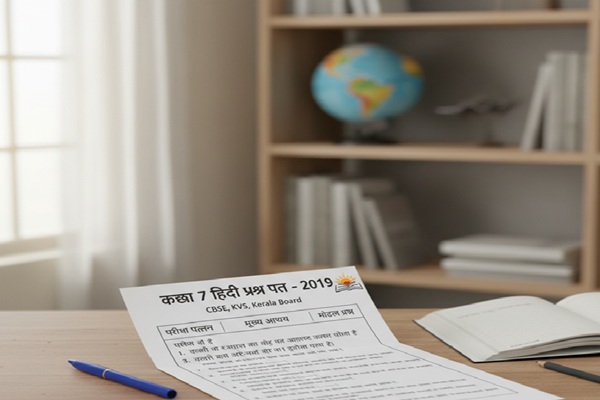
There is a specific reason the Hindi question paper from 2019 keeps showing up in search results six years later. 2019 was the last academic year before the pandemic disrupted school examinations. For Class 7 students and teachers, that makes the 2019 Hindi paper the clearest, most reliable reference for understanding how the subject is examined under normal conditions.
The challenge is that most pages you will find on this topic either give you vague three-line summaries or link you to papers that may not match your board. Class 7 Hindi exams differ significantly depending on whether your school follows CBSE, Kendriya Vidyalaya Sangathan (KVS), Kerala SCERT, or another state board. The textbooks are different, the grammar sections are different, and the marks distribution is different.
This guide covers all of that. You will find the exact paper structure for each board type, the actual Vasant and Durva chapters that fell within the 2019 exam scope, a full grammar topic breakdown, model questions built on the 2019 pattern, and a step-by-step preparation method that still works today.
Why the 2019 Hindi Paper Is Still the Right Paper to Practice
Students preparing for Class 7 Hindi today often ask whether a 2019 paper is still useful. The answer depends on one thing: did the syllabus change significantly between 2019 and now?
For CBSE Class 7, the core Hindi syllabus remained largely unchanged from 2019 through 2024. The Vasant Bhag 2 and Durva Bhag 2 textbooks that were in use during 2019 continued to be the primary textbooks. Grammar topics like samasa, sandhi, muhavare, and sarvnam have been part of Class 7 Hindi since well before 2019.
The 2019 paper therefore reflects the same question types, the same section structure, and the same grammar emphasis that students face today. The only adjustment needed is to check whether your school’s specific term syllabus matches the chapters tested in the 2019 exam.
| Aspect | 2019 Paper Relevance Today |
| NCERT textbooks (Vasant, Durva) | Same books still in use. Chapters may differ by term but content is identical. |
| Grammar topics tested | Sandhi, Samasa, Muhavare, Vilom, Paryayvachi still form the grammar backbone in current papers. |
| Paper format (sections) | Same 4-section pattern used in 2019 continues in current school-level exams. |
| Marks distribution | 80 marks written + 20 internal remains standard across CBSE and most state boards. |
| Writing section | Patra lekhan and anuchchhed lekhan formats from 2019 remain unchanged. |
| Apathit Gadyansh | Unseen passage section format, number of sub-questions, and marks allocation unchanged. |
Board-Wise Overview: Which Hindi Paper Are You Looking For?
The term ‘Hindi question paper 2019 Class 7’ means different things for students from different schools. Before downloading or practicing any paper, confirm which board your school follows.
| Board / System | Hindi Textbooks Used | Exam Authority |
| CBSE (Central Board) | Vasant Bhag 2, Durva Bhag 2 | CBSE / Individual school |
| KVS (Kendriya Vidyalaya) | Same as CBSE but KVS-designed question papers | KVS Regional Office |
| NCERT Model Schools | Vasant Bhag 2, Durva Bhag 2 | School-level under NCERT guidelines |
| Kerala Board (SCERT) | Kerala SCERT Hindi textbook (different from NCERT) | Department of General Education, Kerala |
| Chhattisgarh Board (CGBSE) | CGBSE Hindi textbook | Chhattisgarh Board of Secondary Education |
| UP Board | UP Board Hindi textbook | Uttar Pradesh Madhyamik Shiksha Parishad |
| Maharashtra Board | Balbharati Hindi textbook | Maharashtra State Bureau of Textbook Production |
This guide focuses primarily on the CBSE and KVS pattern, which is the most commonly searched version of the Class 7 Hindi 2019 paper. Kerala Board students will find a dedicated section later in this guide.
Hindi Question Paper 2019 Pattern for Class 7: Exact Section Breakdown
Understanding the structure of the paper is the first step. Here is the exact four-section pattern used in CBSE-aligned Class 7 Hindi papers in 2019. This pattern applies to both half-yearly and annual examination papers.
Section A: Apathit Gadyansh (Unseen Reading Comprehension)
This section carries 10 marks and includes one or two unseen passages. For each passage, students answer 4 to 5 sub-questions. Questions test the ability to extract meaning, identify the main idea, explain vocabulary in context, and write short answers based on the passage. In 2019 papers, most passages were 150 to 200 words in length.
Section B: Vyakaran (Grammar)
Grammar carries 20 marks and is the most structured section of the paper. It tests specific grammar topics through fill-in-the-blank, matching, and short-answer formats. The 2019 paper typically covered 8 to 10 grammar sub-topics in this section.
| Grammar Topics Most Commonly Tested in Class 7 Hindi 2019 Papers:
1. Sarvnam (Pronouns) – Identification and substitution 2. Visheshan (Adjectives) – Types and usage in sentences 3. Kriya (Verbs) – Tense forms and sentence construction 4. Muhavare aur Lokoktiyan (Idioms and Proverbs) – Meaning and usage in sentences 5. Vilom Shabd (Antonyms) – 4 to 5 pairs 6. Paryayvachi Shabd (Synonyms) – 4 to 5 words 7. Sandhi (Word Joining) – Basic sandhi vichchhed 8. Samasa (Compound Words) – Identify and explain the type 9. Vaakya Nirmaan (Sentence Formation) – Using given words 10. Shabd Bhandar (Vocabulary) – Matching or fill in the blank |
Section C: Paath Aadharit Prashna (Literature-Based Questions)
This section carries 30 marks and tests chapters directly from the Vasant Bhag 2 textbook. It includes short answer questions (2 to 3 marks each) and long answer questions (5 marks). Questions ask students to explain the meaning of passages, describe characters and themes, answer who-what-why questions about specific chapters, and write paragraph-length answers about the author’s message.
Section D: Lekhan Karya (Writing Skills)
Writing carries 20 marks. In the 2019 paper, this section typically included one or two of the following tasks: patra lekhan (letter writing), anuchchhed lekhan (paragraph writing), nibandh (essay), and sometimes a creative writing or story completion task. Students are expected to write 80 to 150 words for most tasks.
| Section | Marks Breakdown |
| Section A: Apathit Gadyansh (Unseen Comprehension) | 10 marks |
| Section B: Vyakaran (Grammar) | 20 marks |
| Section C: Paath Aadharit Prashna (Literature) | 30 marks |
| Section D: Lekhan Karya (Writing) | 20 marks |
| Total Written Marks | 80 marks |
| Internal Assessment | 20 marks (projects, portfolio, class tests) |
| Grand Total | 100 marks |
| Exam Duration | 2 hours to 2 hours 30 minutes |
Vasant Bhag 2 Chapters Covered in the 2019 Class 7 Hindi Exam
The literature section of any Class 7 Hindi paper draws entirely from the Vasant Bhag 2 textbook. Knowing which chapters were typically covered in the second half of the academic year (the period corresponding to the 2019 annual or half-yearly exam) helps you focus your revision.
Vasant Bhag 2 has 20 chapters. For a half-yearly or second-term exam in 2019, the paper would typically cover Chapters 9 onwards, depending on the school’s teaching pace. For an annual exam, all 20 chapters are in scope.
| Chapter | Title | Type | Likely in 2019 Exam |
| Ch 9 | Chidiya ki Bachchi (Jainendra Kumar) | Gadya (Prose) | Yes |
| Ch 10 | Apoorv Anubhav (Tetsuko Kurianagi) | Gadya | Yes |
| Ch 11 | Raheem ke Dohe (Rahim) | Padya (Poetry) | Yes |
| Ch 12 | Kancha (T. Padmanabhan) | Gadya | Yes |
| Ch 13 | Ek Tinka (Ayodhyasigh Upadhyay) | Padya | Yes |
| Ch 14 | Khaanpan ki Badalti Tasveer | Gadya | Yes |
| Ch 15 | Neelkanth (Mahadevi Verma) | Gadya | Yes |
| Ch 16 | Bhor aur Barkha (Meerabai) | Padya | Yes |
| Ch 17 | Veer Kunwar Singh | Gadya / Biography | Yes |
| Ch 18 | Sangharsh ke Karan (Dhanraj Pillay) | Gadya / Interview | Yes |
| Ch 19 | Ashram ka Anumanit Vyay | Gadya / Document | Selective |
| Ch 20 | Viplav Gayan (Balkrishna Sharma) | Padya | Yes |
Chapters 1 to 8 were typically covered in the first term. For the annual exam, schools include all chapters but the question distribution tends to favour the later chapters since those are fresher in students’ minds.
Durva Bhag 2: Second Language Supplementary Reader
Durva Bhag 2 is the supplementary reader for CBSE Class 7 Hindi. It contains 18 chapters of shorter, activity-based texts meant to build reading fluency. In most school exams including the 2019 papers, Durva chapters contribute a smaller share of questions compared to Vasant.
Questions from Durva in the 2019 paper typically appeared in the form of short comprehension questions (2 marks) or vocabulary-based questions. The following Durva chapters are most commonly tested:
- Chapter 1: Chidiya aur Churungun (Poem)
- Chapter 3: Main Hoon Robot (Prose – technology theme)
- Chapter 5: Thotha Chana Baje Ghana (Story)
- Chapter 8: Kyonjimali ki Duniya (Descriptive prose)
- Chapter 11: Himat aur Zindagi (Motivational prose)
- Chapter 14: Khoon aur Hamara Shareer (Science-linked reading)
- Chapter 15: Parivar mein Pyar (Social theme)
Note: Schools vary in how many Durva chapters they include in exams. If your school does not test Durva separately, those marks are redistributed to Vasant or grammar questions.
Grammar Section Breakdown: The 20 Marks You Should Not Lose
The grammar section is where most Class 7 students either secure easy marks or lose them unnecessarily. It is fully rule-based. If you know the topic, you will get the marks. There is no interpretation involved. Here is what the 2019 paper tested and how each topic was framed.
| Grammar Topic | How It Appeared in 2019 Paper | Marks |
| Sarvnam (Pronouns) | Fill in the blank with correct pronoun. Identify the type of pronoun used. | 2 |
| Visheshan (Adjectives) | Underline the adjective in a sentence. Write the visheshan for a given noun. | 2 |
| Kriya (Verbs) | Change the tense of underlined verbs. Identify the type of kriya. | 2 |
| Muhavare (Idioms) | Write the meaning of given muhavara. Use it in a sentence. | 3 |
| Vilom Shabd (Antonyms) | Write antonyms for 4 to 5 given words. | 2 |
| Paryayvachi Shabd (Synonyms) | Write two synonyms for each of the given words. | 2 |
| Sandhi Vichchhed | Break the given compound word into its parts and name the type. | 2 |
| Samasa | Identify the type of samasa for the given compound word. | 2 |
| Vaakya Sudhi (Sentence Correction) | Correct grammatical errors in given sentences. | 2 |
| Shabd Bhandar / Matching | Match Hindi words to their meanings or categories. | 1 |
Writing Section: What the 2019 Paper Expected
The writing section in the 2019 Class 7 Hindi paper tested two types of tasks. Understanding exactly what each task requires helps you write answers that score full marks.
Patra Lekhan (Letter Writing) – 8 to 10 Marks
The 2019 papers included either a formal letter (aupcharik patra) or an informal letter (anaupcharik patra). Common topics in 2019 included: writing to a friend about a trip, writing to a principal requesting leave, writing to a parent describing school life, and writing to a library for book donation requests.
The expected format includes: date, sender address, salutation, body paragraphs (2 to 3 short paragraphs), vaishyavaran, and sender name. Letters that follow the correct format receive full format marks even if the content is average.
Anuchchhed Lekhan (Paragraph Writing) – 5 to 8 Marks
Students were asked to write a paragraph of 80 to 100 words on a given topic. Common topics in 2019 Class 7 Hindi papers included: my favourite teacher, importance of trees, Diwali celebrations, my morning routine, and the value of friendship. Paragraphs are evaluated for content relevance, sentence structure, grammar accuracy, and neat presentation.
Nibandh (Essay) – Optional in Some Schools
Some KVS and CBSE schools in 2019 included a short essay question of 150 words instead of or alongside the paragraph task. Essay topics followed themes from the Vasant textbook chapters or general awareness. Students were evaluated on organisation, sentence variety, and topic coherence.
| Writing Task Type | Marks Typically Allocated in 2019 |
| Formal Letter (Aupcharik Patra) | 8 to 10 marks |
| Informal Letter (Anaupcharik Patra) | 8 to 10 marks |
| Paragraph Writing (Anuchchhed) | 5 to 8 marks |
| Short Essay (Nibandh) | 5 to 8 marks (if included) |
| Story Completion / Creative Writing | 4 to 5 marks (selective schools) |
Model Questions Based on the 2019 Class 7 Hindi Paper Pattern
The following questions are based on the actual pattern, section structure, and topic coverage of the 2019 Class 7 Hindi examination. These are representative questions, not copied from any specific paper.
Section A: Apathit Gadyansh (Sample)
Read the following passage and answer the questions below:
| Neeche diya gaya gadyansh padhkar niche pooche gae prashnon ke uttar likhiye:
Ped-paudhe hamare jeevan ka aadhaar hain. Ve hamein oxygen dete hain, barishon ko bulate hain, aur dharti ki mitti ko rokate hain. Jab hum ped kaatat hain, to hum apne aap ko hi nuksan pahuchate hain. Isliye hamein prayavaran ki raksha ke liye adhik se adhik ped lagane chahiye aur unhe katne se rokna chahiye.
1. Is gadyansh ka uchit shirshak likhiye. (1 ank) 2. Ped-paudhe hamare kya kaam aate hain? Do binduon mein likhiye. (2 ank) 3. ‘Prayavaran’ shabd ka arth likhiye. (1 ank) 4. Is gadyansh se do sarvnam shabd chunkar likhiye. (1 ank) |
Section B: Vyakaran (Grammar Sample Questions)
- Niche diye gae shabdon ke vilom likhiye: (2 ank)
- (i) sukha (ii) preem (iii) din (iv) shuru
- Niche diye gae muhavaron ka arth likhkar vakya mein prayog keejiye: (3 ank)
- (i) naak katana (ii) aankhon ka taara (iii) haath malte rehna
- Niche diye gae shabdon ke do-do paryayvachi likhiye: (2 ank)
- (i) aasman (ii) paani (iii) phool (iv) ratri
- Sahi sandhi vichchhed keejiye: (2 ank)
- (i) Vidyarthi (ii) Mahesh (iii) Navaagat (iv) Swaagat
Section C: Paath Aadharit (Literature Sample Questions)
- ‘Chidiya ki Bachchi’ kahaani ki mukhya paatra ka swabhav kaise tha? Unke vyavahaar ka ek udaaharan deejiye. (3 ank)
- ‘Raheem ke Dohe’ mein se kisi ek dohe ka arth apne shabdon mein likhiye aur uski seekh bataiye. (3 ank)
- ‘Neelkanth’ path ke lekhika ka naam likhiye aur is path mein unke manoranjan ka kya sadhan tha? (2 ank)
- ‘Veer Kunwar Singh’ path ke aadhar par unki veerta ka ek prasang apne shabdon mein likhiye. (5 ank)
Section D: Lekhan (Writing Sample Question)
- Apne mitra ko ek patra likhiye jis mein aap apni grisha avkash ki yaadon ka varnan karein. (8 ank)
- Niche diye gae vishay par 80 se 100 shabdon mein ek anuchchhed likhiye: ‘Mera Priya Tyohar’ (5 ank)
Kerala Board Class 7 Hindi 2019: A Separate System
If you are a student in Kerala, the Hindi question paper you are looking for is completely different from the CBSE version. Kerala Board (SCERT Kerala) follows its own Hindi textbook and examination pattern for Class 7.
The Kerala Class 7 Hindi paper in 2019 was part of the Second Terminal Examination (Christmas Exam) held in December 2019. The paper followed the SCERT Kerala Hindi curriculum, which is a second-language Hindi course rather than a first-language one.
| Feature | Kerala Board Class 7 Hindi 2019 |
| Textbook | SCERT Kerala Hindi textbook (not Vasant or Durva) |
| Exam Type | Second Terminal Examination (Christmas Exam) |
| Total Marks | 60 marks written (lower than CBSE’s 80) |
| Paper Duration | 2 hours |
| Grammar Coverage | Basic grammar suited to second-language learning |
| Writing Tasks | Simple letter writing and paragraph based on textbook themes |
| Medium of Instruction | Malayalam medium or English medium |
| Download Source | Education Observer (educationobserver.com) – Kerala section |
| Answer Key Availability | Available through Education Observer and teacher networks |
Kerala Board students should specifically search for ‘Kerala Class 7 Hindi Christmas Exam 2019 paper’ or ‘SCERT Kerala STD 7 Hindi second terminal question paper 2019’ to find the correct version.
Also Read : 8th Class Question Paper 2019 – All Boards, All Subjects | PDF Download Guide
CBSE vs KVS vs State Board: How the 2019 Hindi Papers Differed
A common confusion among students is that all Class 7 Hindi papers from 2019 are the same. They are not. Here is a side-by-side comparison to help you identify exactly which paper matches your school.
| Feature | CBSE (School Level) | KVS 2019 | Kerala SCERT 2019 |
| Textbook | Vasant + Durva | Vasant + Durva | SCERT Kerala Hindi |
| Total Written Marks | 80 | 80 | 60 |
| Grammar Marks | 20 | 20 | 15 |
| Literature Marks | 30 | 28-30 | 25 |
| Writing Marks | 20 | 20 | 15 |
| Common Paper | School-set paper | KVS regional paper | District-level common paper |
| Answer Key | School provides | KVS regional office | SCERT / Education Observer |
| Difficulty | Moderate | Moderate to slightly higher | Easy to moderate |
Common Mistakes Students Make in the Class 7 Hindi Exam
These mistakes come up repeatedly in Hindi exam answer sheets and cost students marks they could easily have kept.
- Writing grammar answers without reading the question type carefully. Many students write the vilom (antonym) when the question asked for paryayvachi (synonym) or vice versa. Read each sub-question fully before writing.
- Skipping the muhavara sentence in writing tasks. Most grammar questions on idioms ask for both the meaning AND a sentence using the idiom. Students who write only the meaning lose half the marks for that question.
- Writing the letter in English format. Hindi letters have a specific format including date placement, greetings in Hindi, and the ending phrase. Using an English-style format causes format marks to be deducted.
- Answering literature questions without chapter reference. Long answers in Section C should include the chapter name, the character’s name, and specific details from the text. General answers without textbook grounding score lower.
- Leaving the anuchchhed (paragraph) too short. Many students write 40 to 50 words when the question asks for 80 to 100 words. Short paragraphs lose marks for development and content coverage.
- Not checking sandhi vichchhed answers. Sandhi is a precise topic. One incorrect vowel change invalidates the answer. Practice common sandhi pairs and double-check before submission.
- Writing carelessly in the apathit gadyansh section. The unseen passage is the only section where students have all the answers in front of them. Losing marks here due to careless reading is avoidable.
How to Prepare Using the 2019 Hindi Question Paper
Most students approach previous year papers the wrong way. They read through the questions, feel vaguely familiar with the topics, and think they are prepared. That does not work for Hindi, and here is why: Hindi exams test writing skill, not just recall. You cannot practice writing by reading.
The Right Approach
- Download the 2019 Hindi question paper that matches your board (CBSE, KVS, or state board). Verify it is the correct class, year, and school type.
- Read through the paper once without attempting. Note the sections, the number of questions, and which chapters appear in Section C.
- Identify which Vasant Bhag 2 chapters are covered in the literature questions. Compare with your current syllabus to confirm overlap.
- Set a timer for 2 hours and attempt the full paper on paper. Not on a screen and not in your head. Write every answer as you would in the real exam.
- After finishing, evaluate your Section B (grammar) answers against a textbook or answer key. Mark strictly and count your score.
- For Section C and D, evaluate your answers yourself: Did you mention the chapter and character by name? Did your letter have all the required format elements? Did your paragraph reach the word count?
- Note the three areas where you lost most marks. Spend the next week specifically on those three things.
- Repeat with another paper (a sample paper from a different year or a model paper) to measure improvement.
Subject-Specific Revision Focus
| Area | Best Revision Strategy |
| Grammar (Section B) | Write 5 vilom, 5 paryayvachi, 2 sandhi, and 1 muhavara sentence daily. Do not just memorise lists. |
| Literature (Section C) | For each Vasant chapter, write 3 lines on: what happens, who the main character is, what the message is. |
| Writing (Section D) | Practice writing one full letter and one anuchchhed every two days. Check format after each attempt. |
| Unseen Passage (Section A) | Read one short Hindi passage daily from a newspaper or textbook and answer self-made questions. |
Where to Find the Hindi Question Paper 2019 for Class 7
The 2019 Hindi Class 7 paper is available from several free sources. Use the source that matches your board type.
- StudiesToday (studiestoday.com): Maintains a large archive of CBSE Class 7 Hindi question papers and sample papers including 2019-20 session papers. Papers are available by set (Set A, Set B) and include solutions.
- LearnCBSE (learncbse.in): Provides CBSE Class 7 Hindi sample papers with solutions for the 2019-20 session. Particularly strong on NCERT-based literature questions and grammar answer keys.
- AglaSem Schools (schools.aglasem.com): Has CBSE Class 7 Hindi papers organized by year and includes both solved and unsolved versions. Navigation is straightforward.
- AECS School Websites (e.g. aecsrbt3.ac.in): Atomic Energy Central Schools publish their own previous year papers including 2019-20 Class 7 Hindi. These are KVS-pattern papers and are particularly useful for students in AECS or KVS schools.
- Education Observer (educationobserver.com): Best source for Kerala SCERT Class 7 Hindi 2019 papers. Organized by year, class, and subject with both English and Malayalam medium options.
- Vedantu (vedantu.com): Offers CBSE Class 7 Hindi sample papers with detailed solutions and marking scheme explanation. Good for understanding how to write answers that score full marks.
- Your class teacher or school library: The most reliable source. Most schools retain printed question papers from previous years. A direct request to your Hindi teacher is the fastest way to get the actual 2019 paper used in your school or affiliated region.
Frequently Asked Questions
Q1. Is the Hindi question paper for Class 7 in 2019 the same across all CBSE schools?
No. CBSE does not issue a single common question paper for Class 7 Hindi. Each school prepares its own paper based on the CBSE syllabus guidelines. KVS (Kendriya Vidyalaya schools) use a common paper set by the KVS regional office. The chapters tested and the specific questions will differ between schools, but the paper format, section structure, and marks distribution are uniform.
Q2. Which Vasant chapters were in scope for the Class 7 Hindi annual exam in 2019?
For the annual examination in 2019-20, all chapters of Vasant Bhag 2 (Chapters 1 to 20) were in scope. For a half-yearly or second-term exam held in November or December 2019, typically Chapters 9 to 18 or 20 would have been covered depending on the school’s teaching pace. Chapters 1 to 8 are generally in scope for the first-term exam.
Q3. How many marks does the grammar section carry in the Class 7 Hindi 2019 paper?
The grammar section (Vyakaran) carries 20 marks in the standard CBSE Class 7 Hindi question paper. It covers topics including sarvnam, visheshan, kriya, muhavare, vilom, paryayvachi, sandhi, and samasa. Grammar is the most mark-dense section per topic and rewards consistent daily practice more than last-minute revision.
Q4. Where can I get the answer key for the Hindi question paper 2019 Class 7?
For CBSE and KVS papers, official answer keys are provided by the school or the KVS regional office. Community answer keys are available on StudiesToday, LearnCBSE, and Vedantu. For Kerala SCERT papers, Education Observer provides teacher-prepared answer keys. Note that for literature and writing sections, answers are evaluated holistically and exact wording will differ between students.
Q5. Is the 2019 Hindi paper useful for students preparing for the 2025 exam?
Yes. The NCERT Vasant Bhag 2 and Durva Bhag 2 textbooks have not changed fundamentally since 2019. The grammar topics and their testing format remain the same. The paper section structure (A, B, C, D) with the same marks breakdown is still in use. Practicing the 2019 paper gives students a clear, unmodified version of the standard Class 7 Hindi exam format.
Q6. How is the Class 7 Hindi paper different from the Class 8 Hindi paper?
Class 7 Hindi uses Vasant Bhag 2 and Durva Bhag 2. Class 8 Hindi uses Vasant Bhag 3 and Durva Bhag 3 which contain more complex prose and poetry. Grammar in Class 8 extends to topics like upsarg-pratyay, alankar, and more complex sandhi. The paper structure (four sections) remains similar but the content difficulty and grammar depth increase in Class 8.
Q7. What is the passing mark for Class 7 Hindi?
For CBSE affiliated schools, the passing mark for Class 7 Hindi is 33 percent of total marks. On an 80-mark written paper, this means a minimum of 27 marks from the written exam. Including the 20 marks internal assessment, the combined passing threshold is 33 marks out of 100. Most schools require students to pass both the written and internal components independently.
Q8. How long should I spend on each section during the Hindi exam?
A practical time split for the 2-hour Class 7 Hindi exam: Section A (unseen passage) 15 minutes, Section B (grammar) 30 minutes, Section C (literature questions) 40 minutes, Section D (writing) 25 minutes. Reserve 10 minutes for review and to check that all questions are attempted. The writing section benefits most from unhurried time, so do not let grammar sub-questions consume too much time.
Q9. Do Durva Bhag 2 questions appear in the 2019 Class 7 Hindi paper?
Yes, but in smaller proportion than Vasant. In most 2019 Class 7 Hindi papers, one or two questions from Durva appeared in Section C as short-answer questions worth 2 marks each. Durva chapters were also occasionally referenced in the unseen passage or vocabulary sections. Vasant chapters dominate the literature section and carry the majority of Section C marks.
Q10. What format should a Class 7 Hindi letter follow?
A formal Hindi letter (aupcharik patra) follows this format: date at the top right, sender’s address, receiver’s designation and address, subject line, salutation (Mahodaya or Mahodaya ji), body in 2 to 3 short paragraphs, closing phrase (Aapka aagyadkari vidyarthi or similar), and sender’s name and class. An informal letter to a friend uses Priya Mitra as the salutation and a warmer closing. Both formats carry dedicated format marks, so following the structure correctly guarantees some marks even if the content is average.
Conclusion: Use the 2019 Paper as a Practice Tool, Not a Reading Exercise
The Hindi question paper from 2019 for Class 7 is one of the most useful preparation resources available. It shows you exactly how the paper is structured, which grammar topics carry marks, which Vasant chapters generate the most questions, and what the writing section actually expects.
The students who benefit most from it are the ones who sit down with a pen and actually write answers under timed conditions. Reading through a question paper and feeling familiar with it is not the same as practicing Hindi writing under exam pressure.
Use the 2019 paper, time yourself, write every answer, evaluate your grammar section against a key, and identify where your marks are going. That process, repeated with two or three papers, is the most reliable path to scoring well in Class 7 Hindi.