
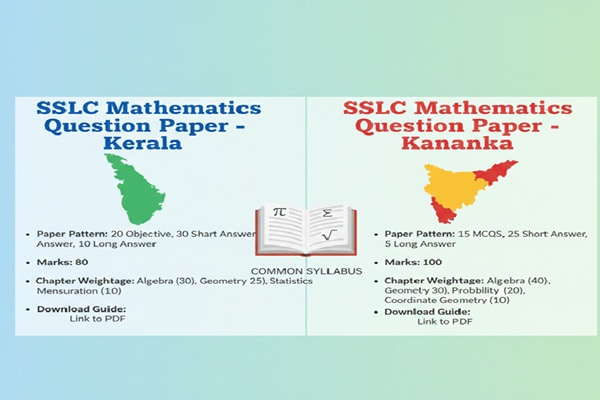
Talk to any teacher who evaluates SSLC Maths answer sheets, and they will tell you the same thing. The most common reason students lose marks is not because they do not know the answer. It is because they write the final answer without showing the steps that led to it.
Kerala SSLC Maths awards marks for correct method at every stage of a solution. A student who writes a wrong final answer but correct intermediate steps will score more than a student who writes only the correct final answer with no working shown. Karnataka follows a similar principle for its long answer sections.
This guide covers everything about the SSLC Mathematics question paper across Kerala and Karnataka: the exact paper structure, how marks are distributed chapter by chapter, what previous year papers reveal about question patterns, where to download official papers and answer keys, and how to prepare in a way that earns marks even when you are not 100 percent certain of an answer.
Which Board Are You Looking For? SSLC Maths Across India
The term SSLC (Secondary School Leaving Certificate) is used by Kerala, Karnataka, and Tamil Nadu for their Class 10 board exams. The Maths paper is different across each board. Before downloading anything, confirm which board you need.
| Board | Conducting Body | Total Marks | Duration | Paper Format | Official Website |
| Kerala SSLC | Kerala Pareeksha Bhavan (BPE) | 80 (theory) + 20 (internal) = 100 | 2 hours 45 minutes | Descriptive step-wise. No MCQs. 4 sections with increasing marks per question. | sslcexam.kerala.gov.in |
| Karnataka SSLC | KSEAB (Karnataka School Examination and Assessment Board) | 80 marks | 3 hours 15 minutes | Mixed: MCQ (1 mark), fill-in-the-blank, short answer (2 marks), long answer (3-4 marks), theorem proof. | kseab.karnataka.gov.in |
| Tamil Nadu SSLC | Tamil Nadu Government (DGE) | 100 marks | 3 hours | Mixed: MCQ, 2-mark short answer, 5-mark descriptive, 8-mark long answer. | dge.tn.gov.in |
This guide focuses primarily on Kerala and Karnataka SSLC Maths, as these two boards generate the highest search volume for this keyword. Tamil Nadu SSLC Maths is covered in a dedicated section at the end.
Kerala SSLC Mathematics Question Paper: Complete Guide
Kerala SSLC is conducted by the Board of Public Examinations (Pareeksha Bhavan). The Mathematics examination in 2026 was held on March 16, from 9:30 AM to 12:15 PM. It is one of the most important papers in the Kerala SSLC examination and follows a unique step-wise answer format that rewards process knowledge as much as correct answers.
Kerala SSLC Maths Paper Pattern 2026
| Section | Marks per Question | Number of Questions | Total Marks | Instructions |
| Section 1 | 2 marks each | 6 questions (any 5 to be answered) | 10 marks | Short answer type. Concept-based. Usually one or two steps required. |
| Section 2 | 3 marks each | 7 questions (any 5 to be answered) | 15 marks | Problem-solving questions requiring 3 to 4 steps. Show all intermediate steps. |
| Section 3 | 4 marks each | 7 questions (any 4 to be answered) | 16 marks | Application-type problems. Diagrams, proofs, algebraic working required. |
| Section 4 | 5 marks each | 5 questions (any 3 to be answered) | 15 marks | Long answer / complex problem-solving. Full step-wise working mandatory. Proof or derivation type included. |
| Bonus Internal Score | 20 marks | From school (projects, tests, attendance) | 20 marks | Added to theory marks for final result. |
| Total Theory | 56 marks from attempted questions | Score shown on mark sheet: Theory + Internal = 80 marks total (56 theory + up to 24 varies by year) |
Note on Kerala SSLC Maths: The above pattern reflects the 2025-26 structure. In some years the section distribution changes slightly. Always verify the current year structure from the official model question paper released by SCERT Kerala on sslcexam.kerala.gov.in.
Chapter-wise Marks Weightage for Kerala SSLC Maths
Based on the official SCERT blueprint and the pattern observed across 2019 to 2026 papers, here is how marks are typically distributed across chapters:
| Chapter | Typical Marks Weightage | Most Common Question Types | Priority Level |
| Arithmetic Sequences | 8 to 10 marks | Find the nth term, sum of terms, sequence problems using real-life contexts | Very High |
| Polynomials | 6 to 8 marks | Find zeros, factorize, draw graphs, polynomial division | Very High |
| Pair of Linear Equations | 6 to 8 marks | Solve by substitution and elimination, graphical interpretation | High |
| Second Degree Equations (Quadratic) | 6 to 8 marks | Solve using factorization and formula, form equations from word problems | High |
| Trigonometry | 6 to 8 marks | Trigonometric ratios, complementary angles, heights and distances | High |
| Circles | 4 to 6 marks | Tangent properties, angle in semicircle, chord properties | High |
| Coordinates and Geometry | 4 to 6 marks | Distance formula, section formula, slope and midpoint | Medium |
| Statistics | 4 to 5 marks | Mean, median, mode from grouped data | Medium |
| Probability | 3 to 4 marks | Basic probability, sample space, events | Medium |
| Solids (Surface Area and Volume) | 4 to 6 marks | Cone, cylinder, sphere, combinations of solids | Medium |
| Proofs in Mathematics (Chapter A1) | 4 to 5 marks | Mathematical proofs, logical reasoning | Medium |
| Mathematical Modelling (Chapter A2) | 2 to 3 marks | Model real situations using mathematics | Lower Priority |
Kerala SSLC Maths: Step-wise Scoring Explained
This is the single most important concept for Kerala SSLC Maths preparation. Unlike objective exams, Kerala SSLC awards marks for each correct step in a solution. Here is how it works in practice:
| Question Type | How Marks Are Awarded | Practical Example |
| 2-mark short answer | Usually 1 mark for correct setup + 1 mark for correct answer | Finding the nth term of a sequence: 1 mark for writing the formula, 1 mark for correct substitution and result. |
| 3-mark question | 1 mark per correct step. If 3 steps, 1 mark each. | Solving a quadratic by factorization: 1 mark for standard form, 1 mark for correct factors, 1 mark for both roots. |
| 4-mark question | Typically 1 mark each for 4 identifiable steps or sub-parts | A circle-tangent proof: marks awarded for each correct geometric reasoning step. |
| 5-mark question | 1 or 2 marks per step across 3 to 5 evaluable stages | A Heights and Distances problem: 1 mark for diagram, 1 mark for identifying ratios, 2 marks for calculation, 1 mark for final answer with units. |
This means: always attempt a question even if you are unsure of the final answer. Set up the problem correctly, write the relevant formula, and show as many steps as you know. Partial marks for correct method are consistently awarded in Kerala SSLC evaluation.
Kerala SSLC Maths: Chapter-wise Important Questions Based on Previous Papers
These question types have appeared repeatedly across 2019 to 2026 Kerala SSLC Maths papers:
- Arithmetic Sequences: Given three terms, find the common difference and sum of first n terms. Find which term of a sequence equals a given value.
- Polynomials: Given the sum and product of zeros, write the polynomial. Draw the graph of a quadratic and identify zeros.
- Linear Equations: A problem gives two conditions (e.g., two numbers, sum and difference given). Form two equations and solve.
- Quadratic Equations: A rectangle or other geometric shape has area given. Form and solve the quadratic. Interpret the solution in the context given.
- Trigonometry: Two poles of given heights, angles of elevation or depression to find distance or height. Always draw a labelled diagram first.
- Circles: Prove that tangent is perpendicular to radius at point of contact. Alternate segment theorem applications. Chord-distance problems.
- Statistics: Calculate mean, median, or mode from a grouped frequency table. The table is always given; identify the correct formula for each measure.
- Probability: A bag of coloured balls or a pack of cards. Find probability of specific events. Simple calculations but correct setup required.
- Solid Geometry: A solid is given (cone placed on cylinder, or hemisphere on sphere). Find total surface area and volume.
Where to Download Kerala SSLC Maths Question Papers
| Source | What Is Available | Direct Navigation |
| sslcexam.kerala.gov.in | Official SCERT model question papers for the current year. Most accurate for paper pattern. | Go to sslcexam.kerala.gov.in > Publications > Model Question Papers > Select Maths |
| educationobserver.com | Most comprehensive. Previous year papers 2014 to 2026, model papers from all 14 DIETs (SMILE, EQUIP series), and answer keys. | Go to educationobserver.com > SSLC section > Mathematics > Download links organized by year and type |
| hsslive.guru | Kerala SSLC Maths model question papers Set 1 to Set 4 in English Medium and Malayalam Medium with full answers. | Go to hsslive.guru > search “SSLC Maths model question paper” > download Set 1 to 4 PDFs |
| hsslive.in | SCERT official model papers Sets A, B, C for the current year in both mediums. | Go to hsslive.in > search “SSLC model question paper 2026” |
| careers360.com (school section) | Previous year Kerala SSLC Maths papers 2019 to 2026 with answer keys. | Go to school.careers360.com > Boards > Kerala Pareeksha Bhavan > SSLC Maths Question Paper |
| competitivecracker.com | SCERT model papers for 2026 all subjects including Maths in PDF. | Go to competitivecracker.com > search “Kerala SSLC Model Question Papers 2026” |
Karnataka SSLC Mathematics Question Paper: Complete Guide
Karnataka SSLC is conducted by KSEAB (Karnataka School Examination and Assessment Board). The Maths paper in 2025 was held on March 24, from 10:00 AM to 1:15 PM, and the 2026 paper was held in the same window. Karnataka SSLC Maths is known for its structured blueprint which distributes marks across difficulty levels.
Karnataka SSLC Maths Paper Pattern 2026
| Section | Question Type | Questions | Marks | Notes |
| Section A | Multiple Choice Questions (MCQ) – 1 mark each | 8 MCQs (all compulsory) | 8 marks | Objective, no steps needed. Covers concepts from all chapters. Speed-round section. |
| Section B | Very Short Answer (VSA) – 1 mark each | 8 VSA questions (all compulsory) | 8 marks | One-line answers. Formulas, definitions, identify a property. |
| Section C | Short Answer (SA) – 2 marks each | 16 questions (answer 12) | 24 marks | Show working for full marks. Usually 2 to 3 steps per question. |
| Section D | Long Answer (LA) – 3 marks each | 9 questions (answer 8) | 24 marks | Full working required. Includes theorem proof and 1 graph-based question. |
| Section E | Long Answer / Construction / Proof | 4 questions (answer 2) | 16 marks | Includes geometric construction (8 marks), proof/derivation (4 marks). Compass and ruler needed for construction. |
| Total | 45 questions given, 38 to be answered | 80 marks | School candidates: 38 questions, 80 marks. Private candidates: 48 questions, 100 marks. |
Karnataka SSLC Maths: Chapter-wise Marks Weightage
| Chapter | Marks Range | Typical Question Types | Difficulty Level |
| Real Numbers | 4 to 5 marks | Euclid division lemma, HCF and LCM, rational/irrational identification | Easy |
| Polynomials | 4 to 6 marks | Find zeros, form polynomial from zeros, polynomial division | Easy to Medium |
| Pair of Linear Equations | 5 to 7 marks | Graphical and algebraic methods, word problems | Medium |
| Quadratic Equations | 5 to 6 marks | Solve by factorization, complete square, and formula. Discriminant. | Medium |
| Arithmetic Progressions | 4 to 5 marks | nth term, sum of n terms, word problems using AP | Easy |
| Triangles (Similar Triangles, Pythagoras) | 5 to 7 marks | Proof of Pythagoras, similarity criteria, proportionality theorem | High (proof required) |
| Coordinate Geometry | 4 to 5 marks | Distance formula, section formula, slope, midpoint | Medium |
| Introduction to Trigonometry | 4 to 6 marks | Ratios, identities, complementary angle relationships | Medium |
| Heights and Distances | 3 to 4 marks | Word problems using trigonometric ratios, draw diagram first | Medium |
| Circles (Tangents) | 5 to 7 marks | Tangent from external point, tangent-radius perpendicularity proof, chord-angle | High (proof required) |
| Constructions | 8 marks (Section E) | Division of line segment, construction of tangents, similar triangle construction | Very High (full marks easily earned with practice) |
| Surface Area and Volume | 4 to 6 marks | Combination of solids, frustum, conversion of shapes | Medium |
| Statistics | 4 to 5 marks | Mean, median, mode from grouped data, ogive curve | Medium |
| Probability | 3 to 4 marks | Classical probability, simple events | Easy |
The Construction Question: 8 Marks You Should Not Miss
In Karnataka SSLC Maths, the Geometric Construction question in Section E carries 8 marks and is considered one of the easiest scoring opportunities in the entire paper. Students who practice constructions consistently earn full 8 marks here.
The 2025 paper required the construction of a triangle similar to a given triangle with a given scale factor. The 2024 paper had construction of tangents to a circle from an external point. Both are standard constructions with clear steps that can be memorized.
- Practice the two most common construction types: (1) Division of a line segment in a given ratio, and (2) Construction of tangents to a circle from an external point.
- Use a sharp pencil and a good compass. Marks are deducted for untidy or inaccurate constructions in KSEAB evaluation.
- Write the steps of construction alongside the diagram. The steps carry marks independently from the diagram.
- Always label all points (A, B, C, T1, T2) as per the question requirement.
Where to Download Karnataka SSLC Maths Question Papers
| Source | What Is Available | Direct Navigation |
| kseab.karnataka.gov.in | Official KSEAB website. Has model question papers for 2024, 2025, 2026 for Maths in English and Kannada Medium. | Go to kseab.karnataka.gov.in > Model Question Papers > Class 10 > Maths |
| kseebsolutions.com | KSEEB Karnataka SSLC Maths model papers 2021-22 onwards with answers. Includes Kannada Medium and English Medium sets. | Go to kseebsolutions.com > KSEEB SSLC Maths Model Question Papers section |
| shiksha.com (school section) | Karnataka SSLC Maths previous year papers 2019 to 2025 (Sets A, B, C, D) in PDF. Answer keys included for 2025. | Go to school.shiksha.com > Karnataka SSLC > Question Papers > Mathematics |
| careers360.com (school section) | Karnataka SSLC Maths 2025 paper with answer key from KSEAB subject experts. Previous year papers 2019 to 2024. | Go to school.careers360.com > Boards > KSEEB > Karnataka SSLC Maths Question Paper |
| vedantu.com | Karnataka SSLC Maths previous year papers with step-by-step solutions and important questions analysis. | Search “Karnataka SSLC Maths question paper” on vedantu.com |
Kerala SSLC vs Karnataka SSLC Maths: How the Papers Differ
Students often confuse the two boards when searching for SSLC Maths papers. Here is a clear comparison to help you understand which paper is yours.
| Factor | Kerala SSLC Maths | Karnataka SSLC Maths |
| Total Theory Marks | 80 marks theory + 20 marks internal | 80 marks (all theory, no separate internal component in the main paper) |
| Exam Duration | 2 hours 45 minutes | 3 hours 15 minutes (includes 15 min reading time) |
| Question Format | Entirely descriptive. No MCQs. Step-wise solutions required for all questions. | Mixed format: MCQ (16 marks), Short Answer (24 marks), Long Answer (24 marks), Construction/Proof (16 marks) |
| Choice in Paper | Significant choice: answer 5 of 6 in Section 1, 5 of 7 in Section 2, 4 of 7 in Section 3, 3 of 5 in Section 4 | Limited choice: answer 12 of 16 in Section C, 8 of 9 in Section D, 2 of 4 in Section E. MCQs and VSAs are compulsory. |
| Construction Question | Not a standard standalone section. Geometric constructions appear within regular question sections. | Dedicated Section E with 8-mark construction question. Major scoring opportunity. |
| Proof/Theorem | Appears in higher-mark sections (4 or 5 marks). Circle theorems and polynomial factorization proofs. | Appears in Section D (3-mark) and Section E (part of 8-mark). Pythagoras proof appears almost every year. |
| Internal Assessment | 20 marks from school (projects, tests). Added to 80 marks theory for 100 total. | Final result = theory marks only (80 marks). Internal activities inform promotion but final board exam is 80 marks. |
| Passing Marks | D+ grade (30-39% = 24 to 31 marks out of 80 theory minimum) | Minimum 35% of 80 = 28 marks for regular pass |
| Textbook Basis | SCERT Kerala Class 10 Mathematics (KBPE syllabus) | NCERT Mathematics Class 10 (Karnataka state adaptation by KSEAB) |
| Medium | Malayalam Medium and English Medium (separate papers) | Kannada Medium and English Medium (separate papers for Section A and B language context; Maths content identical) |
Tamil Nadu SSLC Mathematics Question Paper
Tamil Nadu uses the term SSLC for its Class 10 public exam conducted by the Directorate of Government Examinations (DGE). The Maths paper carries 100 marks and follows a distinct structure from both Kerala and Karnataka.
| Section | Type | Questions | Marks |
| Part I | 1-mark MCQs (choose the correct answer) | 15 MCQs + 1 additional question = 14 to be answered | 14 marks |
| Part II | 2-mark short answer questions | 10 questions (any 10 from 12) | 20 marks |
| Part III | 5-mark short descriptive | 10 questions (any 8 from 14) | 40 marks |
| Part IV | 8-mark long answer (one choice per question) | 2 compulsory (choice given for each) | 16 marks |
| Total | 100 marks |
Tamil Nadu SSLC Maths question papers are available on tnkalvi.net (official Tamil Nadu government portal), padasalai.net, and nammakalvi.com. Previous year papers from 2018 to 2024 are available with full solutions.
What Previous Year SSLC Maths Papers Reveal: Pattern Analysis 2019 to 2026
Across all three boards, certain chapters and question types repeat with remarkable consistency. Here is what the data from 7 years of papers shows:
Kerala SSLC Maths: Chapters That Appear Every Year
- Arithmetic Sequences: Guaranteed 8 to 10 marks. Usually appears in Sections 2, 3, and 4. Never skipped in any year from 2019 to 2026.
- Polynomials: Guaranteed 6 to 8 marks. Graph drawing of a quadratic appeared in 5 of 7 years. Finding zeros from graph appeared in 4 of 7 years.
- Trigonometry and Heights and Distances: Combined 8 to 10 marks. A practical problem (pole height, angle of elevation) appeared in all 7 years without exception.
- Circles: Tangent-related questions (proof or application) appeared in 6 of 7 years. Alternate segment theorem appeared in 4 of 7 years.
- Statistics: Mean or median from grouped data appeared in all 7 years. The table is always provided; marks come from correct formula and calculation.
Karnataka SSLC Maths: Questions That Repeat Most
- Pythagoras theorem proof: Appeared in 5 of 7 years in Section D. This is a 3-mark question with a fixed proof structure. Memorize and practice the proof.
- Construction of tangents to a circle from an external point: Appeared in 4 of 7 years in Section E. Always practice this construction with accurate measurement.
- Arithmetic Progression sum: Appeared in MCQ, SA, and LA sections in all 7 years. At least 4 to 5 marks every year.
- Quadratic formula question: Appeared in SA or LA in every year. Discriminant calculation with nature of roots appeared in 5 of 7 years.
- Statistics (Mean using step-deviation method): Appeared in all 7 years in the SA section. The step-deviation formula is specifically tested because it simplifies calculation.
How to Prepare Using SSLC Maths Model Question Papers
Here is a proven three-phase preparation method based on how top-scoring students use SSLC Maths question papers:
Phase 1: Pattern Recognition (First Week with Model Papers)
- Download 2 model papers and one previous year paper. Read through all three without solving.
- For each paper, mark every question with its chapter name. Count the marks per chapter.
- Identify the top 5 chapters by marks across all three papers. These are your mandatory preparation chapters.
- For Kerala SSLC: note which sections have the most choice. Section 3 (4 marks) and Section 4 (5 marks) often allow you to skip your weakest chapters.
- For Karnataka SSLC: the Construction section in Section E is always 8 marks. Decide immediately to commit to this section and practice it until you can score full marks.
Phase 2: Chapter-by-Chapter Preparation (4 to 6 Weeks)
- Work through each high-priority chapter from the textbook: understand the concept, study 3 solved examples, then attempt 10 questions from model papers for that chapter only.
- For Kerala SSLC: practice writing step-wise solutions from day one. Never write only the final answer. Every intermediate step must be visible and labeled.
- For Karnataka SSLC: separate your preparation into short-answer practice (20 minutes daily) and long-answer/proof practice (30 minutes daily). MCQs should be done as quick 10-minute sessions.
- Create a formula sheet for each chapter. Write every formula used in that chapter on one page. Review this sheet daily from 2 weeks before the exam.
Phase 3: Full Paper Practice (Final 3 to 4 Weeks)
- Solve one complete model paper under real exam conditions every 3 to 4 days (2 hours 45 min for Kerala, 3 hours 15 min for Karnataka).
- After each practice paper: check every answer step by step. For Kerala, count how many marks you would get for partial steps even where the final answer is wrong.
- Calculate your part-wise or section-wise score. Track it across 4 to 5 papers. Your weak sections should improve each time if your targeted revision is working.
- In the final week before the exam: do not start new chapters. Revise your formula sheet, practice 2 or 3 constructions, and solve the most recent previous year paper as a final test.
Also Read : 9th SA1 Question Paper 2019: All Subjects Official PDF
Chapter-wise Scoring Tips for SSLC Maths
| Chapter | Board | How to Score Full Marks | Common Mistake to Avoid |
| Arithmetic Sequences | Both Kerala and Karnataka | Identify a (first term) and d (common difference) clearly at the start. Write these values before substituting into any formula. | Using the wrong formula (sum vs nth term). Labeling errors: mixing up n, a, and d in the formula. |
| Quadratic Equations | Both boards | For word problems: define variables clearly (let x = …). Form the equation. Solve. Check if both roots make sense in the context. | Forgetting to verify if negative roots are valid in the problem context. Not writing the discriminant value for nature-of-roots questions. |
| Trigonometry and Heights/Distances | Both boards | Always draw a diagram first. Label all angles and sides. Identify the trigonometric ratio before calculating. | Using the wrong angle (angle of elevation vs angle of depression). Not labeling the diagram which makes step marking impossible for evaluators. |
| Circles and Tangents | Both boards | For proofs: write Given, To Prove, Construction, and Proof as separate headings. Each heading earns marks independently. | Skipping the Construction step in circle proofs. Evaluators cannot award full marks without a labeled construction diagram. |
| Geometric Construction | Karnataka (8 marks Section E) | Practice the construction 5 to 7 times before the exam until your hands perform it automatically. Write numbered steps alongside the diagram. | Loose arcs and untidy lines. Forgetting to write the construction steps in words alongside the diagram (steps carry half the marks). |
| Statistics (Mean, Median, Mode) | Both boards | Identify which measure is asked before starting. For grouped data, identify midpoints of class intervals correctly. Show the frequency x midpoint column clearly. | Using direct method when assumed mean would be cleaner (Karnataka step-deviation is tested specifically). Missing the midpoint column in the table. |
| Polynomials | Both boards (especially Kerala) | For graph-based questions: identify zeros as x-intercepts. Write the equation of the polynomial from the graph as y = a(x – r1)(x – r2). | Drawing a rough sketch without labeling the axes, intercepts, and turning point. These labels carry marks. |
Common Mistakes Students Make in SSLC Maths Exams
| Mistake | How Often It Costs Marks | How to Avoid It |
| Writing only the final answer without showing steps | Costs 1 to 4 marks per question in Kerala SSLC. In Karnataka, long-answer questions award 0 marks without working. | Treat each step as a separate deliverable. Write the formula, write the substitution, write the intermediate result, then write the final answer as four distinct lines. |
| Not writing units in answers | Costs 0.5 to 1 mark per question in application problems. Teachers consistently deduct for missing units. | After writing the final answer, always ask: does this answer have a unit? (cm, m, km, sq cm, litres, etc.) Add the unit. |
| Attempting all questions instead of strategically choosing | Kerala SSLC has choice. Students who attempt more questions than required waste time and sometimes introduce errors that confuse the evaluator. | Read all questions in each section before starting. Choose your strongest options. Do not attempt extra questions unless you are far ahead of time. |
| Skipping the construction question in Karnataka SSLC | 8 marks left on the table by students who do not practice constructions. | Construction is the most predictable scoring opportunity in the Karnataka paper. Practice the two standard constructions 5 times each before the exam. |
| Leaving blank answers instead of attempting partially | Zero marks for blank. Partial marks (often 1 to 2 out of 3 or 4) for correct setup even with wrong calculation. | For any question you are unsure of: write the relevant formula, state what is given, and attempt to set up the equation. You will earn partial marks for correct method. |
| Using wrong formulas from the wrong chapter | Leads to setting up the problem correctly but calculating wrong, losing the calculation marks. | Keep a formula sheet for all chapters. Review it before the exam. Write the formula before substituting values, even in the exam. |
Complete Resource List: SSLC Maths Question Papers by Board and Year
| Resource | Board | What Is Available | URL |
| SCERT Official Model Papers 2026 | Kerala | Model question papers Set A, B, C in English and Malayalam Medium with answer keys | sslcexam.kerala.gov.in > Publications |
| KSEAB Model Papers 2026 | Karnataka | Mathematics model paper for 2026 in Kannada and English Medium | kseab.karnataka.gov.in > Model Question Papers |
| educationobserver.com | Kerala | All DIET model papers (SMILE by DIET Kannur, EQUIP by DIET Kasargod, Trivandrum Edl District papers) + previous year papers 2014 to 2026 | educationobserver.com > SSLC > Mathematics |
| hsslive.guru | Kerala | Model papers Sets 1 to 4 with complete worked answers in English Medium and Malayalam Medium | hsslive.guru > SSLC Maths model question paper section |
| kseebsolutions.com | Karnataka | KSEEB SSLC Maths model papers 2021-22 onwards with detailed step-wise answers | kseebsolutions.com > KSEEB SSLC Maths |
| shiksha.com (school section) | Karnataka | Karnataka SSLC Maths question papers 2019 to 2025, Sets A B C D, English and Kannada Medium | school.shiksha.com > Karnataka SSLC > Question Papers |
| careers360.com (school section) | Kerala + Karnataka | Both boards: previous year papers and model papers. Kerala: 2021 to 2026. Karnataka: 2019 to 2025. | school.careers360.com > Boards section |
| padasalai.net | Tamil Nadu | Tamil Nadu SSLC Maths previous year papers and model papers with answers | padasalai.net > SSLC > Mathematics |
| tnkalvi.net | Tamil Nadu | Official TN government education portal. SSLC Maths question papers 2018 to 2024. | tnkalvi.net > SSLC section > Mathematics |
Preparation Checklist for SSLC Mathematics
- Confirm your board: Kerala (Pareeksha Bhavan), Karnataka (KSEAB), or Tamil Nadu (DGE)
- Download the current year official model question paper from the board website
- Identify the top 5 chapters by marks weightage from the model paper
- Create a formula sheet with every formula from each high-priority chapter
- For Kerala SSLC: practice writing step-wise solutions for every practice question
- For Karnataka SSLC: practice the Construction section (Division of line segment + Tangents to circle) at least 5 times each
- Solve 3 full model papers under timed exam conditions with no interruptions
- After each model paper: calculate section-wise marks and update your weak topic list
- Revise weak chapters from the textbook, not from guides, for concept accuracy
- Solve the most recent previous year paper (2025 or 2024) as a final-stage timed test
- In the final week: review formula sheet daily, practice 2 constructions, and attempt no new chapters
Frequently Asked Questions
| Q: What is the SSLC Mathematics question paper? |
| A: The SSLC Mathematics question paper is the Class 10 board exam Maths paper for the Secondary School Leaving Certificate examination. It is associated primarily with Kerala (conducted by Pareeksha Bhavan) and Karnataka (conducted by KSEAB). Kerala SSLC Maths carries 80 theory marks plus 20 internal assessment marks. Karnataka SSLC Maths is an 80-mark paper. Tamil Nadu SSLC Maths carries 100 marks. Each board has a different paper structure, question format, and syllabus. |
| Q: How many marks is the Kerala SSLC Mathematics paper? |
| A: The Kerala SSLC Mathematics paper carries 80 marks for the theory examination plus 20 marks for internal assessment, totaling 100 marks. The theory paper has 4 sections with 2-mark, 3-mark, 4-mark, and 5-mark questions, with choice available in each section. The duration is 2 hours 45 minutes. Step-wise working is mandatory as marks are awarded for each correct step, not just the final answer. |
| Q: Where can I download Kerala SSLC Maths model question papers? |
| A: The official SCERT model question papers are on sslcexam.kerala.gov.in under the Publications section. For a wider collection including DIET model papers, previous year papers from 2014 to 2026, and answer keys, go to educationobserver.com and navigate to the SSLC Mathematics section. hsslive.guru has Sets 1 to 4 of model papers with complete worked solutions in both English and Malayalam medium. |
| Q: What chapters are most important for Kerala SSLC Maths? |
| A: Based on 7 years of previous papers (2019 to 2026), the highest-weightage chapters are Arithmetic Sequences (8 to 10 marks, appears every year), Polynomials (6 to 8 marks, graph questions appear frequently), Trigonometry and Heights and Distances (8 to 10 marks combined, one practical problem appears every year), and Circles (4 to 6 marks, tangent properties tested in 6 of 7 years). Statistics (mean, median from grouped data) also appears in every paper. |
| Q: What is the Karnataka SSLC Maths paper structure? |
| A: Karnataka SSLC Maths has 5 sections. Section A: 8 MCQs (8 marks). Section B: 8 Very Short Answers (8 marks). Section C: 16 Short Answers, attempt 12 (24 marks). Section D: 9 Long Answers, attempt 8 (24 marks). Section E: 4 questions, attempt 2 (16 marks, includes the 8-mark Construction question). Total: 80 marks in 3 hours 15 minutes for school candidates. |
| Q: How is the Kerala SSLC Maths paper different from Karnataka? |
| A: Kerala SSLC Maths is entirely descriptive (no MCQs), has significant choice in each section, and awards step-wise marks at every stage of a solution. Karnataka SSLC Maths has a mixed format with MCQs, short answers, and long answers, has a dedicated 8-mark Construction section, and is based on the NCERT Class 10 syllabus. Kerala uses the SCERT Kerala syllabus. The two papers also differ in duration: Kerala is 2 hours 45 minutes; Karnataka is 3 hours 15 minutes. |
| Q: Are there negative marks in SSLC Maths exams? |
| A: No. Neither Kerala SSLC nor Karnataka SSLC Maths has negative marking. Wrong answers in MCQs (Karnataka) earn zero but do not deduct marks. Unanswered questions also earn zero. For Karnataka, you should attempt all MCQs and VSAs since there is no penalty for wrong answers. For Kerala, attempting a question partially (writing the formula or first step correctly) earns partial marks even if the final answer is wrong. |
| Q: What is the passing mark for SSLC Mathematics? |
| A: For Kerala SSLC, students must achieve a D+ grade (30 to 39 percent of total marks) to pass. On the 80-mark theory paper, this translates to approximately 24 to 32 marks as the minimum. For Karnataka SSLC, the minimum pass mark is approximately 35 percent of 80 marks (around 28 marks). Both boards have supplementary examinations for students who fail in one or more subjects. |