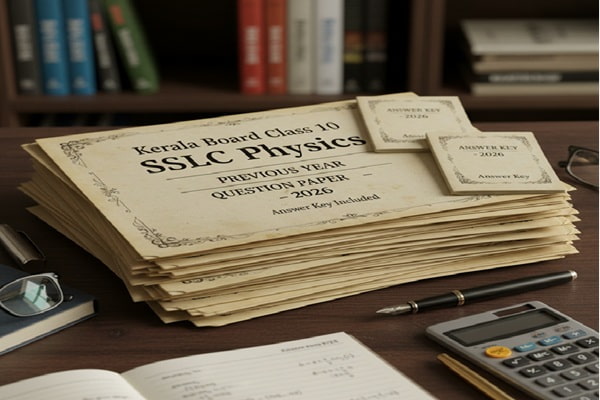
Here is something most Class 10 students figure out too late. The SSLC Physics exam is not really about how much you know. It is about how well you know what the Kerala board expects you to write. The students who score A+ are not always the ones who studied the hardest. They are the ones who understood the question pattern, practised with real papers, and knew exactly which section to attempt first.
This guide is built around one goal: giving you everything in one place. You will find a direct download directory for Kerala SSLC Physics question papers from 2016 to 2026, a breakdown of the paper structure and marking scheme, chapter-wise analysis of what gets asked most often, a preparation strategy that actually works, and an honest look at the mistakes students keep making year after year.
Whether you are preparing for the board exam this March or helping a student as a parent or teacher, this is the most complete resource on SSLC Physics question papers you will find.
Kerala SSLC Physics Exam: Structure and Marking Scheme
Before you touch a single previous year paper, you need to understand exactly what you are walking into. The Kerala SSLC Physics exam has a very specific structure. Once you know it, every paper you practise becomes far more useful.
| Detail | Information |
| Conducting Body | Kerala Board of Public Examinations (KBPE) |
| Subject | Physics (separate paper, not combined Science) |
| Total Theory Marks | 40 marks |
| Internal Assessment (CE) | 10 marks (Continuous Evaluation) |
| Total Marks | 50 marks |
| Duration | 90 minutes (1 hour 30 minutes) |
| Reading Time | 15 minutes extra (cool-off time) |
| Minimum Passing Marks | 30% in theory (12 marks out of 40) |
| Medium Available | English Medium and Malayalam Medium |
| TE to CE Ratio | 40:10 |
| No Negative Marking | Confirmed |
Section-Wise Breakdown of the Question Paper
The SSLC Physics question paper is divided into four sections. Each section tests a different level of understanding, from simple recall to multi-step problem solving.
| Section | Question Type | Marks Each | Total Questions (Approx) | Strategy |
| Section A | Very Short Answer / Objective | 1 mark | 4 to 5 questions | Attempt all first, takes least time |
| Section B | Short Answer | 2 marks | 4 to 5 questions | Write crisp 2-3 line answers |
| Section C | Descriptive / Short Essay | 3 marks | 4 questions | Include diagrams where possible |
| Section D | Long Answer / Problem Solving | 4 marks | 3 to 4 questions | Show full working for numericals |
The 2025 and 2026 papers confirm this four-section pattern. Section A is consistently the most straightforward and should be attempted first. Section D contains numericals and application-based questions that require deeper understanding and are where students often lose marks.
SSLC Physics Syllabus: Chapters and Topics Covered
The Kerala SSLC Physics syllabus is set by SCERT Kerala and covers the following chapters. Understanding which chapters carry the most weight in question papers is one of the most powerful preparation tools available.
| Chapter / Unit | Key Topics | Frequency in Papers |
| Effects of Electric Current | Heating effect, Joule’s law, Fuses, MCB, Domestic wiring | Very High |
| Electromagnetic Induction | Faraday’s law, AC and DC generators, Transformers | Very High |
| Refraction of Light | Snell’s law, Lens formula, Mirror formula, Ray diagrams | Very High |
| Power Transmission | Step-up/step-down transformers, Grid, Transmission losses | High |
| Wave Motion | Sound waves, Frequency, Wavelength, Resonance, Doppler effect | High |
| Heat | Kinetic theory, Change of state, Principle of mixtures, Specific heat | High |
| Semiconductor Electronics | p-n junction diode, Rectification, Transistors, Logic gates | Moderate to High |
| Colors of Light | Dispersion, Prism, Spectrum, Rainbow | Moderate |
| Energy Management | Sources of energy, Fossil fuels, Solar energy, Nuclear energy | Moderate |
Chapters on Electromagnetic Induction, Refraction of Light, and Effects of Electric Current appear in virtually every paper from 2016 to 2026. Numericals from Lens Formula (1/v – 1/u = 1/f), Mirror Formula, and Ohm’s Law are standard in Section D across all years. If you do nothing else, master these three chapters completely.
Where to Download SSLC Physics Question Papers: Year-Wise Directory
The following sources are verified and actively maintained by Kerala teacher communities. All papers are available for free download in PDF format.
| Website | Papers Available | Medium | Special Feature |
| apluseducare.blogspot.com | 2016 to 2025 annual exam papers + model exam papers | English and Malayalam | Most complete single-page collection with EM and MM links side by side |
| hsslive.guru | 2020 to 2024 annual papers + 5 model paper sets | English and Malayalam | Expert teacher-prepared answer keys included |
| examwinner.com | Last 5 years annual papers with detailed answer keys | Both mediums | Marks distribution and scoring tips alongside each paper |
| educationobserver.com | Last 10 years annual and model exam papers with keys | Both mediums | Discussion forum where teachers post corrections and tips |
| aglasem.com | 2023 and 2024 papers with direct PDF download links | English Medium | Clean single-page download format, no ads or redirects |
| selfstudys.com | 2024 paper with step-by-step solutions | English Medium | Solutions explained per question, not just answer keys |
| adda247.com | 2024 paper with expert answer key and marking guide | English Medium | Faculty-verified solutions with error-free accuracy |
| careers360.com | 2023, 2024, 2025 papers with student reaction and analysis | Both mediums | Post-exam analysis helps you understand difficulty level trends |
| collegedekho.com | Previous year papers with subject-wise preparation tips | Both mediums | Combines paper download with chapter-wise study advice |
| allinpsc.com | 2024 paper in both mediums, linked by subject | Both mediums | Clean presentation, useful alongside PSC preparation resources |
For the most complete experience, use apluseducare for the year-by-year paper collection, hsslive.guru for model papers with answer keys, and selfstudys.com or examwinner.com for step-by-step solutions when you want to verify your working on numerical problems.
Year-by-Year Paper Analysis: What Changed and What Stayed the Same
2025 and 2026 Papers
The 2025 paper was conducted on March 21, 2025, from 9:30 AM to 11:15 AM with 40 theory marks. Student reactions described it as moderate in difficulty, with some questions requiring strong conceptual understanding rather than rote answers. Significant emphasis was placed on numerical problems related to the Lens Formula, Mirror Formula, and Ohm’s Law. Application-based questions connecting Physics to everyday life featured prominently, as did diagram-based questions for ray optics and electric circuits.
The 2026 paper, conducted on March 18, 2026, was described by subject experts as moderate in difficulty, with students finding Section A the easiest. The paper was characterised as well-balanced and not overly lengthy, with enough time for revision.
2022 to 2024 Papers
Papers from this period maintained the four-section format and continued the trend of rewarding conceptual understanding over memorisation. Numerical problems on transformer ratios, mirror and lens calculations, and Ohm’s Law circuits were consistent across all three years. Diagram labelling for electric generators, transformers, and ray diagrams for refraction and reflection appeared in every paper in this period.
2016 to 2021 Papers
The older papers in this range follow a slightly different format in some years, reflecting syllabus revisions. However, the core topics remain consistent. Apluseducare and Education Observer both host the full range from 2016 onward in both English medium and Malayalam medium. Practising from 2016 gives students a ten-year view of how the paper has evolved, which is the single most reliable way to identify topics that are asked repeatedly.
Also Read : 2018 Annual Exam Question Paper: Download PDF for Classes 1-12 (SSLC, Plus One, Plus Two) with Answer Keys
How to Use SSLC Physics Question Papers Effectively
Most students download question papers, glance at them once, and move on. That approach gives almost no preparation benefit. The method below is what separates students who score A+ from those who are surprised by the exam.
- Complete your full SCERT Physics textbook first. Question papers are a revision and practice tool, not a shortcut to skip chapters.
- Download papers from the last five years: 2020, 2022, 2023, 2024, and 2025. Start with the most recent and work backward.
- Attempt one full paper in exactly 90 minutes, sitting at a desk with no phone. Treat it like the real exam, including the 15-minute reading time at the start.
- After finishing, wait at least 10 minutes before comparing with the answer key. This gap helps you spot your own errors more clearly.
- For every wrong answer, classify it: was it a conceptual gap, a calculation error, a diagram mistake, or a time management failure? Each type needs a different fix.
- For numerical errors, re-derive the answer from first principles, writing every step. Do not just copy the answer key answer.
- Keep a separate notebook for formulas and diagram practice. Draw the diagrams for refraction, reflection, electric circuits, and transformers at least twice per week.
- Repeat with two more papers from different years before the exam. By the third paper, your speed and accuracy should both have improved.
| Teacher Insight: Why the 15-Minute Reading Time Matters
Almost every experienced Kerala Physics teacher will tell you the same thing: use the 15-minute cool-off time to read every question in the paper, not just the first page. Mark the questions you are confident about, the ones you are unsure of, and the ones you want to leave for last. Students who plan their attempt sequence during reading time consistently complete the paper more efficiently than those who simply start from Question 1 and work forward. |
Chapter-Wise Scoring Strategy for SSLC Physics
Electromagnetic Induction and Transformers
This chapter appears in Section C or Section D in almost every paper. The transformer ratio formula (Np/Ns = Vp/Vs) and the relationship between voltage, current, and power in transformers are standard numerical types. The diagram of a step-up or step-down transformer is a high-frequency diagram question. Master the working principle, the formula, and the diagram labels. This single chapter can secure you 4 to 7 marks per paper.
Refraction of Light and Lenses
The lens formula (1/v – 1/u = 1/f) and mirror formula appear in Section D numericals in nearly every paper. Ray diagrams for convex and concave lenses showing object, image, principal axis, focal points, and the path of rays are equally important. Students who lose marks here almost always do so because of incomplete diagrams or sign errors in the lens formula. Practice drawing ray diagrams from memory at least ten times before the exam.
Effects of Electric Current
Ohm’s Law, Joule’s law of heating, and the relationship between power, current, and resistance are the backbone of this chapter. Section D numericals involving series and parallel circuit calculations are standard. Know how to calculate equivalent resistance, current flow, and power dissipation in each resistor. Also be confident explaining the working of a fuse and an MCB, as these appear frequently as short-answer questions.
Wave Motion and Sound
Frequency, wavelength, wave speed, and the relationship between them (v = f x lambda) form the basis of numerical questions from this chapter. The Doppler effect explanation and the conditions for resonance appear as 2-mark or 3-mark questions regularly. Keep the definitions of frequency, amplitude, and period precise and crisp.
Semiconductor Electronics
This chapter tends to produce diagram questions and short notes rather than numericals. The p-n junction diode, forward and reverse bias, full-wave rectification circuit, and the basic logic gates (AND, OR, NOT) are the most frequently tested topics. Drawing the circuit for a half-wave and full-wave rectifier is a reliable source of marks if practised.
Mistakes Students Make in SSLC Physics Exams
- Not reading the question carefully. Many students answer what they think the question is asking rather than what it actually asks. This is especially costly in application-based questions where a single word changes the required answer.
- Drawing incomplete or unlabelled diagrams. A ray diagram or circuit diagram without proper labels earns zero or partial marks. Every arrow, label, and component must be included and legible.
- Skipping units in numerical answers. In Kerala SSLC Physics, not writing the unit after a numerical answer is a standard deduction. Always write the unit: ohms, watts, volts, joules, metres per second, and so on.
- Starting with the hardest question. Students who attempt Section D first often run out of time before completing Section A and B. Start with Section A, lock in the easy marks, then move to the harder sections.
- Memorising without understanding. The 2025 and 2026 papers both contained application-based questions that could not be answered by memorised text alone. If you do not understand why a transformer increases voltage, no amount of memorisation helps.
- Ignoring the question pool. SCERT Kerala publishes an official question pool for SSLC Physics every year. This pool contains questions directly from the textbook with answers. Students who practise from the question pool before attempting previous year papers have a significant advantage.
- Practising only Malayalam medium papers when studying in English medium (or vice versa). Always practise papers in your own medium. The question phrasing and expected answer format differ subtly between mediums.
Pre-Exam Preparation Checklist
- Download the last five years of SSLC Physics question papers from apluseducare or hsslive.guru in your medium
- Download the official SCERT question pool for SSLC Physics and attempt all questions
- Attempt at least three full papers under 90-minute exam conditions before the board exam
- Practise all ray diagrams (convex lens, concave lens, convex mirror, concave mirror) at least 10 times each
- Practise drawing the circuit for half-wave and full-wave rectification
- Practise drawing transformer and electric generator diagrams with all labels
- Memorise all core formulas: Lens formula, Mirror formula, Ohm’s Law, Joule’s law, Power formula, Transformer ratio
- Revise all units: ohms, watts, volts, joules, hertz, metres per second, and so on
- Use the 15-minute reading time in the actual exam to plan your attempt sequence
- On exam day, start with Section A, then B, then C, then D
- Always write units after every numerical answer
- Label every arrow and component in every diagram
Previous Year Papers vs Model Papers vs Question Pool: Which to Use When
| Resource | What It Is | Best Used For | Limitation |
| Previous Year Papers | Actual board exam papers from past years | Simulating real exam conditions, understanding difficulty trends | Exact questions will not repeat |
| Model Question Papers | Papers prepared by KBPE or teacher groups following the official pattern | Practising additional papers when you run out of previous year papers | Not as predictive as actual board papers |
| SCERT Question Pool | Official bank of questions from the SCERT textbook with answers | Ensuring full textbook coverage before attempting past papers | Not time-bound, not structured like a real paper |
| Terminal Exam Papers | First and second term exam papers from previous years | Practising specific chapters before the full paper revision phase | Covers only one term’s worth of topics |
The best preparation uses all four in sequence: start with the SCERT question pool to cover the full textbook, then use terminal exam papers for chapter-specific practice, then use model question papers to start full-paper simulation, and finally use previous year board exam papers to refine your speed and accuracy under real conditions.
Frequently Asked Questions
Where can I download SSLC Physics question papers for free?
SSLC Physics question papers from 2016 to 2026 are available for free download on apluseducare.blogspot.com (most complete collection), hsslive.guru (with answer keys), examwinner.com (with scoring tips), and educationobserver.com (with a 10-year archive). Papers are available in both English medium and Malayalam medium in PDF format.
How many marks is the SSLC Physics exam?
The SSLC Physics theory paper carries 40 marks and is conducted for 90 minutes with 15 additional minutes for reading. Students also receive 10 marks from Continuous Evaluation (internal assessment), making the total marks 50. The minimum passing requirement is 30% of the theory marks, which means scoring at least 12 out of 40 in the written paper.
What chapters are most important for SSLC Physics?
Based on question paper analysis from 2016 to 2026, the three most important chapters are Electromagnetic Induction and Transformers, Refraction of Light and Lenses, and Effects of Electric Current. These chapters produce the highest number of numericals and diagram-based questions and appear in virtually every previous year paper. Heat, Wave Motion, and Semiconductor Electronics are the next most important chapters.
How many years of SSLC Physics question papers should I practise?
Practising the last five years gives you the best picture of the current paper format and difficulty level. Aim for papers from 2020, 2022, 2023, 2024, and 2025. Papers from 2020 and 2021 had limited syllabus coverage due to COVID, so their pattern is not fully representative of a standard board paper. Supplementing with model papers fills any remaining gaps.
Are SSLC Physics question papers available in English medium?
Yes. English medium SSLC Physics question papers are available on all major sites including apluseducare, hsslive.guru, examwinner.com, aglasem.com, selfstudys.com, and adda247.com. Earlier resources focused more on Malayalam medium, but English medium papers are now widely available for all years from 2016 onward.
What is the difference between a previous year paper and a model question paper for SSLC Physics?
A previous year paper is the actual question paper used in the board exam in a specific year. A model question paper is a paper prepared by KBPE or teacher groups following the same format as the board exam, intended as practice material. Previous year papers are more valuable for understanding real exam difficulty and trends, but model papers provide additional practice when previous year papers are exhausted.
Is the SSLC Physics paper in Kerala the same as the national CBSE Class 10 Science paper?
No. The Kerala SSLC Physics paper is a separate subject-specific paper worth 40 marks, conducted by KBPE under the SCERT Kerala syllabus. In CBSE, Physics, Chemistry, and Biology are combined into one Science paper. The question format, marking scheme, and syllabus content differ significantly. Always use Kerala board-specific papers for SSLC preparation.
What is the Kerala SSLC Physics question pool?
The SCERT question pool is an official bank of questions compiled directly from the SSLC Physics textbook content with answer keys. It is published by SCERT Kerala and Samagra Shiksha Kerala. The question pool covers all chapters and is available in both English and Malayalam medium as a free PDF download through aglasem.com and the SCERT Kerala website. Completing the question pool ensures full textbook coverage before board exam preparation.
How difficult is the SSLC Physics exam in Kerala?
Based on post-exam student and expert analysis from 2022 to 2026, the Kerala SSLC Physics paper is consistently described as moderate in difficulty. The paper rewards conceptual understanding and application skills more than rote memorisation. Section A is typically the easiest. The most challenging questions appear in Section D, particularly application-based numericals and higher-order thinking questions. Students who practise regularly with previous year papers and the question pool consistently describe the actual exam as manageable.
Can I score full marks in SSLC Physics?
Yes, and it is not uncommon. The two most important habits for scoring full marks are drawing neat, fully labelled diagrams for every applicable question and showing complete working for every numerical, including intermediate steps. Students who lose marks on perfect concepts usually do so because of missing units, incomplete diagrams, or skipped working steps. Address these three habits directly and consistently during practice.
Conclusion
The SSLC Physics question paper is not unpredictable. Across ten years of papers, the same chapters show up, the same types of numericals appear, and the same diagram-based questions repeat in different forms. The students who struggle are mostly the ones who studied Physics without ever seeing what the actual board exam looks like.
Now you have the full picture: the paper structure, the chapter weights, the download sources for every year, the preparation sequence that works, and the mistakes to avoid. The one thing that remains is practice. Download a paper, set a timer, and write it out. That single act, done five times before March, changes results more than any other preparation step.
Physics is one of the most reliable subjects for securing full marks in the Kerala SSLC exam, if you know what to practise and how to answer. Use the resources in this guide, follow the strategy, and go into the exam knowing exactly what to expect.