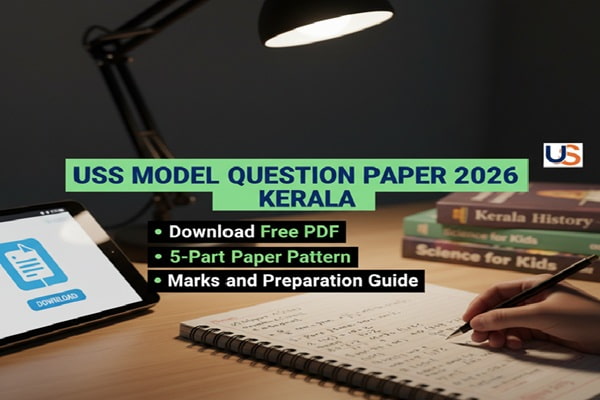
Every year, thousands of Class 7 students in Kerala sit for the USS exam. And every year, most of them make the same preparation mistake. They download a USS model question paper, read through it once, and think they are prepared.
The students who consistently clear the USS cutoff do something different. They use model papers to understand what types of questions appear in each part, how time should be distributed across 5 sections in 120 minutes, and which subjects need the most practice. They treat the model paper as a diagnostic tool, not just a practice test.
This guide explains everything about USS model question papers: what the exam actually tests, how the 5-part structure works, where to download the most reliable model papers, and how to build a preparation plan that uses them correctly. Whether your child is in Malayalam Medium or English Medium, whether they are strong in Maths or struggling with Social Science, this guide has a specific plan for each situation.
What Is the USS Exam? Full Form and Purpose
The USS exam is not just a financial scholarship. For students from economically weaker backgrounds, winning it provides both monetary support and academic recognition. For all students, appearing for USS builds familiarity with competitive MCQ exams, which directly helps in later exams like NMMS, NuMaTs, and NTSE.
The exam is officially called the Educational Talent Search Programme at the upper primary level. It is distinct from centrally-run schemes like NMMS (which targets Class 8 students) because it is fully administered by the Kerala state government through BPE Kerala.
USS Exam 2026: Key Facts Every Student and Parent Must Know
| Detail | Information |
| Full Form | Upper Secondary Scholarship (USS) |
| Conducting Authority | Board of Public Examinations (BPE) Kerala / Kerala Pareeksha Bhavan |
| Official Website | bpekerala.in and pareekshabhavan.kerala.gov.in |
| Eligible Class | Class 7 (Standard VII) only |
| Eligible Schools | Government, Aided, Approved, and Unaided schools in Kerala |
| Residency Requirement | Permanent resident of Kerala |
| Academic Eligibility | Grade A in previous qualifying class exams |
| Exam Format | Objective type – Multiple Choice Questions (MCQ) |
| Total Questions | 90 questions (1 paper, 5 parts) |
| Total Marks | 90 marks (1 mark per question, no negative marking) |
| Exam Duration | 120 minutes (2 hours) |
| Qualifying Mark | 63 out of 90 (70 percent) – students scoring above this are eligible for scholarship |
| Medium | Malayalam Medium and English Medium (separate papers) |
| Scholarship Amount | Rs. 1,500 per year from Class 8 to Class 10 |
| USS Exam 2026 Date | February 26, 2026 (10:00 AM onwards) |
| Result Platform | bpekerala.in |
The 5-Part USS Question Paper Structure: What Each Part Tests
This is the section that most websites skip entirely. Understanding the 5-part structure of the USS exam is the foundation of effective model paper preparation. Every model question paper, regardless of who prepared it (DIET, KSTA, or individual teachers), follows this same 5-part framework.
| Part | Subject | Questions | Marks | Syllabus Basis |
| Part 1 | Malayalam (First Language) or equivalent First Language (Arabic, Urdu, Sanskrit for respective medium students) | 18 questions | 18 marks | Class 7 SCERT Kerala Malayalam / First Language textbook – reading comprehension, grammar, vocabulary, literary appreciation |
| Part 2 | English | 18 questions | 18 marks | Class 7 SCERT Kerala English textbook – comprehension, grammar, vocabulary, poetry and prose from the textbook |
| Part 3 | Mathematics | 18 questions | 18 marks | Class 7 SCERT Kerala Mathematics textbook – all chapters including integers, fractions, algebra, geometry, data handling |
| Part 4 | Science | 18 questions | 18 marks | Class 7 SCERT Kerala Science textbook – physics, chemistry, biology, and environmental science from all units |
| Part 5 | Social Science | 18 questions | 18 marks | Class 7 SCERT Kerala Social Science textbook – history, geography, civics, and economics from all units |
| Total | 5 parts | 90 questions | 90 marks | Complete Class 7 SCERT Kerala syllabus across all five subjects |
Important: The USS exam from the 2021-22 academic year onwards has 1 paper with 5 parts, all within the single 120-minute duration. Earlier years had a different structure. When using model papers from before 2021, verify the part structure matches the current format.
USS Qualifying Mark and Scholarship Selection Process
One of the most frequently misunderstood aspects of the USS exam is how students are selected for the scholarship. It is not simply a matter of clearing a fixed cutoff. Here is how it works:
| Aspect | Details |
| Total Marks | 90 marks (1 mark per correct answer, no negative marking for wrong answers) |
| Qualifying Mark | 63 out of 90 (70 percent) – this is the general qualifying benchmark cited consistently in official communications |
| No Negative Marking | Students should attempt all 90 questions. Unanswered questions earn zero. Wrong answers earn zero but do not deduct marks. |
| Selection Priority | Students from minority communities and economically weaker backgrounds receive priority when marks are equal |
| Result Format | Results show ES (Eligible for Scholarship) or NS (Not Eligible for Scholarship) or Ab (Absent) |
| Scholarship Disbursement | Through school administration. Students must submit required documents (income certificate, school verification) by the deadline (typically June 15). |
| Scholarship Duration | Rs. 1,500 per year for 3 years (Class 8, Class 9, Class 10) |
| Total Scholarship Value | Rs. 4,500 over 3 years per selected student |
The qualifying mark of 63 should be treated as the minimum target, not the goal. Students who score closer to 75 to 80 marks have a significantly better chance of selection, especially in years with high competition. Model papers help you set realistic score targets before the actual exam.
Types of USS Model Question Papers: Which One Should You Use
Not all USS model papers are the same. They come from different sources, have different levels of quality, and serve different preparation purposes. Here is a breakdown of the main types available:
| Type | Who Prepares It | Quality Level | Best Used For |
| SCERT Official Model Papers | Kerala SCERT and BPE Kerala. Released on the official website. | Highest accuracy. Directly reflects the exam pattern and question style used in the actual exam. | Understanding the exact question format, difficulty level, and subject distribution. Use these first. |
| DIET Model Papers (Velicham and others) | District Institute of Education and Training (DIET). DIET Thrissur publishes the well-known Velicham series (12 papers for USS and 12 for LSS). | Very high quality. DIETs follow the SCERT blueprint closely and include answer keys. | Practice papers with answer keys for self-assessment. Multiple sets allow for repeated testing. |
| KSTA Model Exam Papers | Kerala School Teachers Association (KSTA). Published as Paper I and Paper II with answer keys. | High quality. KSTA includes Arabic, Urdu, and Sanskrit variants for respective language medium students. | Language-specific preparation. KSTA papers are especially useful for Arabic Medium and Urdu Medium students. |
| Teacher Association Papers | Various district-level teacher clubs and associations in Kerala. Available on educationobserver.com and almakthab.blogspot.com. | Variable quality. Most are reliable but some may not perfectly match the current year format. | Additional practice variety. Useful after completing SCERT and DIET papers. |
| Previous Year Official Papers | BPE Kerala. The actual question paper used in past USS exams. | Most accurate representation of the real exam. Cannot be changed. | Final-stage preparation. Solve under timed conditions (120 minutes) to simulate the actual exam experience. |
The recommended preparation order is: SCERT official model papers first, then DIET papers (Velicham series), then previous year papers as timed practice tests, then KSTA papers for language-specific practice.
Where to Download USS Model Question Papers: Complete Source Guide
| Source | What Is Available | URL / How to Access |
| educationobserver.com | Most comprehensive collection. Has model papers from multiple years, DIET papers, KSTA papers, and the actual previous year USS question papers with answer keys from 2016 to 2023 and beyond. Both Malayalam Medium and English Medium available. | Go to educationobserver.com > search “USS question papers” or visit the direct USS page at educationobserver.com/uss-question-papers/ and the forum thread for previous year papers at educationobserver.com/forum/showthread.php?tid=31707 |
| almakthab.blogspot.com | USS model question papers and answer keys organized by year. Includes Arabic, Urdu, and Sanskrit medium variants. Has KSTA USS Model Exam papers with full answer keys. | Go to almakthab.blogspot.com > click on LSS/USS Model Questions in the menu > select USS model questions section |
| apluseducare.blogspot.com | USS Question Bank with papers from 2016 to 2022 in both English Medium (EM) and Malayalam Medium (MM) with answer keys. Well-organized by year. | Search “USS question bank 2016 to 2022” on the site or visit the USS section directly at apluseducare.blogspot.com |
| bpekerala.in | Official BPE Kerala website. Has official notifications, syllabus, model question papers released by SCERT, and results. Most reliable source for pattern accuracy. | Go to bpekerala.in > navigate to LSS/USS section > download model question papers and official syllabus |
| biovisions.in | USS Model Exam Question Papers and Answer Keys from multiple sets (Set 1, Set 2, etc.) for each year. Includes Velicham DIET Thrissur papers. | Go to biovisions.in > search “USS model question paper” > select the year needed |
| textbooksall.blogspot.com | KPSTA USS Model Examination papers with answer keys in both English Medium and Malayalam Medium. | Search for “KPSTA USS model examination” on the site or use Google with site:textbooksall.blogspot.com USS model |
| vijayajalakam.com | Free model papers and mock tests for LSS and USS. Also sells printed guide books with 8+ years of previous papers and 4,500+ practice questions. | Go to vijayajalakam.com and download from the Model Question Papers section (free) or order books from the guides section |
Step-by-Step Download Guide
- Start with educationobserver.com for the most complete collection. It has both official and teacher-prepared model papers.
- On educationobserver.com, go to the USS Question Papers page. Look for the “Model Question Papers by DIETs, Teachers Clubs and Associations” section.
- Download 2 to 3 DIET model papers first. These are the closest in quality to the actual exam.
- Download the most recent previous year official papers (the 2025 paper is available with provisional answer key on the forum thread).
- For Arabic, Urdu, or Sanskrit medium students: go to almakthab.blogspot.com and download KSTA USS papers which include language-specific variants.
- Click the download link. Papers open as PDFs. On mobile: long press and save. On desktop: right-click and save as.
- Keep all papers organized in a folder by source and year for easy revision access.
Subject-wise Breakdown of the USS Model Paper: What Each Part Tests
Part 1: Malayalam (First Language) – 18 Marks
The Malayalam section tests reading comprehension from both prose and poetry, vocabulary, and grammar. Questions are based on the Class 7 Kerala SCERT Malayalam textbook.
| Topic Area | Typical Questions in Model Papers | Marks Weightage |
| Gadya Vayana (Prose Comprehension) | A passage from the textbook or a new passage is given. Questions test main idea, character details, vocabulary in context, and inference. | 6 to 7 questions |
| Padya Vayana (Poetry Comprehension) | Lines from a poem taught in Class 7. Questions test meaning, Alankarams (poetic devices), and appreciation. | 3 to 4 questions |
| Vyakaran (Grammar) | Vibhakti forms, Sandhi, Samasa Vigraha, Kaal (tense identification), sentence types, Ling-Vachan changes. | 4 to 5 questions |
| Vocabulary | Synonyms, antonyms, one-word substitutes, Muhavare (idioms), word meanings in context. | 3 to 4 questions |
| Total | 18 questions | 18 marks |
Part 2: English – 18 Marks
The English section tests reading comprehension from unseen and textbook passages, grammar, and vocabulary from the Class 7 Kerala SCERT English textbook.
| Topic Area | Typical Questions in Model Papers | Marks Weightage |
| Reading Comprehension | Short passage followed by inference and vocabulary questions. Tests main idea, character understanding, and word meanings. | 5 to 6 questions |
| Grammar | Tenses (identify and fill in), articles (a/an/the), prepositions, conjunctions, question tags, sentence transformation, reported speech basics. | 6 to 7 questions |
| Vocabulary | Synonyms, antonyms, phrasal verbs, one-word substitutes, word forms (noun/verb/adjective). | 3 to 4 questions |
| Literature | Questions from prose lessons and poems in the Class 7 English textbook. Characters, events, themes, poetic devices. | 2 to 3 questions |
| Total | 18 questions | 18 marks |
Part 3: Mathematics – 18 Marks
Mathematics is where many USS candidates lose or gain marks. The questions are not calculation-heavy but test conceptual understanding and quick problem-solving ability.
| Chapter / Topic | Typical Questions | Marks Weightage |
| Integers (Negative numbers, operations) | Simple integer operations, ordering, real-world problems with negative numbers. | 2 to 3 questions |
| Fractions and Decimals | Operations on fractions, comparison, word problems involving fractions. | 2 to 3 questions |
| Data Handling | Reading bar graphs, pie charts, mean/median/mode calculation. | 2 questions |
| Algebra (Simple equations) | Forming and solving simple linear equations, identifying algebraic expressions. | 3 questions |
| Ratio and Proportion | Direct and inverse proportion, ratio comparison. | 2 questions |
| Geometry (Lines, angles, triangles) | Properties of triangles, angle relationships, types of triangles and quadrilaterals. | 3 questions |
| Perimeter, Area, Volume | Area and perimeter of rectangles, triangles, circles. Volume of simple 3D shapes. | 2 questions |
| Total | 18 questions | 18 marks |
Part 4: Science – 18 Marks
The Science section covers all three domains from the Class 7 SCERT Kerala Science textbook: Physical Science, Biological Science, and Environmental Science.
| Topic Area | Typical Questions | Marks Weightage |
| Physical Science (Light, Heat, Motion, Electricity) | Properties of light, types of motion, effects of heat, simple circuit questions. | 5 to 6 questions |
| Biological Science (Cells, Plants, Animals, Human Body) | Cell structure, photosynthesis, human organ systems, reproduction in plants. | 6 to 7 questions |
| Chemistry (Acids, Bases, Salts, Materials) | Identification of acids/bases, properties of materials, simple chemical changes. | 3 to 4 questions |
| Environmental Science (Ecology, Conservation) | Food chains, ecosystems, environmental pollution, water conservation. | 2 to 3 questions |
| Total | 18 questions | 18 marks |
Part 5: Social Science – 18 Marks
Social Science combines History, Geography, Civics, and Economics. This is the part most students underestimate. Questions test specific facts, map knowledge, and civic concepts from the Class 7 syllabus.
| Topic Area | Typical Questions | Marks Weightage |
| History (Medieval to Modern India) | Mughal empire, colonial India, freedom struggle events and dates. | 4 to 5 questions |
| Geography (India and World) | Physical features of India, states and capitals, rivers, climate regions, map-based questions. | 5 to 6 questions |
| Civics (Government and Democracy) | Constitution, Panchayati Raj, fundamental rights, role of local bodies. | 4 questions |
| Economics (Basic Concepts) | Resources, types of industries, production and consumption, simple economic concepts. | 3 questions |
| Total | 18 questions | 18 marks |
How to Use USS Model Question Papers Effectively
The difference between students who clear the USS cutoff and those who do not is almost never about intelligence. It is usually about how they prepared. Here is the correct method for using model papers:
Phase 1: Diagnostic Use (First 2 Model Papers)
- Download 2 model papers and solve them with no time pressure. The goal is not to score high. The goal is to identify exactly which topics in each of the 5 parts you are weak in.
- For each wrong answer, write the topic name. After finishing both papers, count wrong answers by topic.
- Your topic list with the most wrong answers is your revision priority list. This is unique to every student.
- Students who skip this diagnostic phase waste revision time studying topics they already know.
Phase 2: Targeted Revision (Following 4 to 6 Weeks)
- For Maths: revisit each weak chapter from the SCERT textbook. Understand the concept, do 3 to 4 examples, then solve 10 MCQs from that chapter in the model papers.
- For Science: create a topic summary card for each chapter (half a page). List 5 key facts, one diagram, and one definition per chapter.
- For Social Science: make a timeline for History and a list of India states and capitals for Geography. These two areas account for 9 to 10 marks in the Social Science section.
- For Malayalam and English: practice reading passages under timed conditions. Comprehension speed matters in a 120-minute exam where 90 questions must be answered.
Phase 3: Timed Full-Paper Practice (Final 3 to 4 Weeks)
- Solve one complete USS model paper every 3 to 4 days under strict 120-minute exam conditions.
- Do not stop mid-paper to check answers. Complete all 90 questions first.
- After finishing, calculate your score and identify which parts you ran short on time.
- If you are consistently scoring below 60, focus Phase 2 revision on your two weakest parts and reduce time spent on your strongest parts.
- If you are scoring 65 to 70, the focus should shift to eliminating careless errors (marking the wrong option for questions you actually know).
- Target score before the actual exam: at least 72 to 75 out of 90.
Time Management for the USS Exam: 120 Minutes for 90 Questions
Many students who know the answers to most questions still miss the cutoff because they run out of time. Here is a proven time allocation strategy for the 120-minute USS exam:
| Part | Subject | Recommended Time | Questions | Strategy |
| Part 1 | Malayalam / First Language | 22 to 25 minutes | 18 questions | Read comprehension passages quickly. Do not spend more than 90 seconds on any single question. Mark difficult questions and return to them. |
| Part 2 | English | 22 to 25 minutes | 18 questions | Grammar questions are fastest. Do them first within Part 2. Comprehension passage questions take longer; do them last. |
| Part 3 | Mathematics | 28 to 30 minutes | 18 questions | Maths takes the most time per question due to calculations. Budget 90 seconds per question. Simple concept questions (algebra, ratio) should be answered quickly to save time for geometry. |
| Part 4 | Science | 20 to 22 minutes | 18 questions | Most Science questions are direct recall. Read questions carefully (Kerala SCERT questions sometimes have tricky phrasing). Do not overthink definition-based questions. |
| Part 5 | Social Science | 18 to 20 minutes | 18 questions | Fastest section for well-prepared students. Map-based questions require careful reading. History date questions are quick if memorized. Do not leave any question blank. |
| Buffer / Review Time | All parts | 5 to 8 minutes | Review flagged questions | Use remaining time to revisit any marked questions. Double-check OMR sheet for missed bubbles. |
LSS vs USS: How They Differ and What Parents Should Know
Parents often confuse the LSS and USS exams. Both are Kerala Pareeksha Bhavan scholarship exams, but they are distinct in every important way.
| Factor | LSS (Lower Secondary Scholarship) | USS (Upper Secondary Scholarship) |
| Class | Class 4 | Class 7 |
| Total Questions | 80 questions | 90 questions |
| Total Marks | 80 marks | 90 marks |
| Qualifying Mark | 48 out of 80 (60 percent) | 63 out of 90 (70 percent) |
| Scholarship Amount | Rs. 1,000 per year | Rs. 1,500 per year |
| Scholarship Duration | Class 5, 6, and 7 (3 years) | Class 8, 9, and 10 (3 years) |
| Subjects in Paper | 4 parts: Language, English, Maths, EVS (Environmental Studies) | 5 parts: Language, English, Maths, Science, Social Science |
| Syllabus Basis | Class 4 SCERT Kerala textbooks | Class 7 SCERT Kerala textbooks (complete portions) |
| Exam Date (2026) | Same day as USS: February 26, 2026 | February 26, 2026 (10:00 AM) |
| Model Paper Source | Same websites: educationobserver.com, almakthab.blogspot.com | Same websites: educationobserver.com, almakthab.blogspot.com |
If a student passed LSS in Class 4, they receive LSS scholarship until Class 7. If they also qualify for USS in Class 7, the USS scholarship replaces it from Class 8 onwards. The two scholarships do not run simultaneously.
Subject-wise Preparation Tips: What Works in Model Paper Practice
| Subject | Most Common Question Types in USS Model Papers | Preparation Method That Works |
| Malayalam | Comprehension inference, vocabulary meaning, Vibhakti identification, Alankaram identification, Muhavare meaning | Re-read Class 7 Malayalam textbook prose and poetry once. Make a word list of 30 difficult words with meanings. Practice Vibhakti daily for 5 days before the exam. |
| English | Grammar (tenses, articles, prepositions), reading passage inference, synonym/antonym, reported speech identification | Solve the Grammar section of 5 to 6 model papers first. Grammar questions follow patterns. Build speed on grammar MCQs so you have more time for comprehension passages. |
| Mathematics | Fraction operations, algebra (find the unknown), area/perimeter, ratio problems, integer operations | Do not practice from guides. Go back to the SCERT Class 7 Maths textbook exercises. All USS Maths MCQs are concept-based on textbook-level problems. Work through each exercise once. |
| Science | Define/identify concepts, fill in missing parts of a process (e.g., photosynthesis steps), application questions (what happens when) | Create a chapter-by-chapter summary card for all Science units. Each card should have: 5 key facts, 1 process diagram, 1 definition. Practice identifying diagrams from previous model papers. |
| Social Science | Date-event matching (History), state-river-capital identification (Geography), rights and duties identification (Civics) | For History: make a timeline with 15 key dates and events. For Geography: practice labeling 20 Indian states, major rivers, and geographical features on a blank map. Civics questions come directly from textbook definitions. |
Common Mistakes Students Make with USS Model Papers
| Mistake | Why It Hurts | What to Do Instead |
| Solving model papers without timing | Students develop a false sense of readiness. In the actual exam, 90 questions in 120 minutes is a tight constraint that surprises unprepared students. | From the third model paper onwards, always set a 120-minute timer. Treat it as the real exam. The time pressure changes what strategy works. |
| Focusing only on Maths and Science | Many students (and parents) assume Maths and Science are the hard parts. But Social Science and Malayalam also carry 18 marks each and are equally important. | All 5 parts carry equal marks. Schedule equal preparation time for each part in the first month. Adjust based on your diagnostic results. |
| Using outdated model papers without checking the format | Before 2021-22, the USS exam had a different paper structure. Papers from before 2021 may not match the current 1 paper, 5 parts, 90 questions format. | Always check the model paper header or source for the academic year it was prepared for. Use 2021-22 onwards papers for current format accuracy. |
| Skipping Social Science revision | Social Science feels broad and overwhelming so students defer it. But it has the most straightforward mark-earning potential because questions are direct recall. | Break Social Science into three study sessions: one for History (timeline and events), one for Geography (maps and physical features), one for Civics and Economics (textbook definitions). |
| Not checking answer keys after solving | Solving without checking means you never know your actual weak areas. The diagnostic value of model papers is wasted. | After every model paper, immediately check answers, calculate your score per part, and update your weak topic list. This list drives your revision. |
| Relying only on guide books without textbook reading | USS questions are directly based on SCERT textbooks. Guide books summarize content but sometimes miss specific details that appear as MCQ options. | Use guide books for structure and practice questions, but always verify answers against the SCERT Class 7 textbook. The textbook is the primary source of all USS questions. |
Malayalam Medium vs English Medium: What Changes in the USS Paper
The USS exam is available in both Malayalam Medium (MM) and English Medium (EM). The Mathematics, Science, and Social Science parts are identical in content regardless of medium. Only the First Language section changes.
| Factor | Malayalam Medium (MM) | English Medium (EM) |
| Part 1 (First Language) | Malayalam First Language based on Kerala SCERT Malayalam textbook for Class 7 | Also Malayalam First Language for most EM students (unless they study Arabic, Urdu, or Sanskrit as First Language) |
| Parts 2 to 5 | Questions and instructions in Malayalam | Questions and instructions in English |
| Grammar Questions | Malayalam grammar: Vibhakti, Sandhi, Samasa, Alankaram | English grammar: Tenses, Articles, Prepositions, Reported Speech |
| Model Papers | MM model papers labeled MM or Malayalam Medium on download sites | EM model papers labeled EM or English Medium on download sites |
| Comprehension Passages | Malayalam prose and poetry passages from Kerala Padavali (Class 7 Malayalam textbook) | English prose and poetry passages from Class 7 SCERT English textbook |
| Language of Answer Sheet | Students may write in Malayalam for the First Language section | All answers are objective MCQ bubbles – no written language responses needed in USS |
For students who study Arabic, Urdu, or Sanskrit as their First Language (Part 1): KSTA prepares specific USS model papers with Arabic, Urdu, and Sanskrit variants for Part 1. These are available on almakthab.blogspot.com under the USS Arabic Model Questions and USS Urdu Model Questions sections.
Also Read : 8th Class Biology Question Paper 2018: All Boards Free PDF
Year-wise USS Previous Year Papers and Model Papers: What Is Available
| Year | Papers Available | Key Source |
| 2016 | USS Previous Year Paper with answer key – EM and MM | apluseducare.blogspot.com (2016 to 2022 collection) |
| 2017 | USS Previous Year Paper with answer key – EM and MM | apluseducare.blogspot.com, educationobserver.com |
| 2018 | USS Previous Year Paper with answer key – EM and MM | apluseducare.blogspot.com, educationobserver.com |
| 2019 | USS Previous Year Paper with answer key – EM and MM | apluseducare.blogspot.com, educationobserver.com |
| 2020 | USS Previous Year Paper (exam held before COVID shutdown) – EM and MM | apluseducare.blogspot.com, educationobserver.com |
| 2021 | USS Previous Year Paper with answer key – limited availability due to COVID academic disruption | educationobserver.com, almakthab.blogspot.com |
| 2022 | USS Previous Year Paper – EM and MM with answer keys | apluseducare.blogspot.com (2016 to 2022 collection), educationobserver.com |
| 2023 | USS Previous Year Paper – EM and MM with answer keys | educationobserver.com, biovisions.in |
| 2024 | USS Previous Year Paper with answer key – EM and MM | educationobserver.com/forum thread, almakthab.blogspot.com |
| 2025 (Feb 27, 2025) | USS 2025 official question paper (Paper 1, MM) available. Provisional answer key released. | educationobserver.com/forum/showthread.php?tid=31707 |
| 2026 (Feb 26, 2026) | USS 2026 exam conducted. Papers and answer key expected to be uploaded post-exam. | bpekerala.in, educationobserver.com |
Preparation Checklist for USS Exam Using Model Papers
- Download 2 DIET model papers (Velicham series from DIET Thrissur) from educationobserver.com
- Solve both diagnostic papers without a timer. Record every wrong answer by topic.
- Create a weak topic list for each of the 5 parts based on your diagnostic results
- Revise weak topics from SCERT Class 7 textbooks (not guides alone)
- For Maths: complete all textbook exercises for weak chapters
- For Social Science: make a History timeline and label a blank India map with states, capitals, and rivers
- For Science: create a chapter summary card (5 facts, 1 diagram, 1 definition per chapter)
- For Language parts: read 2 unseen passages daily and answer comprehension questions without looking back
- Download and solve previous year papers from 2022 and 2024 under 120-minute timed conditions
- After each timed paper: calculate part-wise scores and update your revision focus
- Target score of 72 to 75 out of 90 in practice papers before the actual exam
- On exam day: attempt all 90 questions. No negative marking means leaving blanks is always a mistake.
Frequently Asked Questions
| Q: What is the USS model question paper? |
| A: The USS model question paper is a practice paper designed to help Class 7 students prepare for the Upper Secondary Scholarship (USS) examination conducted by Kerala Pareeksha Bhavan. Model papers follow the same 5-part, 90-question, 90-mark structure as the actual USS exam. They are prepared by DIETs, KSTA, teacher associations, and SCERT. Free model papers with answer keys are available on educationobserver.com, almakthab.blogspot.com, and apluseducare.blogspot.com. |
| Q: How many questions are in the USS exam? |
| A: The USS exam has 90 questions in 1 paper divided into 5 parts. Each part covers one subject: Part 1 (First Language/Malayalam – 18 questions), Part 2 (English – 18 questions), Part 3 (Mathematics – 18 questions), Part 4 (Science – 18 questions), and Part 5 (Social Science – 18 questions). Each question carries 1 mark. There is no negative marking. The total is 90 marks in 120 minutes. |
| Q: What is the qualifying mark for USS 2026? |
| A: The qualifying mark for the USS exam is 63 out of 90, which is 70 percent. Students who score 63 or above are categorized as ES (Eligible for Scholarship). Preference in final selection is given to students from minority communities and economically weaker backgrounds. Students should target 72 to 75 marks for a comfortable margin above the cutoff. |
| Q: Where can I download USS model question papers for free? |
| A: The best free sources are educationobserver.com (go to the USS question papers page for DIET model papers and previous year papers), almakthab.blogspot.com (for KSTA model exam papers including Arabic and Urdu variants), apluseducare.blogspot.com (for a 2016 to 2022 question bank), bpekerala.in (for official SCERT model papers), and biovisions.in (for multiple sets with answer keys). All these sources provide both Malayalam Medium and English Medium versions. |
| Q: What is the difference between USS model papers and previous year papers? |
| A: Model papers are practice papers prepared by DIETs, KSTA, or teacher associations based on the SCERT blueprint. They are not the actual exam paper. Previous year papers are the actual question papers used in past USS exams (2016 to 2025). Both are useful for preparation, but previous year papers give the most accurate picture of real exam difficulty, question style, and time management challenges. Use model papers for systematic practice and previous year papers for final-stage timed mock tests. |
| Q: Is the USS model paper the same for Malayalam Medium and English Medium students? |
| A: The Mathematics, Science, and Social Science parts are identical in both mediums. The First Language section (Part 1) is based on the same Malayalam textbook for most students in both mediums. The English section (Part 2) tests the same grammar and vocabulary but the question language differs. Download the correct medium version from educationobserver.com. For Arabic, Urdu, or Sanskrit First Language students, KSTA model papers (available on almakthab.blogspot.com) have language-specific Part 1 variants. |
| Q: When is the USS exam conducted each year? |
| A: The USS exam is typically held in February each year. The USS 2025 exam was held on February 27, 2025. The USS 2026 exam was held on February 26, 2026 at 10:00 AM. Registration opens in January through the official website bpekerala.in and is done through the student’s school. The result is typically released in May, with school-wise results available on bpekerala.in. |
| Q: Can a student who failed USS in Class 7 appear again? |
| A: No. The USS exam is conducted only for students currently in Class 7. If a student does not qualify or does not appear in Class 7, there is no second opportunity for USS. However, students in Class 8 can appear for NMMS (National Means-cum-Merit Scholarship), which is a similar merit-based scholarship exam at the national level administered by the Government of India. Students who won LSS in Class 4 continue receiving that scholarship regardless of USS result. |
| Q: How long does the USS scholarship last and how is it paid? |
| A: The USS scholarship pays Rs. 1,500 per year for three years: Class 8, Class 9, and Class 10. The total scholarship value is Rs. 4,500 over three years. The scholarship is disbursed through the school administration. Selected students must submit required documents (income certificate, school verification, bank account details) to their school by the deadline specified in the official notification (typically June 15). Direct bank transfer to the student’s or parent’s bank account is the disbursement method. |